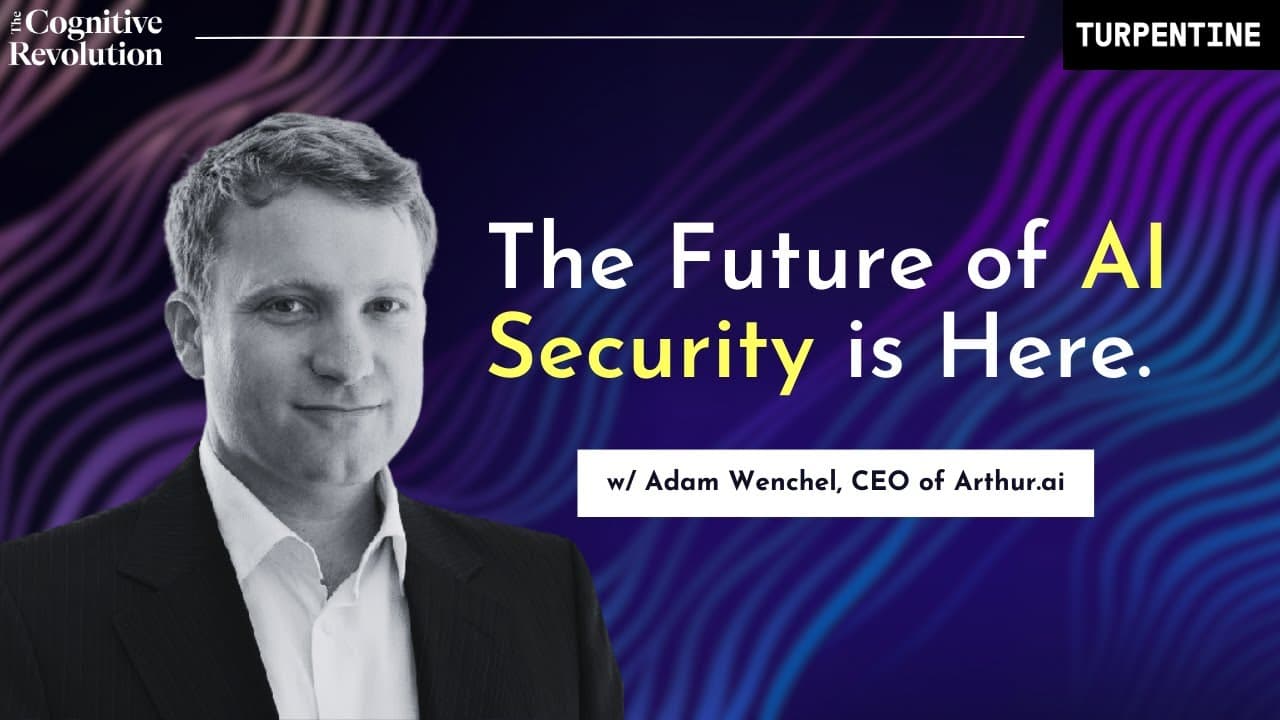
The Future of AI Security with Adam Wenchel, CEO of Arthur.ai
TL;DR
Adam Wenchel discusses AI security and advancements at Arthur.ai.
Transcript
it's a pretty manual review process that can take months if there's a problem like someone's exploiting a weakness in the model oftentimes the easiest thing to do is to put in like a rule up in front of the model because that you can do that in a couple days whereas it might take you literally six eight you know 12 months to get a new model you kno... Read More
Key Insights
- Adam Wenchel founded Arthur.ai in 2019 to address AI security issues, focusing on observability and robust training to mitigate risks.
- Arthur.ai's tools, like Arthur Shield, are designed to protect against common attacks such as prompt injection in LLMs.
- The release of ChatGPT marked a significant moment in AI, accelerating enterprise adoption of LLMs and raising security concerns.
- AI security differs from traditional cybersecurity due to the probabilistic nature of AI models, requiring different approaches to protection.
- Arthur.ai is developing methods for LLMs to evaluate other LLMs, improving security and performance metrics such as helpfulness and concision.
- Corporate interest in AI has surged, with many companies exploring internal applications like technical document queries and call center analysis.
- Benchmarking LLMs on specific tasks is essential for enterprises, as generic benchmarks may not reflect real-world performance.
- Future AI developments may include more robust reasoning capabilities, but security and alignment will remain ongoing challenges.
Install to Summarize YouTube Videos and Get Transcripts
Explore YouTube Video Summarizer or Get YouTube Transcript Extractor
Questions & Answers
Q: What motivated Adam Wenchel to start Arthur.ai?
Adam Wenchel founded Arthur.ai in 2019 to address growing concerns about AI security. His experience at Capital One, where he focused on ensuring AI models made good decisions impacting customers' financial livelihoods, highlighted the need for robust AI security measures. Arthur.ai aims to provide observability and training tools to mitigate AI risks.
Q: How does Arthur.ai's tool, Arthur Shield, enhance AI security?
Arthur Shield, developed by Arthur.ai, acts as a firewall for LLMs, protecting against common attacks like prompt injection. It allows enterprises to set usage policies and monitor LLM interactions to prevent misuse. The tool is part of Arthur.ai's broader strategy to enhance AI security and ensure safe deployment of AI technologies across organizations.
Q: What impact did the release of ChatGPT have on AI adoption?
The release of ChatGPT was a watershed moment for AI, significantly accelerating its adoption across enterprises. It captured the public's imagination and highlighted the transformative potential of generative AI technologies. This surge in interest brought AI security concerns to the forefront, prompting organizations to seek solutions like those offered by Arthur.ai to mitigate risks.
Q: How does AI security differ from traditional cybersecurity?
AI security differs from traditional cybersecurity due to the probabilistic nature of AI models, which exhibit behaviors not explicitly coded into them. This requires a shift from deterministic to probabilistic thinking in addressing security challenges. Arthur.ai focuses on observability and robust training to detect and mitigate potential vulnerabilities in AI systems.
Q: What are some common enterprise use cases for LLMs?
Enterprises are exploring various internal applications for LLMs, such as querying technical documents and analyzing call center transcripts. These applications leverage LLMs' capabilities to provide quick, accurate responses and insights, enhancing operational efficiency. Arthur.ai's tools help ensure these applications are secure and reliable, reducing risks associated with LLM deployment.
Q: How does Arthur.ai approach benchmarking LLMs?
Arthur.ai emphasizes benchmarking LLMs on specific organizational tasks rather than relying on generic benchmarks. The company developed Arthur Bench, an open-source tool that allows enterprises to test LLMs on their exact workloads, evaluating metrics like helpfulness and concision. This approach ensures LLMs perform optimally in real-world applications, providing valuable insights for decision-making.
Q: What are the challenges in reducing hallucinations in LLMs?
Reducing hallucinations in LLMs is challenging due to the models' probabilistic nature. Arthur.ai employs techniques like retrieval augmented generation, where LLMs are provided with relevant data to ground their responses. This approach significantly reduces hallucinations, but the tolerance for incorrect answers varies by domain, with stricter requirements in fields like healthcare and legal contexts.
Q: What future developments does Adam Wenchel anticipate in AI?
Adam Wenchel anticipates continued advancements in AI, including more robust reasoning capabilities and improved performance metrics. However, he acknowledges that AI security and alignment will remain ongoing challenges. Wenchel expects future watershed moments, similar to the release of ChatGPT, that will further propel AI adoption and innovation, necessitating continued focus on security solutions.
Summary & Key Takeaways
-
Adam Wenchel, CEO of Arthur.ai, discusses the evolution of AI security and the company's efforts to address unique challenges posed by LLMs. He highlights Arthur.ai's tools, like Arthur Shield, designed to protect against attacks such as prompt injection. The conversation explores the differences between traditional and AI cybersecurity.
-
The release of ChatGPT was a watershed moment, accelerating AI adoption in enterprises. Wenchel emphasizes the importance of observability and robust training in mitigating AI risks. Arthur.ai is developing methods for LLMs to evaluate each other, improving security and performance metrics like helpfulness and concision.
-
Corporate interest in AI has surged, with companies exploring internal applications such as technical document queries and call center analysis. Benchmarking LLMs on specific tasks is crucial for enterprises, as generic benchmarks may not reflect real-world performance. Future AI developments may include more robust reasoning capabilities, but security and alignment will remain ongoing challenges.
Read in Other Languages (beta)
Share This Summary 📚
Summarize YouTube Videos and Get Video Transcripts with 1-Click
Try YouTube Summary with ChatGPT & Claude or YouTube Transcript Generator
Explore More Summaries from Cognitive Revolution "How AI Changes Everything" 📚




Summarize YouTube Videos and Get Video Transcripts with 1-Click
Try YouTube Summary with ChatGPT & Claude or YouTube Transcript Generator