How to build AI marketing agents that scale
TL;DR
An AI marketing agent is software with a thinking loop and live data that makes proactive marketing decisions. By producing high volumes of creative and using learning loops, CPL can drop while scale increases. The approach treats marketing as code, with automation guiding creative production and bidding based on performance.
Transcript
uh I want to make some Facebook ads uh for the ICP that is basically trying to connect their marketing data to Claude code. >> You need really good creative and you need 10 times the amount of creative that you used to >> on Facebook. We got their cost per lead down from 82 down to $15 is the average like 7-day trailing. Your coding agent is now th... Read More
Key Insights
- The key to successful AI marketing is a thinking loop with live data that informs decisions.
- Marketing has shifted toward needing 10x more creative output and faster iteration to stay competitive.
- All marketing is now code, meaning ads are treated as SKUs with data tracked and updated by software.
- A high volume of creative iterations (10 ads per day) accelerates learning and optimization.
- Learning loops allow rapid testing across multiple variables like emotional triggers and customer personas.
- Automation should balance token use with deterministic software to optimize costs and results.
- The stack for marketing AI includes data pipelines, data warehouses, cloud hosting, and version controlled collaboration.
- Winners in ads are scaled automatically while losers are paused, with winners influencing future creative production.
Install to Summarize YouTube Videos and Get Transcripts
Explore YouTube Video Summarizer or Get YouTube Transcript Extractor
Questions & Answers
Q: What is an AI marketing agent and what does it do?
An AI marketing agent is software with a thinking loop and a live data stream that makes decisions on top of data. It researches target customers, creates and uploads ads, measures performance, and scales winners while turning off losers. The goal is to automate the marketing workflow to improve results and speed.
Q: Why do modern campaigns need 10x more creative than before?
The video explains that advanced AI targeting is now so effective that success relies on strong creative and many variations. Instead of a few ads, campaigns should produce many pieces of creative to learn what resonates. This increases velocity and scale in responding to audience reactions.
Q: How does the concept all marketing is now code influence campaign management?
Treating marketing as code means ads are managed like SKUs with data pipelines, dashboards, and automated workflows. It allows rapid production, testing, and iteration of creative, keywords, and targeting, with automated decision rules guiding when to scale or discontinue elements based on performance.
Q: What does a typical learning loop look like for ads today?
The loop runs multiple iterations per day to generate new creative, upload it, measure performance, and decide which ads win or lose. Winners inform the next round of production, and the cycle repeats to improve results while expanding the creative set and scaling successful variants.
Q: What CPL reductions were achieved in the live demo and how were they achieved?
The live demo reported cost per lead reductions from 82 to 15 dollars on Facebook and from 70 to 35 dollars on Google in four weeks. The reductions came from AI agents shipping 10 new ads per day and learning from every iteration to optimize creative and targeting.
Q: What is the role of human review in this AI marketing workflow?
Human review is used to maintain taste and ensure compliance while the coding agent handles autonomous creation and deployment. The model provides creative options and execution, but humans review to preserve brand alignment and ensure quality before final approval.
Q: What constitutes the full stack for a coding agent in marketing?
The stack includes a data pipeline, a data warehouse, a cloud server to host code, media storage, databases for actions, recurring jobs, application authentication, and a git manager for collaboration, plus a tailored API gateway to connect to tools like Nano Banana or Apollo for execution.
Q: How does the demo describe the coding agent as the smartest marketer?
The speaker argues that when given complete context, the coding agent becomes the smartest marketer on the team because it can process data, generate creative, implement changes, and learn from outcomes at speed and scale beyond human capacity, effectively acting as a high velocity, automated marketing engine.
Summary & Key Takeaways
-
The video explains that marketing now runs on software with a thinking loop and live data, enabling automated decision making. It emphasizes building a stack that includes data pipelines, data warehouses, and a code driven process to deploy agents. The result is higher velocity and scale in campaigns.
-
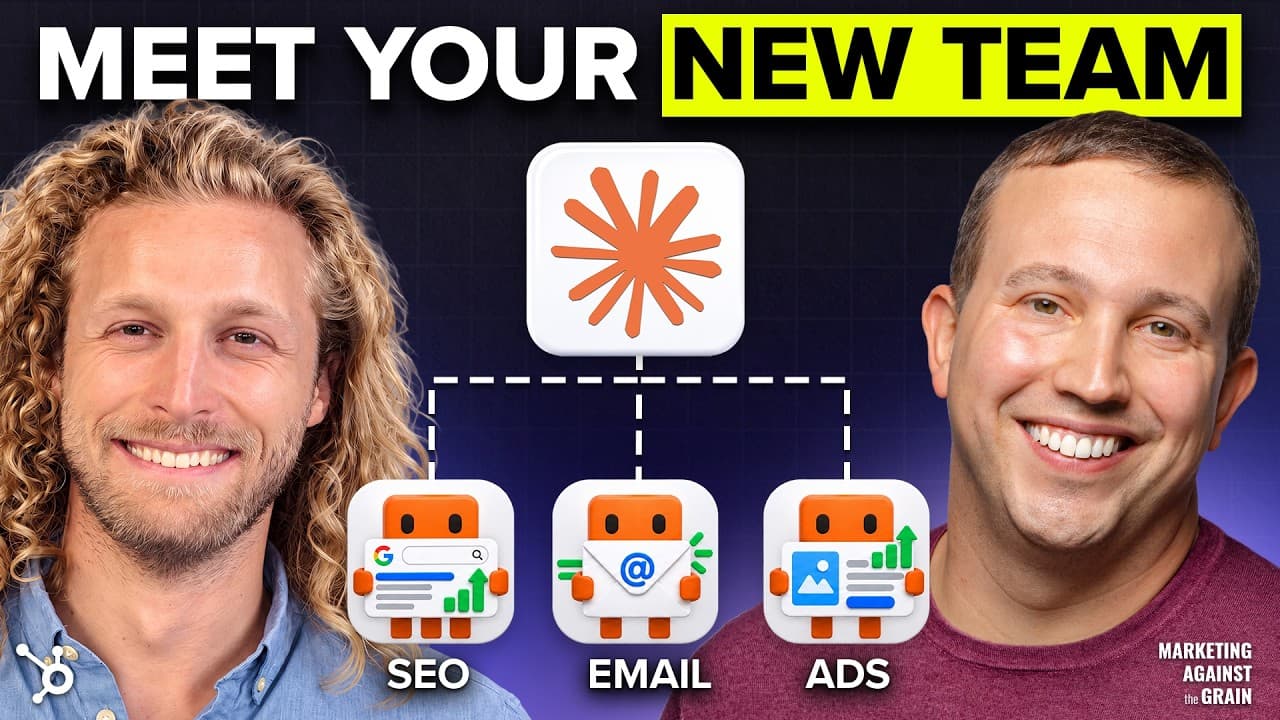
A live demo shows a Google Ads agent, a Meta ads creative agent, an SEO agent, and a cold email workflow all controlled by voice. The approach yields faster learning loops and a larger volume of creative than traditional methods.
-
The author argues that the coding agent is the smartest marketer when given proper context, enabling cost per lead reductions and faster experimentation while maintaining human review for taste and compliance.
Read in Other Languages (beta)
Share This Summary 📚
Summarize YouTube Videos and Get Video Transcripts with 1-Click
Try YouTube Summary with ChatGPT & Claude or YouTube Transcript Generator
Explore More Summaries from Marketing Against the Grain 📚



Summarize YouTube Videos and Get Video Transcripts with 1-Click
Try YouTube Summary with ChatGPT & Claude or YouTube Transcript Generator