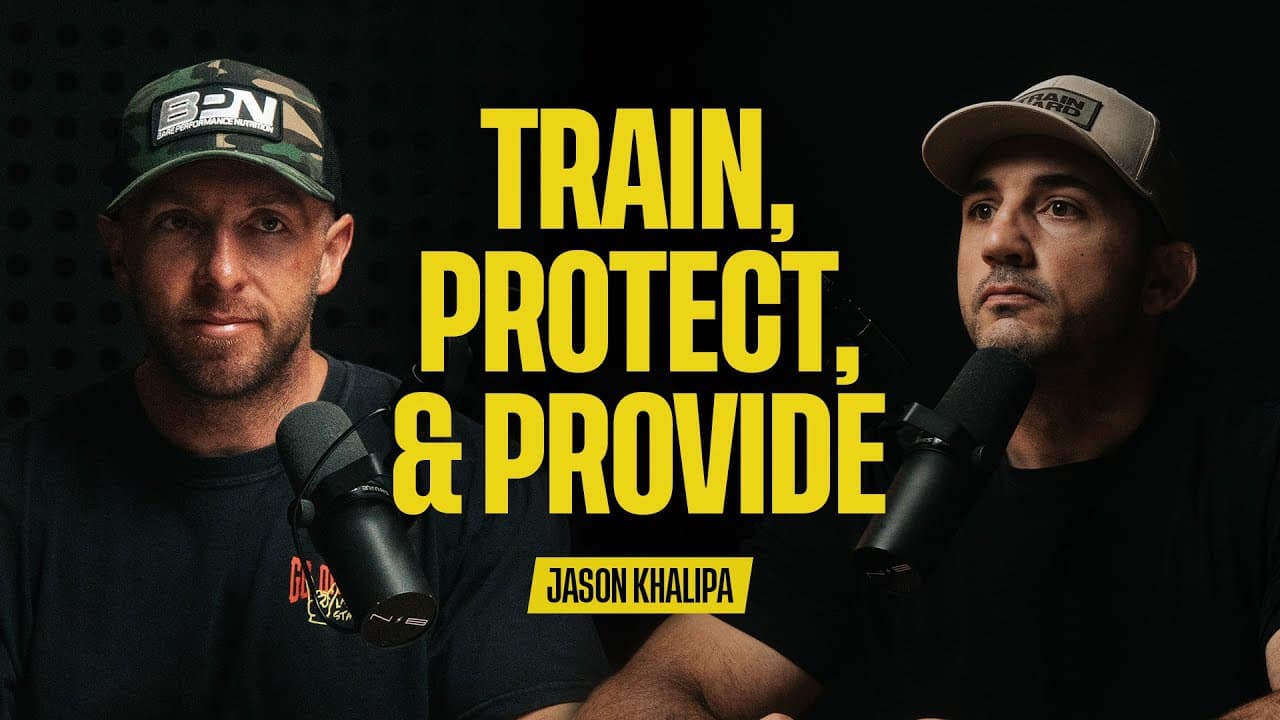
How to Train, Protect, and Provide for Family
TL;DR
Build the fitness to protect your family, provide shared experiences, and say yes when your children invite you into their lives. Combine bodyweight movements, external loads, and conditioning, keep your momentum from reaching zero, and demonstrate work ethic through visible action because children absorb what their parents consistently do.
Transcript
I want to have no regrets I want to know that I reached my potential as a husband a father as a business owner and in my fitness like I want to know that and I reflect on it on a regular basis in particular how am I showing up for my wife how am I showing up for my kids like that's the number one because I get no redus on that there are many people... Read More
Key Insights
- Fitness is a means of protecting and providing for a family, not merely improving physical appearance or competitive performance. Khalipa wants enough capacity to hike, train, and accept new experiences with his children without allowing poor fitness to limit his participation.
- Work ethic is caught through visible behavior, especially when children watch their parents train, sweat, get dirty, or complete difficult tasks. Physical effort gives children a concrete example of perseverance that may be easier to understand than seeing a parent working at a computer.
- Providing for children includes creating experiences, not only earning money. Khalipa aims to say yes more often than no because repeated refusals may eventually cause children to stop asking, reducing opportunities for connection and shared memories.
- A complete fitness program combines gymnastics, weightlifting, and single-modality conditioning. These categories respectively develop control of the body through space, the ability to handle external objects, and capacity in activities such as running, biking, swimming, or skiing.
- External-load training is essential for developing strength beyond what push-ups, sit-ups, pull-ups, and running can measure. Useful loads can include kettlebells, dumbbells, barbells, and sandbags, depending on the demands of the person’s work and environment.
- Physical readiness tests shape how people train, so narrow tests can create narrow preparation. When assessments emphasize only running and bodyweight repetitions, participants may master those events while retaining deficiencies in areas such as pure strength and loaded movement.
- Job-specific fitness standards should resemble the tasks personnel may actually face. Khalipa argues that departments should consider relevant distances, time domains, external loads, breaching demands, and the possibility of pulling another person from a dangerous situation.
- Safe, sustainable training begins with learning how to move well. Khalipa’s seminars establish fitness baselines, explain high-value compound movements, and teach performance points for the back squat, deadlift, and press before participants build greater training volume or intensity.
Install to Summarize YouTube Videos and Get Transcripts
Explore YouTube Video Summarizer or Get YouTube Transcript Extractor
Questions & Answers
Q: How can fitness help parents provide for their family?
Fitness helps parents provide by preserving their ability to participate in experiences with their children. Khalipa wants to be able to say yes when his children ask to hike, train, or attempt another physical activity. In his view, providing is not limited to financial support. It also means having the capacity to be present, active, and involved without fitness becoming the reason an experience cannot happen.
Q: Why should parents demonstrate hard work in front of children?
Children can directly observe effort when parents sweat, get dirty, train in the garage, hike, or complete a difficult task alongside them. Khalipa believes this visible example makes work ethic easier to understand than watching a parent work at a computer. Shared physical challenges show children what persistence looks like and allow discipline to be experienced together rather than communicated only through advice.
Q: What does train, protect, and provide mean for a father?
Train, protect, and provide describes a broad responsibility to develop useful physical capacity, safeguard loved ones, and support both their needs and experiences. Khalipa connects these duties to his desire to reach his potential without regrets. Training prepares him for varied demands, while providing includes remaining capable of joining his children in activities and consistently showing up for his wife and family.
Q: What are the three main components of a balanced fitness program?
A balanced program includes gymnastics, weightlifting, and single-modality conditioning. Gymnastics means controlling the body through space with movements such as push-ups, handstand push-ups, or muscle-ups. Weightlifting adds an external object, including kettlebells, dumbbells, barbells, or sandbags. Single-modality conditioning covers activities such as running, biking, swimming, or skiing. Combining all three develops a wider range of physical abilities.
Q: Why should military and law enforcement fitness tests use external loads?
External loads assess a strength quality that bodyweight exercises and running alone may miss. Khalipa notes that personnel train specifically for the events on their required tests, so an assessment limited to running, push-ups, pull-ups, and sit-ups can encourage narrow preparation. Adding loaded tasks can better reveal whether someone can control weight and perform strength-dependent duties relevant to demanding operational work.
Q: How should physical readiness tests reflect job demands?
Physical readiness tests should examine the movements, distances, time domains, and loads that personnel may encounter while working. Khalipa uses Special Response Team duties as an example, including breaching doors, moving over shorter distances, and possibly pulling a colleague from danger. An assessment aligned with those demands can encourage preparation that transfers to the job instead of rewarding mastery of unrelated test events.
Q: What should someone do with three one-hour training sessions per week?
Khalipa recommends focusing limited training time on high-value compound movements and a balanced mix of physical skills. The program should include bodyweight control, external-load exercises, and conditioning rather than specializing in only one area. Participants should also learn safe performance standards for movements such as the back squat, deadlift, and press, creating a useful foundation that can improve overall fitness efficiently.
Q: How can someone maintain momentum in fitness and daily life?
The episode’s stated principle is to never let momentum reach zero. Applied to fitness and daily life, this means continuing to put points on the scoreboard through consistent action, even while balancing career and family responsibilities. Khalipa’s broader message supports maintaining movement, using sustainable nutrition, and choosing practices that can continue over time instead of allowing progress to stop completely.
Summary & Key Takeaways
-
Jason Khalipa frames success around reaching his potential as a husband, father, business owner, and athlete without accumulating regrets. He regularly evaluates how he shows up for his wife and children, placing family first because missed opportunities with them cannot be repeated. Fitness supports this commitment by preserving his ability to participate.
-
Children understand effort most clearly when they can see it. Working out in the garage, hiking, getting dirty, or completing something difficult together makes discipline tangible in a way that computer work often does not. Khalipa therefore treats shared physical challenges as opportunities to model work ethic and create meaningful family experiences.
-
Effective fitness preparation should reflect real demands rather than reward narrow test performance. Khalipa recommends balancing gymnastics, external-load training, and conditioning while learning safe movement standards for exercises such as squats, deadlifts, and presses. This broad approach develops strength, body control, and endurance for family life and demanding professional responsibilities.
Read in Other Languages (beta)
Share This Summary 📚
Summarize YouTube Videos and Get Video Transcripts with 1-Click
Try YouTube Summary with ChatGPT & Claude or YouTube Transcript Generator
Explore More Summaries from The Nick Bare Podcast 📚
Summarize YouTube Videos and Get Video Transcripts with 1-Click
Try YouTube Summary with ChatGPT & Claude or YouTube Transcript Generator