How to Become an AI Engineer by 2025
TL;DR
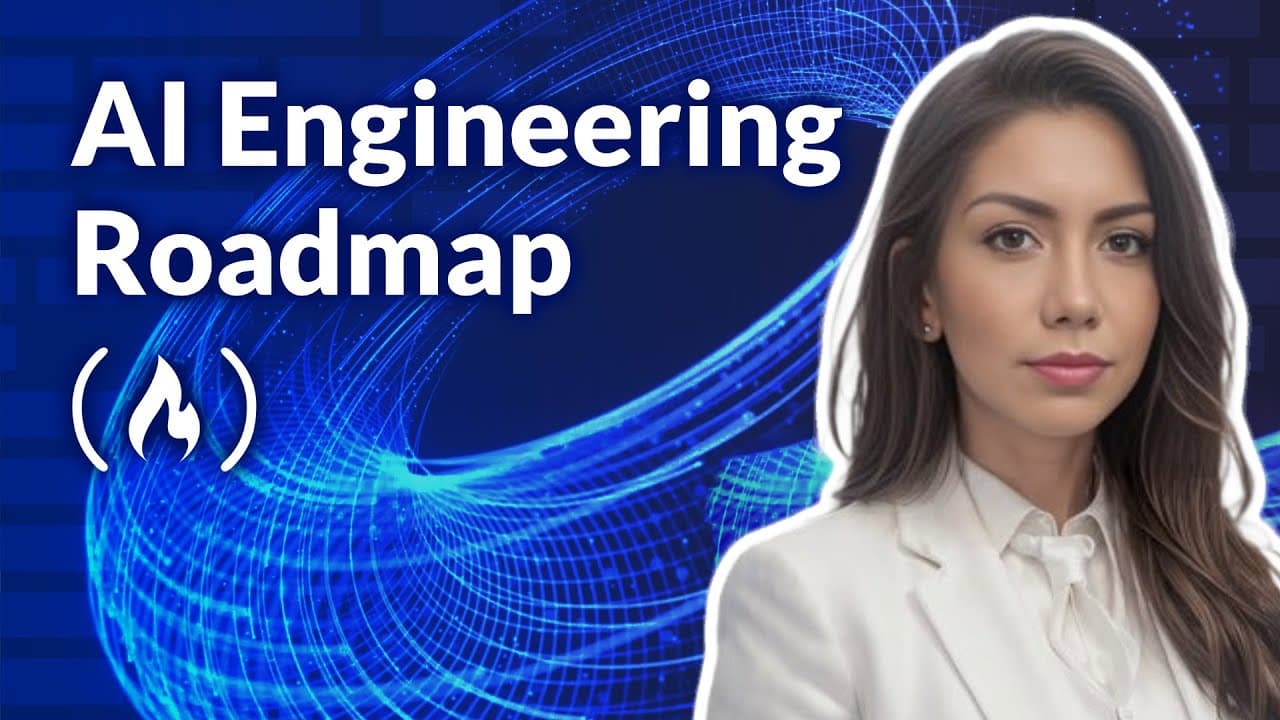
To become a successful AI engineer by 2025, focus on mastering core skills such as mathematics, statistics, data science, and machine learning. Gain hands-on experience with deep learning and large language models, and understand the practical implementation of AI systems. A comprehensive understanding of AI ethics and industry applications is crucial for bridging research with real-world solutions.
Transcript
this AI engineering road map takes you from core fundamentals to Advanced AI implementations it covers essential mathematics machine learning deep learning and large language models providing you with the exact skills needed to thrive as an AI engineer in 2025 whether you're starting fresh or upgrading your skills this road map offers a clear path ... Read More
Key Insights
- AI engineering involves designing, building, and deploying AI systems to solve real-world problems.
- AI engineers bridge the gap between data science models and their practical implementation in various industries.
- Core skills include mathematics, statistics, data science, and traditional machine learning.
- Deep learning and neural networks are essential for modern AI applications, including generative AI.
- Generative AI and large language models are at the forefront of AI advancements and industry demand.
- Practical skills in Python and AI frameworks like PyTorch and TensorFlow are crucial for implementation.
- AI ethics, including bias, privacy, and data security, are integral to responsible AI deployment.
- AI engineering offers competitive salaries and high demand across multiple industries.
Install to Summarize YouTube Videos and Get Transcripts
Explore YouTube Video Summarizer or Get YouTube Transcript Extractor
Questions & Answers
Q: How to start a career in AI engineering?
To start a career in AI engineering, focus on acquiring foundational skills in mathematics, statistics, and data science. Learn programming languages like Python and gain proficiency in AI frameworks such as PyTorch and TensorFlow. Practical experience through projects and understanding AI ethics will enhance your readiness for industry roles.
Q: What skills are essential for an AI engineer?
Essential skills for an AI engineer include a strong foundation in mathematics, statistics, and data science. Proficiency in machine learning and deep learning, particularly neural networks, is crucial. Practical skills in Python, AI frameworks, and understanding AI ethics are also vital for successful AI system development and deployment.
Q: Why is deep learning important in AI engineering?
Deep learning is important in AI engineering because it powers advanced AI applications, including generative AI and large language models. It enables the processing of large datasets and the development of complex models that can perform tasks such as image recognition, natural language processing, and autonomous driving, making it integral to modern AI solutions.
Q: What role do AI ethics play in AI engineering?
AI ethics play a crucial role in AI engineering by ensuring the responsible development and deployment of AI technologies. Understanding bias, privacy, and data security is essential to prevent harm and promote fairness. AI engineers must adhere to ethical guidelines and regulations to build trust and accountability in AI systems.
Q: How do AI engineers use large language models?
AI engineers use large language models to perform tasks such as language translation, sentiment analysis, and conversational AI. These models, based on architectures like Transformers, require pre-training and fine-tuning for specific applications. Engineers must understand tokenization, embeddings, and attention mechanisms to effectively implement and optimize these models.
Q: What is the significance of generative AI in AI engineering?
Generative AI is significant in AI engineering because it enables the creation of new data, such as images, text, and music, through models like generative adversarial networks and variational autoencoders. It is foundational to many cutting-edge AI applications, including creative content generation and synthetic data production, driving innovation and industry demand.
Q: How can AI engineers bridge the gap between research and industry?
AI engineers bridge the gap between research and industry by applying theoretical knowledge to practical applications. They develop and deploy AI systems that solve real-world problems, ensuring models are scalable and reliable. Engineers must understand industry needs and integrate advanced AI technologies, such as deep learning and generative AI, into business solutions.
Q: What are the career prospects for AI engineers in 2025?
Career prospects for AI engineers in 2025 are highly promising, with growing demand across industries such as healthcare, finance, and technology. AI engineers can expect competitive salaries and opportunities to work on innovative projects. Mastery of emerging AI technologies, including generative AI and large language models, will enhance career advancement and job security.
Summary & Key Takeaways
-
AI engineering is the practice of designing and deploying AI systems that provide real-world solutions. It requires a comprehensive skill set, including mathematics, statistics, and machine learning, to effectively bridge the gap between data science and practical applications. Mastery of deep learning and generative AI is crucial in this rapidly evolving field.
-
AI engineers play a critical role in integrating data science models into industry applications, ensuring they are scalable and reliable. Key skills include data science, traditional machine learning, and deep learning. Understanding AI ethics is essential for the responsible development and deployment of AI technologies.
-
Becoming an AI engineer by 2025 involves mastering a wide range of skills, from foundational mathematics to advanced AI models like large language models. Practical experience with Python and AI frameworks, along with a solid grasp of AI ethics, prepares individuals for successful careers in this high-demand field.
Read in Other Languages (beta)
Share This Summary 📚
Summarize YouTube Videos and Get Video Transcripts with 1-Click
Try YouTube Summary with ChatGPT & Claude or YouTube Transcript Generator
Explore More Summaries from freeCodeCamp.org 📚



Summarize YouTube Videos and Get Video Transcripts with 1-Click
Try YouTube Summary with ChatGPT & Claude or YouTube Transcript Generator