How to Cross Wales on a Perfectly Straight Line
TL;DR
Crossing Wales on a straight route required switching between a camper van, electric trials bikes, and a paddle raft whenever roads or terrain blocked the line. The group navigated muddy woodlands and crossed a river near a rapid, while careful planning, local helpers, specialized equipment, and coordinated paddling kept the journey moving toward the rest of Europe.
Transcript
what's up Mafia I am Crossing all of Europe in a perfectly straight line you think that's crazy we're actually going around the entire world in 30 days and uploading on this channel every single day and if I miss a day Mr Beast gets to delete my YouTube channel yesterday we drove across Ireland then had to take a boat across the Irish sea and then ... Read More
Key Insights
- The straight-line challenge requires continuous movement toward a fixed destination, preventing the group from staying long in scenic places. Even while appreciating the Welsh landscape, they must prioritize maintaining the route and finding ways through obstacles rather than taking convenient roads around them.
- The camper van provides a mobile shelter with a stove, refrigerator, shower, popup roof, and sleeping area. It improves comfort during the journey, but it cannot solve every transportation problem because narrow gates, forests, rivers, and other barriers can block vehicle access.
- The Welsh woodland becomes impassable for the van because the route enters through a narrow gate and continues along a muddy trail. Rain makes the ground more difficult, so the travelers change transportation instead of abandoning the straight line or driving around the obstruction.
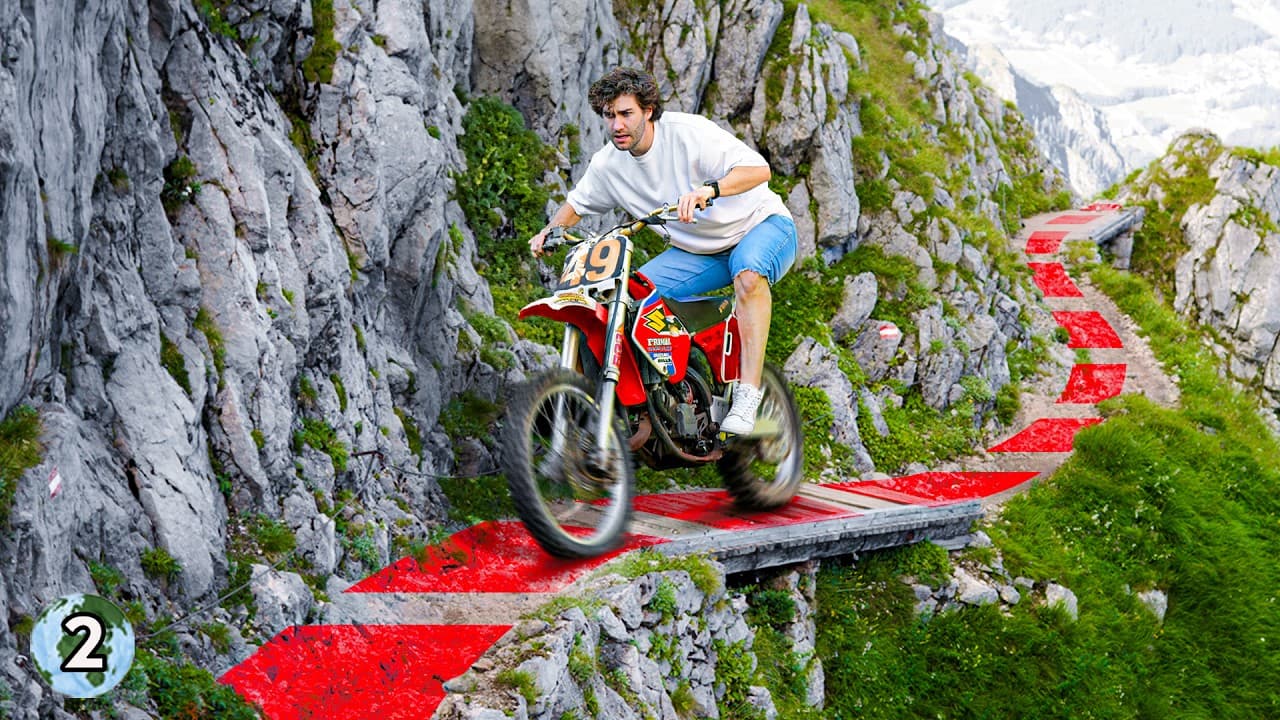
- Electric trials bikes enable the group to cross the wet woodland while remaining close to the planned line. Steve supplies the bikes after months of route preparation, and the cameraman separately drives the camper van around the obstacle to collect everyone on the other side.
- Driving in Wales requires the travelers to adjust to the left side of the road. Multiple group members attempt to drive the camper van, and their uncertainty creates tense moments, including an interaction with a motorcyclist shortly after one traveler takes control.
- A working red telephone booth allows one traveler to call his girlfriend after four days without speaking to her. The roadside stop briefly interrupts the physical challenge and highlights how the fast-moving journey limits ordinary communication with people at home.
- The river crossing is necessary because the available bridges lie far outside the straight route. Nigel provides paddling equipment and explains that the river is manageable if the group behaves carefully, remains stable, and paddles toward the side if accidentally carried into the rapid.
- Coordinated paddling keeps the raft away from the rapid and brings the group safely to the opposite bank. Clear commands, synchronized strokes, a stable landing, and calm movement while leaving the raft help the travelers complete the crossing without falling into the water.
Install to Summarize YouTube Videos and Get Transcripts
Explore YouTube Video Summarizer or Get YouTube Transcript Extractor
Questions & Answers
Q: How did the group cross the Welsh woodland in a straight line?
The group used electric trials bikes supplied by Steve to travel through the Welsh woodland. The camper van could not pass through the narrow gate leading onto the route, and rain had made the trail muddy. They rode through the forest and an open field while their cameraman drove the van around the obstacle and waited at the other side.
Q: Why could the travelers not use the camper van for the entire route?
The camper van was useful on roads and provided shelter, sleeping space, a stove, a refrigerator, a shower, and a popup roof. However, the straight route passed through places the vehicle could not enter, including a narrow woodland gate and a river without a bridge on the line. The group therefore switched to bikes and paddling equipment when necessary.
Q: How did the group prepare for obstacles along the straight route?
The route had been prepared over several months because obstacles were expected along the way. Helpers and specialized equipment were arranged at key locations, including Steve with electric trials bikes for the Welsh woodland and Nigel with paddling gear for the river. The cameraman also transported the van around barriers so it would be ready when the group emerged.
Q: How did the travelers cross the river without using a bridge?
The travelers paddled directly across because every bridge was far outside their required line. Nigel supplied the gear and explained that they should cross rather than drift downstream toward the rapid. The group kept the craft stable, followed coordinated paddling commands, approached the opposite bank carefully, and stepped out calmly before reuniting with the camper van.
Q: What safety advice did Nigel give for the river crossing?
Nigel described the river as easy as long as the travelers behaved carefully. He warned them about a rapid downstream and said that, if they accidentally entered it, the proper response was to paddle toward the side as quickly as possible. During the actual crossing, the group focused on stability, coordinated strokes, and a controlled landing.
Q: What facilities were included in the camper van?
The camper van included a stove, a refrigerator, a shower, a popup roof, sleeping space, and seating in the main cabin. The travelers treated it as their new mobile home for the journey. Although they were impressed by its features, they also noticed its limited interior space and the fact that it had only two visible chairs.
Q: What difficulties did the group face while driving in Wales?
Driving in Wales felt unfamiliar because the travelers needed to stay on the left side of the road. More than one member attempted to drive the camper van, and the others expressed concern about their safety. Shortly after one driver started, a motorcyclist reacted angrily despite the driver saying that the left turn signal had been activated.
Q: How did the group celebrate completing most of the day's UK crossing?
The group celebrated crossing the majority of the UK that day by eating at Nando's, which they had been told to try while visiting the UK. One traveler ordered a chicken wrap, fries, and rice. The chicken was described as fresh and flavorful, while opinions about the restaurant ranged from A tier and B tier to S tier.
Summary & Key Takeaways
-
After arriving in Wales from Ireland, the group received a camper van equipped with a stove, refrigerator, shower, popup roof, and sleeping space. Although the van made travel more comfortable, maintaining the straight route meant they could not remain anywhere long and had to prepare for terrain inaccessible by road.
-
The first major obstruction was a rainy stretch of Welsh woodland that the van could not enter. Steve provided electric trials bikes, allowing the travelers to follow a muddy trail through the forest and across an open field. Their cameraman drove the van around the obstacle and met them at the exit.
-
A river presented the next major challenge because nearby bridges were far outside the required line. Nigel supplied equipment and safety guidance for paddling directly across. The group coordinated its strokes, avoided a rapid downstream, landed calmly, reunited with the van, and celebrated the day with a meal from Nando's.
Read in Other Languages (beta)
Share This Summary 📚
Summarize YouTube Videos and Get Video Transcripts with 1-Click
Try YouTube Summary with ChatGPT & Claude or YouTube Transcript Generator
Explore More Summaries from Airrack 📚





Summarize YouTube Videos and Get Video Transcripts with 1-Click
Try YouTube Summary with ChatGPT & Claude or YouTube Transcript Generator