What Is the Vertebral Column? Regions and Curvatures
TL;DR
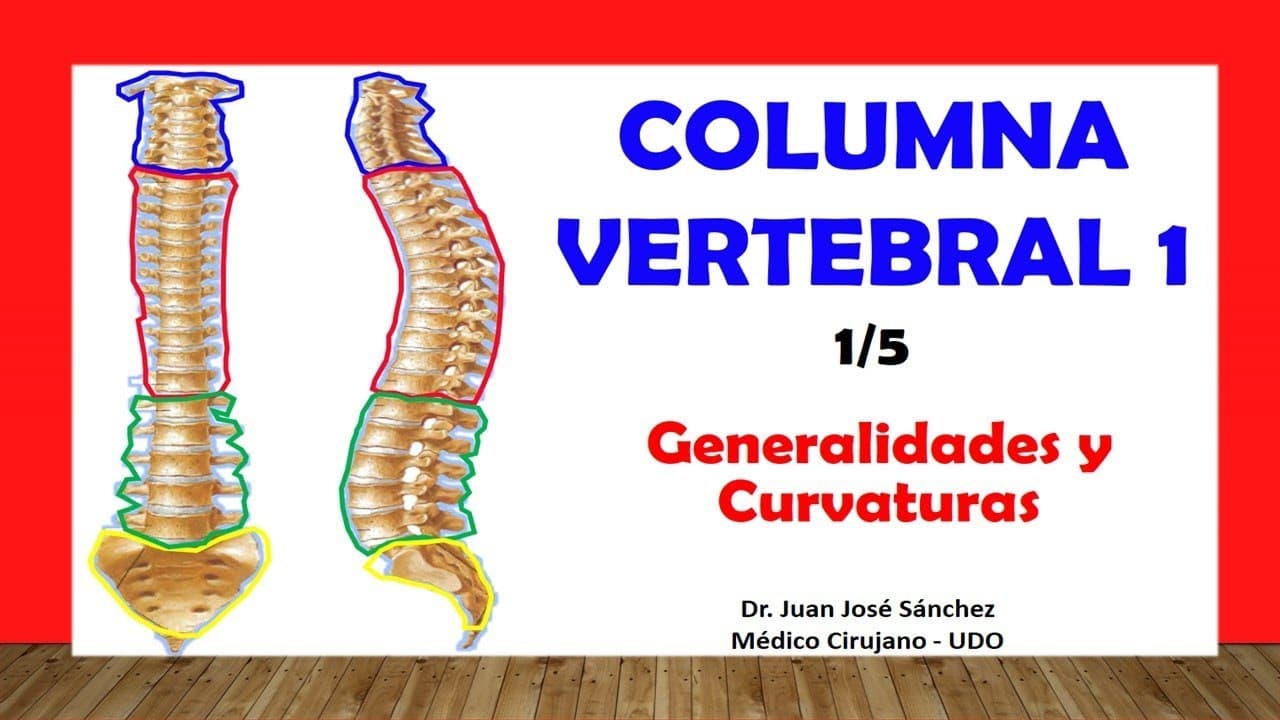
The vertebral column has 24 presacral vertebrae split into 7 cervical, 12 thoracic (dorsal), and 5 lumbar, plus the sacrum (5 fused vertebrae) and coccyx (4 fused). It supports body weight, transmits it to the lower limbs, and protects the spinal cord inside the medullary canal. Its length equals two-fifths of total body height.
Transcript
good good my dear students of anatomy, my name is juan josé sánchez and today we will talk about the vertebral column or what the spinal column is, before starting I urge you, I invite you to join my channel here in the corner At the bottom right I leave you a link so you can directly subscribe to the channel, so the vertebral column is a very long... Read More
Key Insights
- The vertebral column is a rigid yet flexible support structure that lets the body stand upright, carries the entire body's weight, and transmits that weight down to the lower limbs.
- The medullary canal runs inside the vertebral column and houses the spinal cord, so a key function of the column is protecting this important nervous system structure.
- The 24 presacral vertebrae are divided into three groups: 7 cervical (C1-C7) in the neck, 12 thoracic or dorsal (D1/T1-D12/T12), and 5 lumbar (L1-L5), always counted from top to bottom.
- The sacrum is a single large bone formed by the fusion of five vertebrae, and the coccyx (coccygeal bone) is formed by the fusion of four vertebrae; both are studied as part of the column.
- The vertebral column measures two-fifths of total body height, and it has a conical shape because each vertebra is thicker and higher than the one above it to bear increasing weight.
- The lumbosacral angle, formed between the axis of the lumbar vertebrae and the axis of the sacrum, is normally 130 to 160 degrees; below 130 or above 160 indicates a pathology.
- Primary curvatures are the dorsal and sacral curves, which are concave forward (convex backward) and follow the same forward-concave axis the spine has in the embryonic stage.
- Secondary curvatures are the cervical and lumbar curves, which are convex forward; they form after birth, the cervical when the child raises its head and the lumbar when it stands upright.
Install to Summarize YouTube Videos and Get Transcripts
Explore YouTube Video Summarizer or Get YouTube Transcript Extractor
Questions & Answers
Q: How many vertebrae make up the vertebral column?
The vertebral column has 24 presacral vertebrae, which are divided into three groups: 7 cervical vertebrae (C1 to C7) in the neck, 12 thoracic or dorsal vertebrae (D1 to D12, also written T1 to T12), and 5 lumbar vertebrae (L1 to L5). Below these come the sacrum, formed by the fusion of five vertebrae, and the coccyx or coccygeal bone, formed by the fusion of four vertebrae. Vertebrae are always counted from top to bottom, starting at the base of the skull.
Q: What is the function of the vertebral column?
The vertebral column is the support structure of the body that allows us to stand upright. It is a rigid support that is at the same time quite flexible, and it carries the weight of the entire body and then transmits that weight down to the lower limbs. It also has a protective function: inside the column runs the medullary canal, through which the spinal cord passes, so the column protects this important structure of the nervous system.
Q: What are the primary curvatures of the spine?
The primary curvatures are the curvature of the dorsal (thoracic) column and the curvature of the sacral column. They are always concave forward, which is the same as saying convex backward or posterior, like the concavity of a spoon. They are called primary because they follow the same axis as the curvature the embryo has, when the entire spine is concave forward. This same forward-concave shape persists into adult life, which is why they are considered primary curvatures.
Q: What are the secondary curvatures and when do they form?
The secondary curvatures are the cervical and lumbar curves. Unlike the primaries, they are concave toward the back and convex toward the front. They are interspersed with the primaries (secondary cervical, primary thoracic, secondary lumbar, primary sacral) so they counteract each other and act like a spring. At birth all curvatures are concave forward, but the cervical curvature forms after birth when the child raises its head, and the lumbar curvature forms when the child manages to stand up and stabilize.
Q: What is the lumbosacral angle and what is its normal range?
The lumbosacral angle is an angle studied heavily in traumatology. It is formed by a line passing through the entire axis of the lumbar vertebrae and a line passing through the entire axis of the sacral bone. The normal value ranges from 130 to 160 degrees. It should not measure less than 130 degrees or more than 160 degrees, because a value outside that range indicates that there is already a pathology at the level of the lumbosacral angle.
Q: Why does the vertebral column have a conical shape?
The vertebral column has a conical shape that gets wider and higher as it descends from the cervical vertebrae down to the lumbar vertebrae. This happens because the lower the spine goes, the more weight it has to support. Each vertebra below the one preceding it is always thicker and higher because more and more structure is added and it must bear more weight. The lumbar vertebra is the widest and highest, being the last presacral, after which the cone inverts at the sacrum and coccyx, which carry almost no weight.
Q: How long is the vertebral column relative to body height?
The vertebral column measures two-fifths of the total body height. It is a very long structure to study in anatomy, which is why the content is divided across several videos. It originates at the base of the skull and ends at the tip of the coccygeal bone. The presacral bones are articulated with each other and separated by intervertebral discs, which are sheets or cartilaginous discs between the vertebrae that help give the column its arch shape and great flexibility.
Q: What causes the primary curvature to form in the spine?
The primary curvature, such as the dorsal curvature, forms because of the shape of the vertebral bodies, not the discs. The vertebral bodies are not completely quadrilateral: the anterior part is lower and shorter while the posterior part is higher and longer, giving them a wedge or cuneiform shape. When several of these wedge-shaped vertebrae are stacked one on top of another, the column is physically forced to adopt a forward concavity. The intervertebral discs remain the same size, so the primary curvature results from the variation in the vertebral bodies themselves.
Summary & Key Takeaways
-
The vertebral column is the body's rigid but flexible support that enables standing, bears the whole body's weight, and passes it to the lower limbs. Inside runs the medullary canal, which contains and protects the spinal cord. It stretches from the base of the skull to the tip of the coccyx.
-
The column contains 24 presacral vertebrae grouped as 7 cervical, 12 thoracic (dorsal), and 5 lumbar, followed by the sacrum (five fused vertebrae) and the coccyx (four fused vertebrae). It measures two-fifths of body height, has a conical shape widening downward to carry more weight, and its vertebrae are separated by cartilaginous intervertebral discs.
-
Seen from the side, the column shows curvatures. Primary curvatures (dorsal and sacral) are concave forward and match the embryonic shape, caused by the vertebral bodies being taller posteriorly. Secondary curvatures (cervical and lumbar) are convex forward, forming after birth from the intervertebral discs. The lumbosacral angle normally measures 130 to 160 degrees.
Read in Other Languages (beta)
Share This Summary 📚
Summarize YouTube Videos and Get Video Transcripts with 1-Click
Try YouTube Summary with ChatGPT & Claude or YouTube Transcript Generator
Explore More Summaries from Anatomía Fácil por Juan José Sánchez 📚

Summarize YouTube Videos and Get Video Transcripts with 1-Click
Try YouTube Summary with ChatGPT & Claude or YouTube Transcript Generator