What Are the Key Psychological Biases in Human Misjudgment?
TL;DR
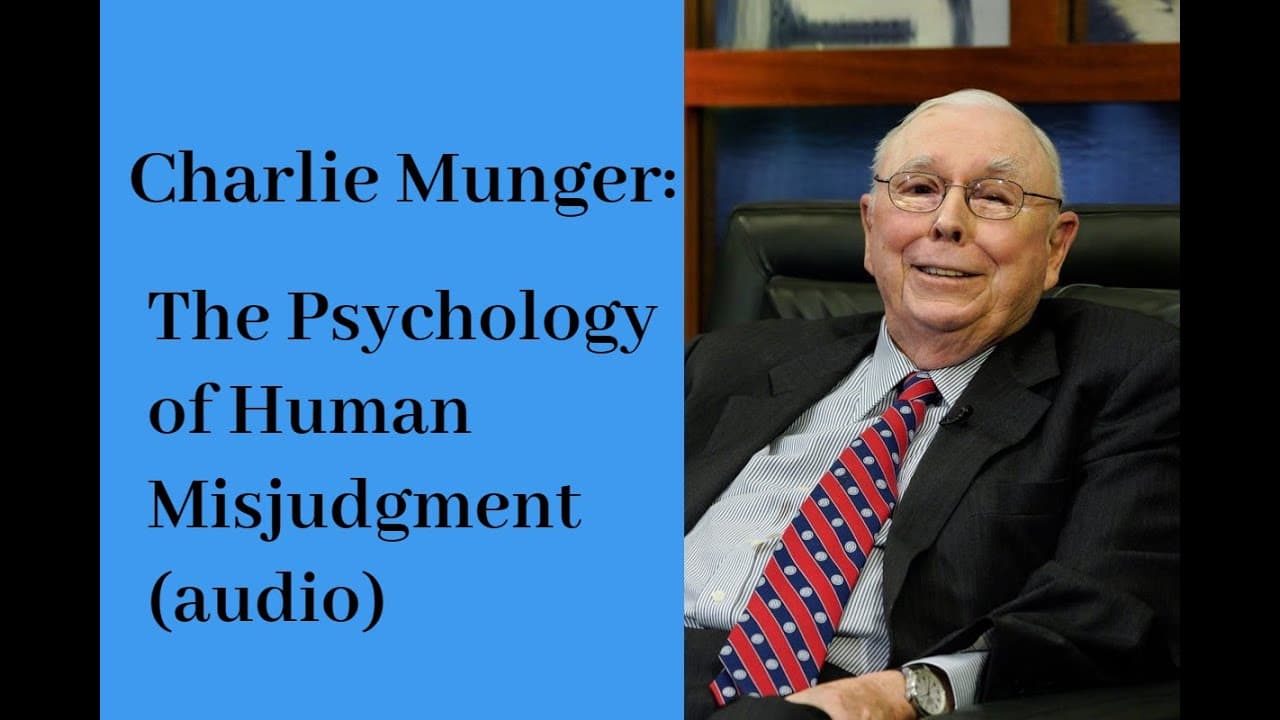
Key psychological biases in human misjudgment include the influence of incentives, consistency and commitment tendencies, and psychological denial. These biases manifest in various decision-making scenarios, revealing how our cognitive processes can lead to irrational behavior. Understanding these tendencies is crucial to mitigating errors in judgment.
Transcript
well i am very interested in the subject of human misjudgment and lord knows i've created my uh well a good bit of it i don't think i've created my full statistical share and uh i think that one of the reasons was the i tried to do something about this terrible ignorance i left the harvard law school with when i saw this patterned irrationality whi... Read More
Key Insights
- 🖐️ Incentives play a significant role in influencing behavior.
- 🥺 Consistency and commitment tendencies can lead to cognitive biases.
- 🧑🏭 Psychological factors like reciprocation tendency and availability impact decision-making.
- 🌲 Strategies like decision trees and postmortems help mitigate cognitive biases.
- ❓ Understanding psychological tendencies is essential in avoiding manipulation.
- 🎙️ More videos with Charlie Munger:
Install to Summarize YouTube Videos and Get Transcripts
Explore YouTube Video Summarizer or Get YouTube Transcript Extractor
Questions & Answers
Q: How did Charlie Munger develop his system of psychology?
Munger created his psychology system based on personal experiences and readings, focusing on understanding irrational behavior patterns.
Q: What role do incentives play in human misjudgment?
Munger highlights the power of incentives, showcasing case studies like FedEx and Xerox to demonstrate the impact on decision-making.
Q: How does the concept of consistency and commitment tendency influence behavior?
Munger explains how consistency in beliefs and commitments can lead to cognitive biases and impact decision-making processes.
Q: Why is understanding psychological tendencies crucial in avoiding manipulation?
Munger emphasizes the importance of recognizing psychological biases to prevent being manipulated by others for negative outcomes.
Summary & Key Takeaways
-
Charlie Munger shares insights on human misjudgment based on psychological tendencies.
-
Examples include behavioral economics and the impact of incentives on decision-making.
-
Strategies like decision trees and postmortems help mitigate cognitive biases.
Read in Other Languages (beta)
Share This Summary 📚
Summarize YouTube Videos and Get Video Transcripts with 1-Click
Try YouTube Summary with ChatGPT & Claude or YouTube Transcript Generator
Explore More Summaries from The value investing channel 📚




Summarize YouTube Videos and Get Video Transcripts with 1-Click
Try YouTube Summary with ChatGPT & Claude or YouTube Transcript Generator