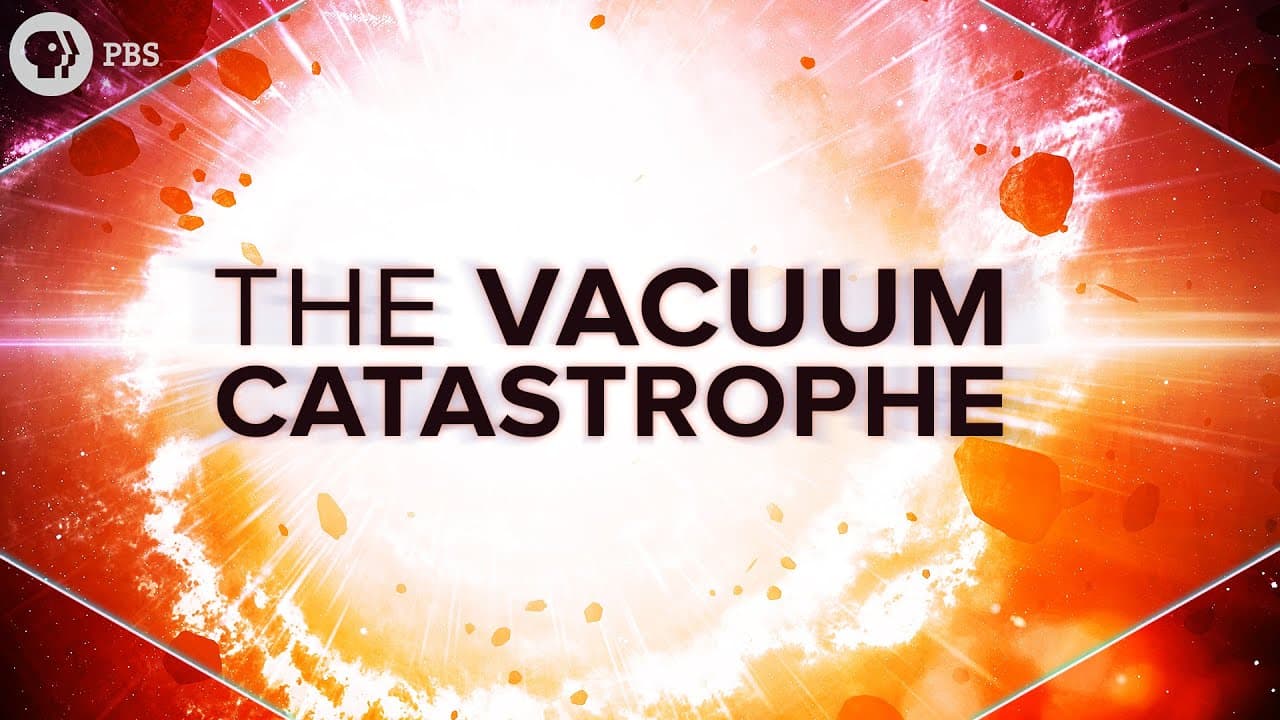
The Vacuum Catastrophe
TL;DR
Quantum field theory predicts a massive vacuum energy discrepancy.
Transcript
[MUSIC PLAYING] The most successful theory in all of physics is arguably quantum field theory. It's made the most precise predictions in all of science, but it's also made the worst. There's a massive disagreement between the theoretical and the measured values of the energy of the vacuum. We call this theoretical fail the vacuum catastrophe. [MUSI... Read More
Key Insights
- Quantum field theory is both highly successful and flawed, predicting vacuum energy discrepancies up to 120 orders of magnitude greater than observed.
- The quantum vacuum is a dynamic space with virtual particles appearing and disappearing, influenced by the Heisenberg uncertainty principle.
- Vacuum energy, predicted to be infinite by quantum field theory, poses a significant theoretical challenge, suggesting space itself contains energy.
- Einstein's theory of general relativity implies that vacuum energy should produce a gravitational effect, impacting the universe's expansion and curvature.
- Supersymmetry, an extension of the standard model, proposes that particles have counterparts that may cancel out vacuum energy.
- The discovery of dark energy in the 1990s revealed an accelerating universe expansion, suggesting a small non-zero vacuum energy.
- The discrepancy between predicted and observed vacuum energy is considered a major unsolved problem in physics, known as the vacuum catastrophe.
- The anthropic principle suggests we exist in a rare universe where vacuum energies cancel out enough to allow life, implying multiple universes with different energies.
Install to Summarize YouTube Videos and Get Transcripts
Explore YouTube Video Summarizer or Get YouTube Transcript Extractor
Questions & Answers
Q: What is the vacuum catastrophe?
The vacuum catastrophe refers to the massive discrepancy between the predicted and observed values of vacuum energy. Quantum field theory predicts a vacuum energy up to 120 orders of magnitude greater than what is measured, presenting a major unsolved problem in physics.
Q: How does quantum field theory predict vacuum energy?
Quantum field theory suggests that every point in space has a quantum oscillator for each elementary particle type. Even the lowest energy oscillation, the vacuum state, contains energy due to the Heisenberg uncertainty principle. Summing energy over infinite frequency modes yields a vast, potentially infinite vacuum energy.
Q: Why doesn't infinite vacuum energy affect quantum predictions?
In quantum mechanics, the zero point of the energy scale is irrelevant as long as vacuum energy is consistent everywhere. Changes in energy, not absolute values, affect particle motion. Thus, high vacuum energy doesn't impact quantum predictions, unlike in general relativity where energy contributes to gravity.
Q: What role does supersymmetry play in resolving vacuum energy issues?
Supersymmetry, an extension of the standard model, proposes that particles have supersymmetric counterparts that might cancel out vacuum energy. This could reduce predicted vacuum energy, but the discovery of dark energy, indicating a small non-zero vacuum energy, complicates this potential resolution.
Q: How does dark energy relate to the vacuum catastrophe?
Dark energy, discovered in the 1990s, causes the universe's expansion to accelerate, consistent with a small non-zero vacuum energy. This contrasts with the vast vacuum energy predicted by quantum field theory, highlighting the vacuum catastrophe and suggesting a need for fine-tuning or new theories.
Q: What is the anthropic principle in this context?
The anthropic principle suggests that we exist in a rare universe where fundamental fields cancel vacuum energies enough to allow life. This implies the existence of countless other universes with different vacuum energies, providing a potential explanation for the observed small non-zero vacuum energy.
Q: Can vacuum energy be used as an energy source?
No, vacuum energy cannot be harnessed as a power source. While science fiction and pseudoscience often suggest otherwise, the zero point energy is inaccessible for practical energy extraction, as changes in energy, not absolute values, are what affect physical systems.
Q: How does vacuum energy affect general relativity?
In general relativity, any form of energy, including vacuum energy, contributes to gravity. A large vacuum energy would cause significant gravitational effects, such as exponential universe expansion and increased spatial curvature, conflicting with our observations of a gently expanding, flat universe.
Summary & Key Takeaways
-
Quantum field theory, despite its precision, predicts a vacuum energy vastly larger than what is observed, leading to the vacuum catastrophe. This discrepancy challenges our understanding of space and energy.
-
The quantum vacuum is a complex realm where virtual particles fluctuate, seemingly defying mass and energy conservation. The Heisenberg uncertainty principle allows for this quantum fuzziness.
-
Supersymmetry offers a potential solution by canceling out vacuum energies, but the discovery of dark energy complicates this, suggesting a small non-zero vacuum energy driving universe expansion.
Read in Other Languages (beta)
Share This Summary 📚
Summarize YouTube Videos and Get Video Transcripts with 1-Click
Try YouTube Summary with ChatGPT & Claude or YouTube Transcript Generator
Explore More Summaries from PBS Space Time 📚
Summarize YouTube Videos and Get Video Transcripts with 1-Click
Try YouTube Summary with ChatGPT & Claude or YouTube Transcript Generator