What Is the Hall-Petch Relation and How to Use It?
TL;DR
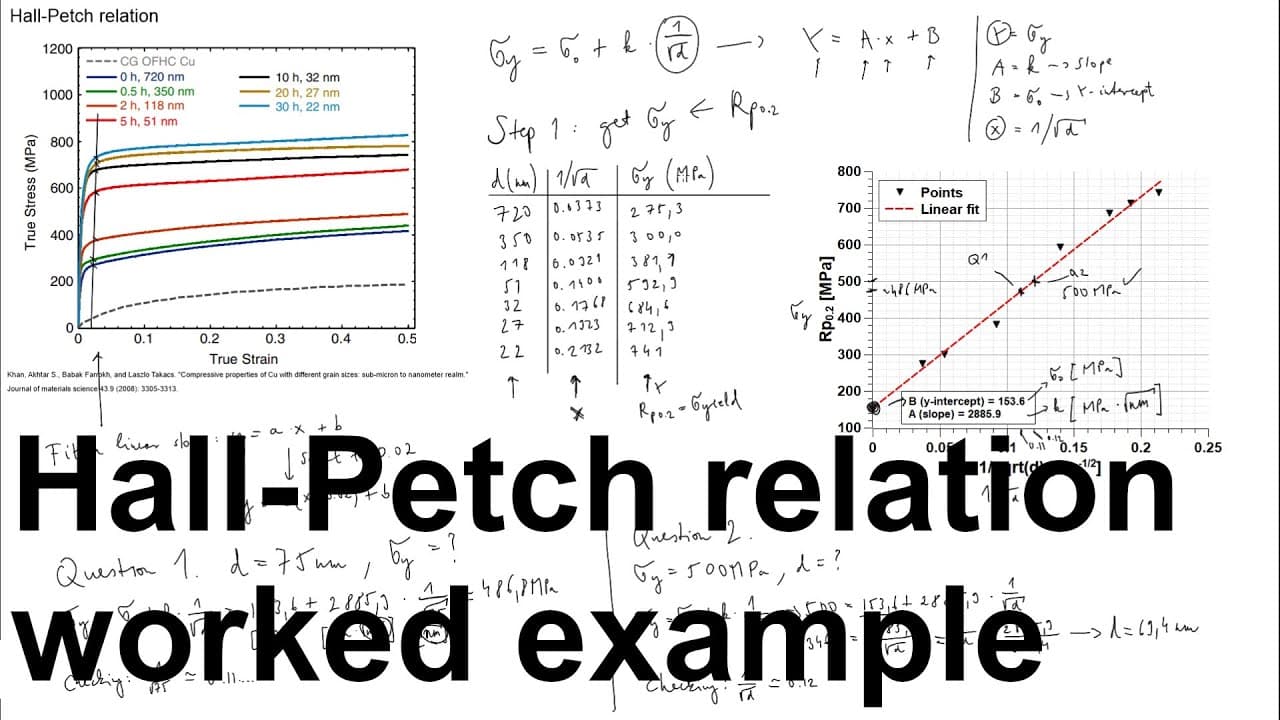
The Hall-Petch relation shows that decreasing grain size increases a material's yield strength, allowing for strength customization. To determine yield strength, create a table of grain sizes and strengths, then fit a linear equation to your data. This method enables you to solve for yield strength or grain size based on the Hall-Petch equation.
Transcript
welcome everyone in this video I'm going to show you how to solve a problem related to whole batch relation and I'm going to talk about some solutions for some typical exam questions so whole batch relation is basically telling you that the yield strength of material changes with the grain size and the type of change is proportional to the 1 over s... Read More
Key Insights
- 📁 The Hall-Petch relation illustrates the direct correlation between grain size and material yield strength, crucial for material engineering.
- 🏆 Yield strength determination involves collecting extensive test data and calculating the slope from tensile test curves.
- 🚰 Adequate data management, like maintaining tables, is critical during analysis, facilitating accurate computations of relationships in materials.
- ❓ Graphical representation enhances understanding of relationships between parameters and provides visual confirmation for calculations.
- 🌍 The significance of offset yield strength calculation is emphasized, highlighting potential discrepancies in real-world applications.
- 🧑🔬 Understanding the parameters of the Hall-Petch equation empowers material scientists to tailor materials for specific applications effectively.
- 💄 Manipulating equations correctly enables practitioners to rearrange relationships, making it easier to address various questions related to material properties.
Install to Summarize YouTube Videos and Get Transcripts
Explore YouTube Video Summarizer or Get YouTube Transcript Extractor
Questions & Answers
Q: What is the Hall-Petch relationship and why is it important?
The Hall-Petch relationship describes how the yield strength of materials increases as grain size decreases, which is pivotal in material science. This relationship allows engineers and scientists to enhance the strength of materials through controlled grain size reduction, essential in applications requiring high strength, like aerospace and automotive industries.
Q: How do you determine yield strength from tensile test data?
To determine yield strength (Sigma Y) from tensile test data, first identify the elastic region's slope to calculate Young's modulus. Then, derive the offset yield strength by shifting the curve by a set amount, typically 0.2% strain, to find the intersection point where plastic deformation begins, allowing calculation of yield strength effectively.
Q: What parameters are required for applying the Hall-Petch equation?
The Hall-Petch equation utilizes the yield strength (Sigma Y), the material's intrinsic strength (Sigma 0), and the grain size (D). Sigma Y is computed from experimental data, while Sigma 0 and K parameters are determined from slope fitting of material-specific tensile or compression curves, leading to the relationship between yield strength and grain size.
Q: Can you explain how to fit a linear equation to experimental data?
Fitting a linear equation to experimental data involves plotting the yield strength against the reciprocal of the square root of grain size. By obtaining data points, a linear regression analysis is conducted to compute the slope (K) and y-intercept (Sigma 0) of the best-fit line, which collectively describes the material's behavior according to the Hall-Petch relation.
Q: How do you calculate yield strength if grain size is known?
To calculate yield strength when grain size is known, use the Hall-Petch equation: Sigma Y = Sigma 0 + K * (1/sqrt(D)). Plug in the values for Sigma 0 and K gathered from previous analyses and then calculate the yield strength corresponding to that specific grain size, ensuring that units are consistent throughout the computation.
Q: What steps can you take to confirm your calculated yield strength?
To confirm your calculated yield strength, visually compare your result with a plotted graph of yield strength versus (1/sqrt(D)). If the calculated values align closely with the graph's trends and other derived parameters, this would validate the accuracy of your calculations. Additionally, perform reverse checks by substituting calculated yield strength back into the original equations.
Summary & Key Takeaways
-
The Hall-Petch relation indicates that smaller grain sizes result in higher yield strength for materials, enabling strength adjustment through various processes.
-
The video outlines steps to determine yield strength (Sigma Y) using tensile and compression test results, emphasizing the importance of creating a data table for analysis.
-
It explains how to fit a linear equation to experimental data, calculate parameters, and manipulate equations to solve for yield strength and grain size.
Read in Other Languages (beta)
Share This Summary 📚
Summarize YouTube Videos and Get Video Transcripts with 1-Click
Try YouTube Summary with ChatGPT & Claude or YouTube Transcript Generator
Explore More Summaries from Curious Scientist 📚






Summarize YouTube Videos and Get Video Transcripts with 1-Click
Try YouTube Summary with ChatGPT & Claude or YouTube Transcript Generator