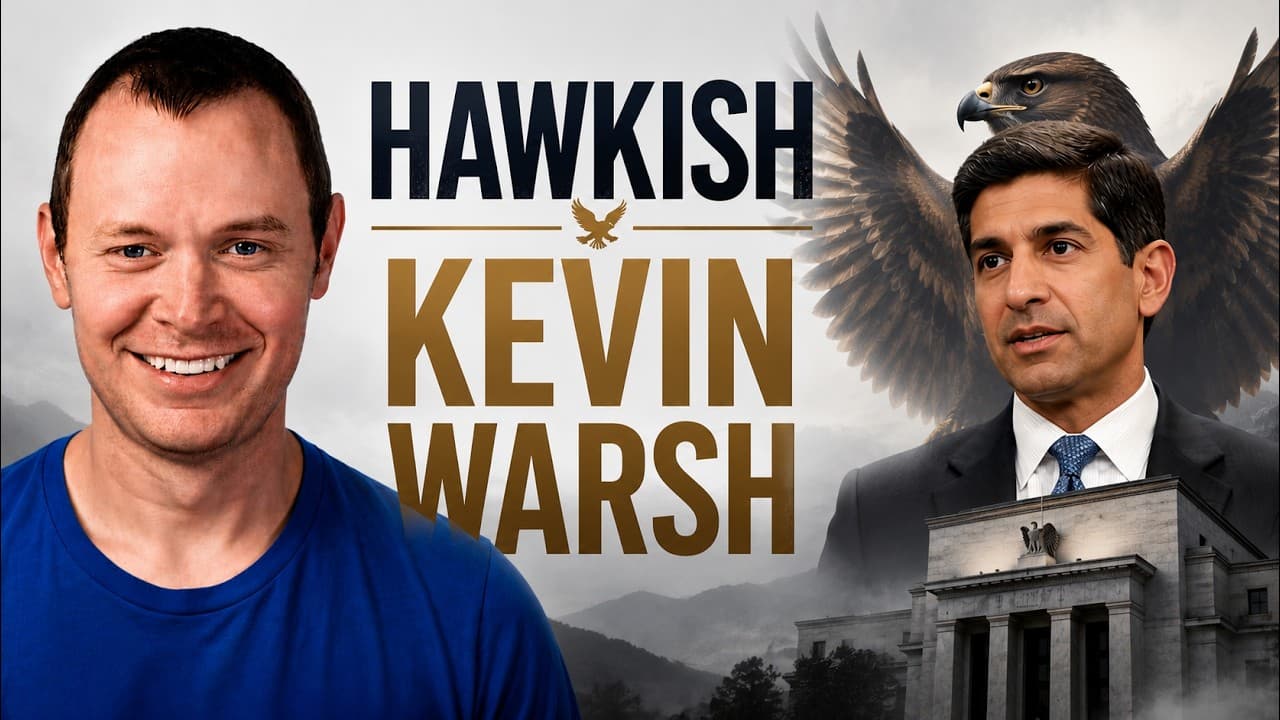
Why Is Kevin Warsh Hawkish on Inflation?
TL;DR
Kevin Warsh's recent speech at Jackson Hole highlighted his hawkish stance on inflation, indicating that current monetary policy is not restrictive enough. He emphasized the potential for quantitative tightening (QT) to control inflation, especially given the ongoing AI market boom. Warsh's history suggests a preference for reducing the Fed's balance sheet, which could influence future interest rate decisions.
Transcript
Hey everyone and thanks for jumping back into the macroverse. Today we're going to talk about the most recent speech given by Kevin Worsh at Jacksonhole. If you guys like the content, make sure you subscribe to the channel, give the video a thumbs up, and check out the sale on Into the Cryptoverse Premium at into the cryptoverse.com. As a reminder,... Read More
Key Insights
- Kevin Warsh is concerned about inflation not being under control and suggests current monetary policy is insufficiently restrictive.
- Warsh is known for wanting to reduce the Federal Reserve's balance sheet, indicating a possible return to quantitative tightening (QT).
- Quantitative tightening could be announced as early as December 2026, but more likely in early 2027, depending on economic conditions.
- Warsh does not view QT as a direct substitute for interest rate hikes but acknowledges it could reduce the need for higher rates.
- The Treasury's bond buyback program aims to lower long-term yields, conflicting with Warsh's reliance on the long end of the yield curve.
- Market expectations for interest rate hikes have shifted, with a higher probability of a rate increase following Warsh's speech.
- Historical patterns suggest stock market corrections often occur in the latter half of midterm years, potentially influenced by rate hikes.
- The AI market boom may affect the timing and impact of monetary policy changes, including potential QT and interest rate adjustments.
Install to Summarize YouTube Videos and Get Transcripts
Explore YouTube Video Summarizer or Get YouTube Transcript Extractor
Questions & Answers
Q: Why is Kevin Warsh considered hawkish on inflation?
Kevin Warsh is considered hawkish on inflation because he believes current monetary policies are not restrictive enough to control inflation effectively. In his recent speech, he emphasized the need for a more aggressive approach, possibly through quantitative tightening (QT), to prevent inflation from running rampant. Warsh's historical preference for reducing the Federal Reserve's balance sheet further underscores his hawkish stance.
Q: What is quantitative tightening and how does it relate to interest rates?
Quantitative tightening (QT) involves reducing the Federal Reserve's balance sheet by selling government securities, effectively decreasing the money supply. It is used as a tool to manage inflation and can complement or substitute interest rate hikes. While QT can reduce the need for higher interest rates, it is not a direct replacement. Warsh's speech suggests QT might be considered to manage inflation alongside interest rate decisions.
Q: How does the Treasury's bond buyback program affect the yield curve?
The Treasury's bond buyback program aims to lower long-term yields by purchasing government bonds, which can affect the yield curve by flattening it. This action contrasts with Warsh's reliance on the long end of the yield curve for monetary policy. The program's goal is to bring down long-term rates, but it may also have inflationary effects, challenging the Federal Reserve's efforts to control inflation through traditional means.
Q: What are the market expectations for interest rate hikes following Warsh's speech?
Following Kevin Warsh's speech at Jackson Hole, market expectations for interest rate hikes have shifted. The probability of a rate increase has risen, with a higher likelihood of multiple hikes by the end of the year. This change reflects the market's anticipation of a more aggressive monetary policy stance to address inflation concerns, as highlighted in Warsh's hawkish remarks.
Q: When could quantitative tightening potentially be announced?
Quantitative tightening (QT) could potentially be announced as early as December 2026, but a more realistic timeframe is early 2027. This timing considers the suspension of QT and the current economic conditions. Warsh's speech suggests that QT could be used to manage inflation, particularly in the context of the ongoing AI market boom, which may influence the timing of its implementation.
Q: How might the AI market boom impact future monetary policy decisions?
The AI market boom could impact future monetary policy decisions by influencing the timing and necessity of quantitative tightening (QT) and interest rate adjustments. As the AI sector continues to grow, it may drive economic activity and inflation, prompting the Federal Reserve to consider more aggressive measures to control inflation. Warsh's speech suggests that the AI boom could be a factor in the decision to implement QT.
Q: What historical patterns suggest about stock market corrections in midterm years?
Historical patterns indicate that stock market corrections often occur in the latter half of midterm years, typically starting in August or September. These corrections can be influenced by various factors, including interest rate hikes and economic conditions. Warsh's speech highlights the potential for a late-cycle rate hike to trigger a correction, aligning with historical trends observed in previous midterm years.
Q: How does Warsh's view on inflation differ from previous Federal Reserve chairs?
Kevin Warsh's view on inflation differs from previous Federal Reserve chairs in his more hawkish approach, emphasizing the need for restrictive monetary policies to control inflation. He has been critical of past Fed chairs for allowing inflation to exceed targets and is focused on preventing a recurrence. Warsh's preference for reducing the Fed's balance sheet through quantitative tightening (QT) further distinguishes his stance from his predecessors.
Summary & Key Takeaways
-
Kevin Warsh's speech at Jackson Hole revealed his hawkish stance on inflation, suggesting that current monetary policies are not adequately restrictive. He emphasized the potential for quantitative tightening (QT) to manage inflation, particularly in the context of the ongoing AI market boom. Warsh's history indicates a preference for reducing the Federal Reserve's balance sheet, which could influence future interest rate decisions.
-
Warsh does not view quantitative tightening as a direct substitute for interest rate hikes but acknowledges it could reduce the need for higher rates. The Treasury's bond buyback program aims to lower long-term yields, conflicting with Warsh's reliance on the long end of the yield curve. Market expectations for interest rate hikes have shifted, with a higher probability of a rate increase following Warsh's speech.
-
Historical patterns suggest stock market corrections often occur in the latter half of midterm years, potentially influenced by rate hikes. The AI market boom may affect the timing and impact of monetary policy changes, including potential QT and interest rate adjustments. Warsh's speech has led to a reevaluation of rate hike probabilities and the potential timing of QT announcements.
Read in Other Languages (beta)
Share This Summary 📚
Summarize YouTube Videos and Get Video Transcripts with 1-Click
Try YouTube Summary with ChatGPT & Claude or YouTube Transcript Generator
Explore More Summaries from Benjamin Cowen 📚




Summarize YouTube Videos and Get Video Transcripts with 1-Click
Try YouTube Summary with ChatGPT & Claude or YouTube Transcript Generator