How To Solve Compound Inequalities
TL;DR
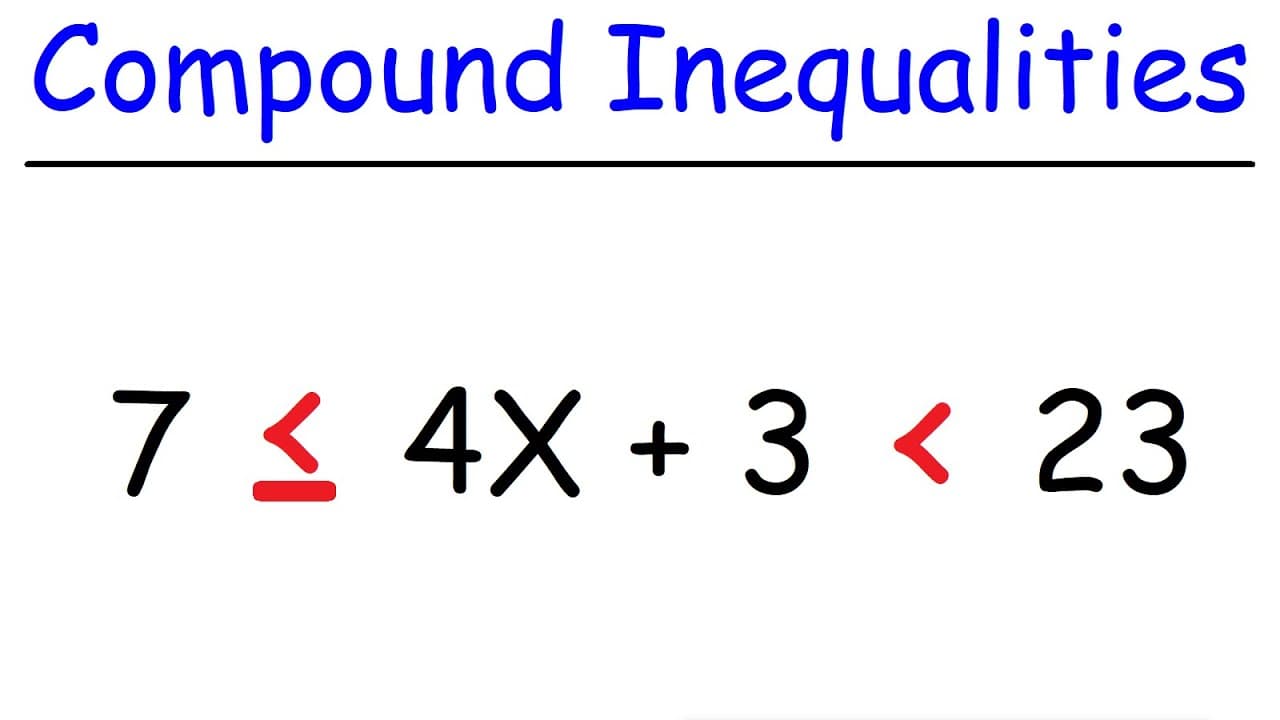
This video explains how to solve compound inequalities, graph them on a number line, and write the solution using interval notation.
Transcript
in this video we're going to focus on solving compound inequalities we're going to talk about how to graph it on a number line and also how to write the solution using interval notation so let's go ahead and begin here's the first problem let's say that three x plus five is less than eight or negative two x plus five is less than or equal to negati... Read More
Key Insights
- 🔑 Compound inequalities involve two or more separate inequalities connected by the words 'and' or 'or'.
- ❓ To solve compound inequalities, you must solve each inequality separately and combine their solutions.
- 🫥 Graphing compound inequalities on a number line helps visualize the solutions and determine the range of possible values for x.
Install to Summarize YouTube Videos and Get Transcripts
Explore YouTube Video Summarizer or Get YouTube Transcript Extractor
Questions & Answers
Q: How do you solve compound inequalities?
To solve compound inequalities, you need to solve each inequality separately and then combine their solutions. This involves performing operations such as subtracting and dividing to isolate the variable x.
Q: When graphing compound inequalities, how do you determine whether to use an open or closed circle?
If the inequality includes 'less than' or 'greater than', you use an open circle. If the inequality includes 'less than or equal to' or 'greater than or equal to', you use a closed circle.
Q: How do you write the solutions in interval notation?
In interval notation, you write the range of possible values for x using brackets or parentheses. A bracket indicates an inclusive value, while parentheses indicate an exclusive value. For example, [3, 9] means x can be any value between 3 and 9, including 3 and 9.
Q: What should you keep in mind when dividing or multiplying inequalities by a negative number?
When multiplying or dividing an inequality by a negative number, the direction of the inequality changes. For example, if x < 4 and you multiply both sides by -1, the inequality becomes -x > -4.
Summary & Key Takeaways
-
The video focuses on solving compound inequalities by graphing them on a number line and using interval notation.
-
The presenter demonstrates how to solve compound inequalities step-by-step, including subtracting and dividing both sides of the inequalities.
-
After solving the inequalities, the presenter shows how to graph the solutions on a number line, using open or closed circles and shading.
-
Finally, the presenter explains how to write the solutions using interval notation, indicating the range of possible values for x.
Read in Other Languages (beta)
Share This Summary 📚
Summarize YouTube Videos and Get Video Transcripts with 1-Click
Try YouTube Summary with ChatGPT & Claude or YouTube Transcript Generator
Explore More Summaries from The Organic Chemistry Tutor 📚




Summarize YouTube Videos and Get Video Transcripts with 1-Click
Try YouTube Summary with ChatGPT & Claude or YouTube Transcript Generator