How to Solve Parallel Plate Capacitor Problems
TL;DR
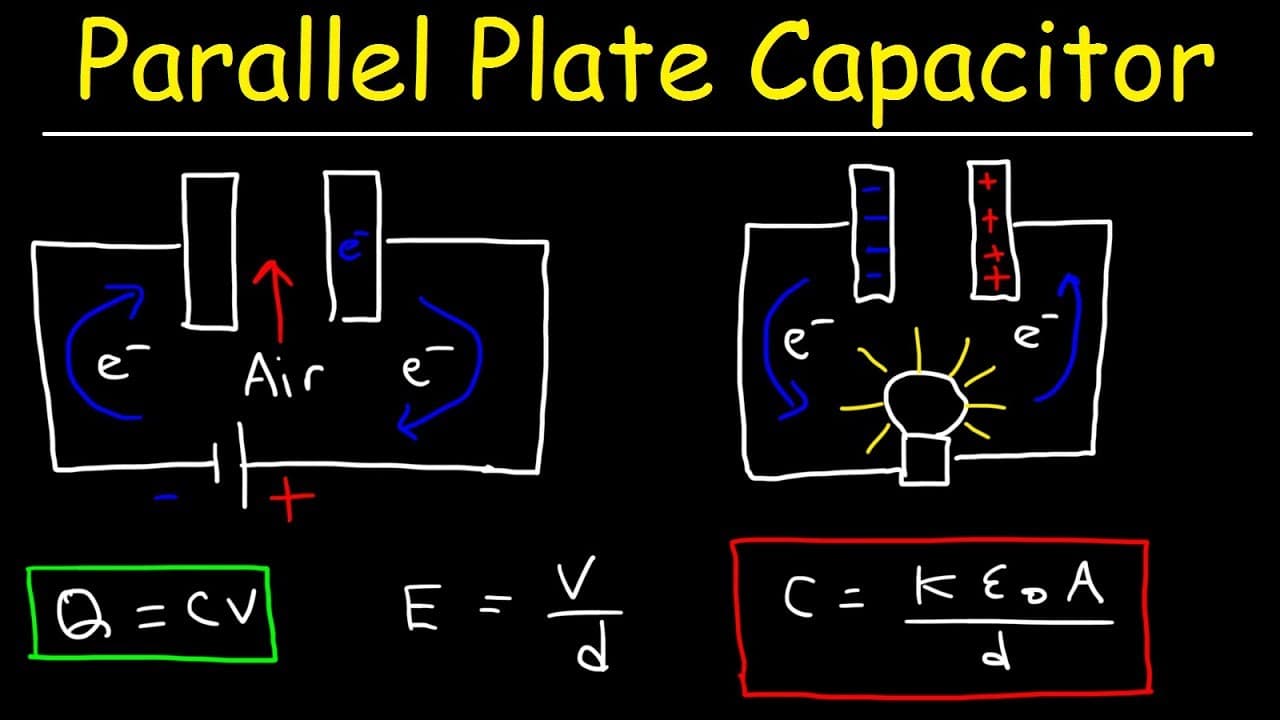
To solve parallel plate capacitor problems, use the formulas for charge (Q = C × V), capacitance (C = Q / V), and electric field (E = V / d). The capacitance increases with plate area and decreases with distance between plates. Understanding these relationships helps in calculating charge, voltage, and electric field effectively.
Transcript
in this video we're going to focus on solving some basic problems associated with parallel plate capacitors so let's focus on this one a 5-farad capacitor is charged to 100 volts determined electric charge stored on this capacitor so the formula that we need is q the electric charge is equal to the capacitance multiplied by the voltage now the unit... Read More
Key Insights
- 🏪 Capacitance is a measure of a capacitor's ability to store charge per volt.
- 🏪 The charge stored on a capacitor can be calculated by multiplying the capacitance by the voltage across it.
- 🏪 The capacitance of a capacitor can be determined by dividing the charge stored on the capacitor by the voltage across it.
- 🍽️ The electric field between the plates of a parallel plate capacitor is equal to the voltage across the plates divided by the separation distance.
- 🍽️ Increasing the area of the plates, decreasing the distance between the plates, or using a material with a high dielectric constant can increase the capacitance of a capacitor.
- 🍽️ Electrons flow from the negatively charged plate to the positively charged plate when a capacitor is connected to a battery.
- 🈂️ The electric field always flows from the positive charge to the negative charge in a parallel plate capacitor.
- 🍽️ The electric field between the plates of a parallel plate capacitor is directly proportional to the voltage across the plates and inversely proportional to the separation distance.
Install to Summarize YouTube Videos and Get Transcripts
Explore YouTube Video Summarizer or Get YouTube Transcript Extractor
Questions & Answers
Q: How is capacitance related to charge and voltage in a parallel plate capacitor?
Capacitance in a parallel plate capacitor is the ratio between the charge stored on the capacitor and the voltage across it. It tells us how much charge the capacitor can store per volt applied to it.
Q: How can we calculate the electric charge stored on a capacitor?
The electric charge stored on a capacitor can be calculated by multiplying the capacitance of the capacitor by the voltage across it. The formula is q = C * V.
Q: How can we determine the capacitance of a capacitor when the charge and voltage are given?
To determine the capacitance of a capacitor when the charge and voltage are given, we need to divide the charge by the voltage. The formula is C = q / V.
Q: How is the electric field between the plates of a parallel plate capacitor calculated?
The electric field between the plates of a parallel plate capacitor is calculated by dividing the voltage across the plates by the separation distance. The formula is E = V / d, where E is the electric field, V is the voltage, and d is the separation distance.
Summary & Key Takeaways
-
Capacitance is the ability of a capacitor to store charge, and it is calculated by dividing the charge stored on the capacitor by the voltage across it.
-
The charge stored on a capacitor can be determined by multiplying the capacitance by the voltage.
-
The electric field between the plates of a capacitor is equal to the voltage across the plates divided by the separation distance.
Read in Other Languages (beta)
Share This Summary 📚
Summarize YouTube Videos and Get Video Transcripts with 1-Click
Try YouTube Summary with ChatGPT & Claude or YouTube Transcript Generator
Explore More Summaries from The Organic Chemistry Tutor 📚



Summarize YouTube Videos and Get Video Transcripts with 1-Click
Try YouTube Summary with ChatGPT & Claude or YouTube Transcript Generator