How to Solve Logarithmic and Exponential Problems
TL;DR
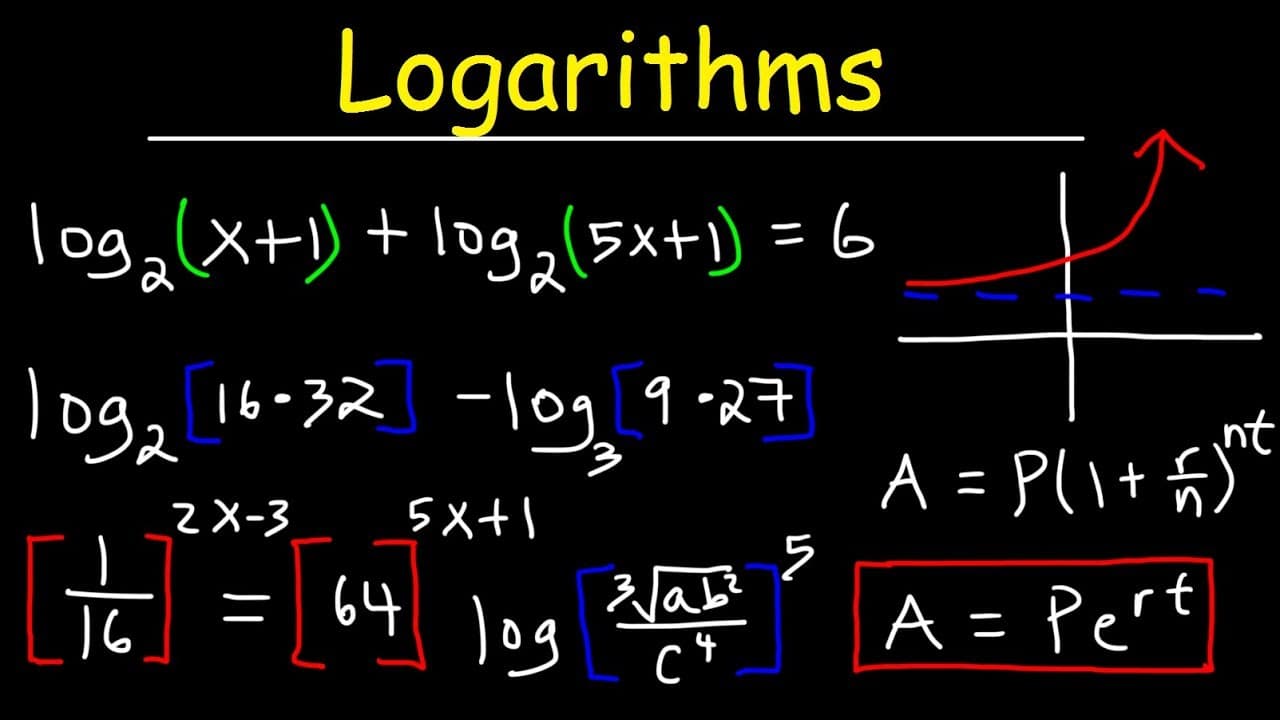
To solve logarithmic and exponential problems, start by condensing or expanding expressions using logarithmic properties. Determine the domain and range by analyzing the function graphically or through inequalities. Use exponential forms for solving equations, and apply the concept of half-life for decay problems, calculating the time required to reach a specific remaining amount.
Transcript
number one condense the following expression into a single logarithm so go ahead and try this problem the first thing we need to do is move the coefficients to their exponent positions so this is equivalent to log x to the third power minus log y to the fifth power plus log z raised to the two thirds so now we can write it as a single log expressio... Read More
Key Insights
- 🧑💻 Moving coefficients and exponents in logarithmic expressions helps condense or expand them into a single log or a sum/difference of logs.
- 😫 Graphing or setting the inside portion of the log greater than zero helps determine the domain of a logarithmic function.
- 💛 The range of an exponential function can be found by analyzing its graph and identifying the lowest and highest y-values.
- 💁 Converting exponential equations to logarithmic form helps simplify the solving process by applying logarithmic properties.
Install to Summarize YouTube Videos and Get Transcripts
Explore YouTube Video Summarizer or Get YouTube Transcript Extractor
Questions & Answers
Q: How can you condense a logarithmic expression into a single log?
To condense a logarithmic expression, you need to move coefficients to their exponent positions, combine logs with a plus sign in the numerator, and logs with a minus sign in the denominator.
Q: How do you expand a logarithmic expression into a sum or difference of logs?
To expand a logarithmic expression, move the coefficients to the front, rewrite the bases with exponents, distribute the exponents, and write them as coefficients in the final expression.
Q: How do you determine the domain of a logarithmic function?
The domain of a logarithmic function can be found by graphing it or setting the inside portion of the log greater than zero since only positive numbers can exist inside the log function.
Q: How do you find the range of an exponential function?
The range of an exponential function is determined by analyzing its graph and identifying the lowest and highest y-values. It typically ranges from a specific value (such as 1) to infinity.
Q: How do you solve an exponential equation in logarithmic form?
To solve an exponential equation, write it in logarithmic form, convert it to exponential form using exponent rules, and then solve for the variable.
Q: What is the relationship between the half-life of an element and the time it takes to decay to a specific amount?
The half-life of an element is the time it takes for half of a substance to decay. To determine how long it takes for a specific amount to decay, you can calculate the number of half-lives required using the given half-life period.
Summary & Key Takeaways
-
The content covers condensing and expanding logarithmic expressions by moving coefficients and exponents, and combining or separating logarithms.
-
It explains how to find the domain of a logarithmic function by graphing or setting the inside portion of the log greater than zero.
-
The range of an exponential function is determined by analyzing its graph and identifying the lowest and highest y-values.
-
The content demonstrates the process of solving logarithmic and exponential equations by converting them to exponential form.
-
It also discusses the concept of half-life, explaining how to calculate the time taken for a substance to decay to a specific amount.
Read in Other Languages (beta)
Share This Summary 📚
Summarize YouTube Videos and Get Video Transcripts with 1-Click
Try YouTube Summary with ChatGPT & Claude or YouTube Transcript Generator
Explore More Summaries from The Organic Chemistry Tutor 📚




Summarize YouTube Videos and Get Video Transcripts with 1-Click
Try YouTube Summary with ChatGPT & Claude or YouTube Transcript Generator