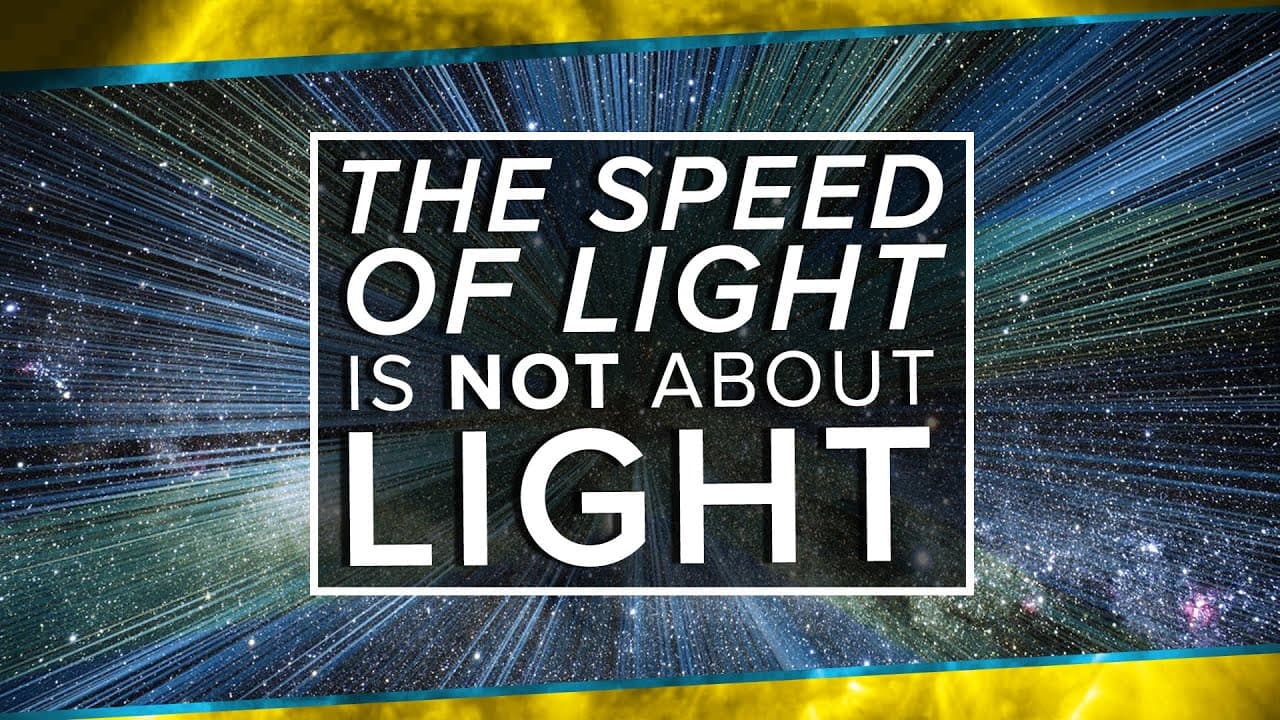
The Speed of Light is NOT About Light
TL;DR
The speed of light is actually the speed of causality.
Transcript
♪ (PBS Digital Studios theme) ♪ Does the speed of light actually have anything to do with light? ♪ (Space Time theme) ♪ So what is it about the speed of light that's so special? Why does the universe seem to conspire to, 1) keep photons from traveling at any speed but 300,000 kilometers per second in a vacuum, according to any observer, and, 2) ke... Read More
Key Insights
- The speed of light is not about light itself but is fundamentally the speed of causality, dictating the maximum speed of information transfer in the universe.
- Galileo's Principle of Relativity laid the groundwork for understanding that no velocity is special, influencing the development of modern physics.
- Maxwell's equations revealed inconsistencies with Galilean Relativity, leading to the realization that a new transformation, the Lorentz transformation, was needed.
- The Lorentz transformation, unlike the Galilean transformation, accurately describes the relationship between space and time, supporting Einstein's Special Theory of Relativity.
- The cosmic speed limit, denoted as 'c', is a fundamental constant derived from the Lorentz transformation and aligns with the speed of light due to the properties of electromagnetic waves.
- Massless particles, such as photons and gluons, travel at the speed of causality because they encounter no resistance to motion.
- The existence of mass and space-time necessitates a finite universal speed limit; without it, the universe would be paradoxically inconsistent.
- Einstein's interpretation of the Lorentz transformation leads to concepts like time dilation and length contraction, essential to the understanding of space-time.
Install to Summarize YouTube Videos and Get Transcripts
Explore YouTube Video Summarizer or Get YouTube Transcript Extractor
Questions & Answers
Q: What is the significance of the speed of light in the universe?
The speed of light is significant because it represents the speed of causality, the maximum speed at which information and causal effects can propagate through the universe. This cosmic speed limit is not about light per se but about the fundamental nature of space-time and the transmission of information.
Q: How did Galileo's Principle of Relativity influence modern physics?
Galileo's Principle of Relativity was crucial in establishing that no velocity is special, meaning that all inertial frames of reference are equivalent. This insight laid the groundwork for Newton's Laws of Motion and later influenced the development of Einstein's theories of relativity, which further explored the relationship between space, time, and velocity.
Q: Why was the Lorentz transformation necessary?
The Lorentz transformation was necessary because Maxwell's equations, which describe electromagnetism, were inconsistent with the Galilean transformation. The Lorentz transformation accurately describes how space and time are interrelated, allowing for consistent physical laws across different reference frames and supporting the concepts of Einstein's Special Theory of Relativity.
Q: How does the Lorentz transformation relate to massless particles?
The Lorentz transformation shows that massless particles, such as photons and gluons, travel at the speed of causality because they encounter no resistance to motion. This speed is the maximum possible speed in the universe, as defined by the cosmic speed limit, and is essential for understanding the behavior of light and other electromagnetic phenomena.
Q: What would happen if the cosmic speed limit were infinite?
If the cosmic speed limit were infinite, it would lead to paradoxical and inconsistent scenarios. There would be no time or space, as all locations and moments would communicate instantaneously. Matter would not exist because infinite energy would be required to create mass. The universe would be reduced to an infinitesimal point without cause or effect.
Q: How does the Lorentz transformation support Einstein's Special Theory of Relativity?
The Lorentz transformation supports Einstein's Special Theory of Relativity by providing the mathematical framework that describes the interdependence of space and time. It predicts phenomena like time dilation and length contraction, demonstrating that the laws of physics are the same in all inertial frames and that the speed of causality is a fundamental constant.
Q: What is the relationship between the speed of light and electromagnetic waves?
The speed of light is the speed at which electromagnetic waves propagate, as determined by Maxwell's equations. This speed is a result of the fundamental constants in these equations and aligns with the cosmic speed limit. Thus, the speed of light is not just about light but about the nature of electromagnetic phenomena and space-time itself.
Q: Why is the finite speed of causality fundamental to the universe?
The finite speed of causality is fundamental because it ensures the consistency and coherence of space-time. It allows for a structured universe where cause and effect are maintained, and information transfer is regulated. Without this finite speed, the universe would be paradoxical, lacking defined space, time, and matter, making it unobservable and incoherent.
Summary & Key Takeaways
-
The speed of light is often misunderstood as a fundamental cosmic speed limit due to light itself. However, it is actually the speed of causality, the maximum speed at which information can be transferred across the universe.
-
Galileo's Principle of Relativity and Maxwell's equations challenged existing notions of space and time, paving the way for the Lorentz transformation, which accurately describes the relationship between space, time, and velocity.
-
Einstein's Special Theory of Relativity, built on the Lorentz transformation, introduces concepts like time dilation and length contraction, emphasizing the finite nature of the cosmic speed limit and its implications for massless particles.
Read in Other Languages (beta)
Share This Summary 📚
Summarize YouTube Videos and Get Video Transcripts with 1-Click
Try YouTube Summary with ChatGPT & Claude or YouTube Transcript Generator
Explore More Summaries from PBS Space Time 📚
Summarize YouTube Videos and Get Video Transcripts with 1-Click
Try YouTube Summary with ChatGPT & Claude or YouTube Transcript Generator