How AI, Free Energy, and Robots Shape Our Future
TL;DR
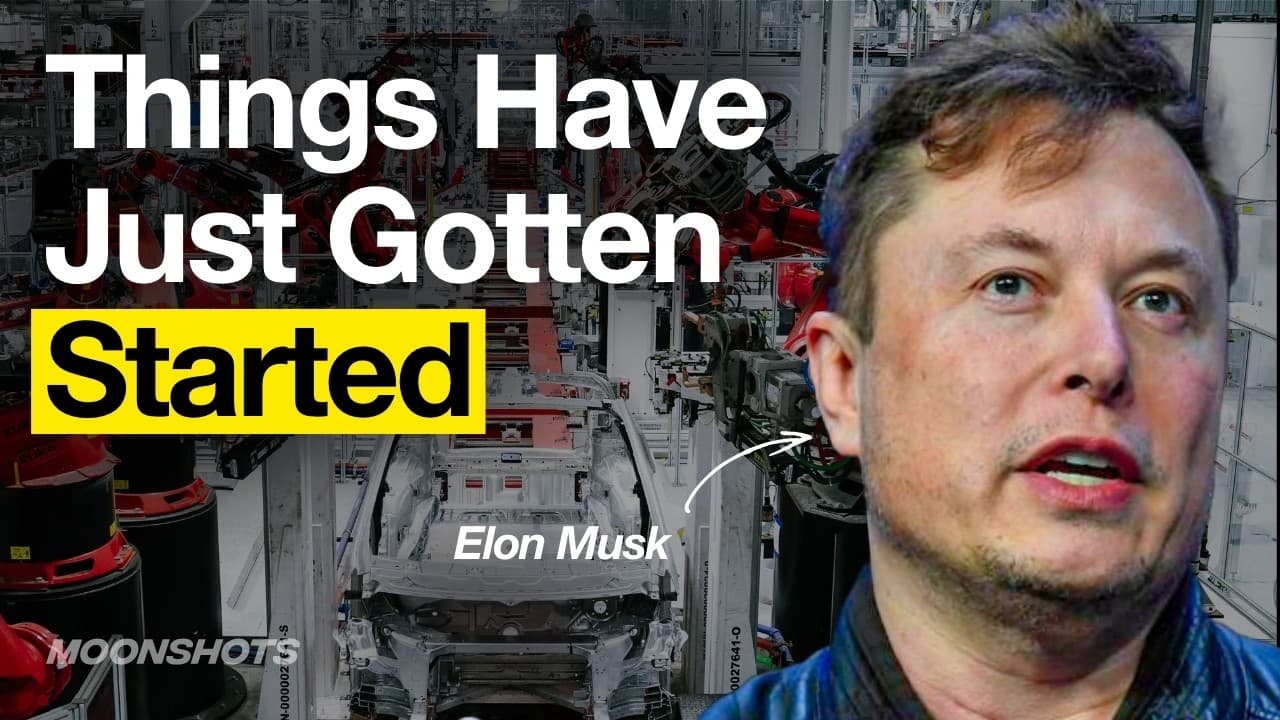
AI is likely to dramatically improve and possibly reach human-level capability within a few years, with safety being essential. Energy demand will rise as AI and electrification grow, with solar becoming the primary long-term source. Nations will build AI compute clusters, and humanoid robots may outnumber people by 2040.
Transcript
ladies and gentlemen prepare for a fun conversation with a very special guest and someone I'm proud to call a friend welcome Elon [Applause] Musk y welcome to uh to Riad um it's been quite an incredible 90 days for you my friend uh yeah xai Colossus came online 122 days you're about to double in size again uh extraordinary success of of the fifth m... Read More
Key Insights
- AI progress is accelerating, with an estimation of substantial capability gains in a few years.
- There is a recognized existential risk from AI alongside a push for safer, truth-seeking AI systems.
- Birth rates are discussed as a long-term demographic challenge impacting humanity’s future.
- XAI and Colossus represent efforts to scale AI compute and safety aligned with human interests.
- Energy demand for digital intelligence is rising, with solar energy identified as the long-term primary source.
- Most countries are expected to develop AI compute clusters, making AI infrastructure a national priority.
- Humanoid robots are projected to be more numerous than humans by 2040 under optimistic timing and pricing.
- Pricing expectations for humanoid robots are discussed, with potential affordability enabling widespread use.
Install to Summarize YouTube Videos and Get Transcripts
Explore YouTube Video Summarizer or Get YouTube Transcript Extractor
Questions & Answers
Q: How fast is AI expected to improve and what is the risk profile?
AI is described as getting dramatically better, with a rough estimate of ten times improvement per year leading to very rapid gains over several years. The risk profile includes a nonzero chance of negative outcomes, but the overall view is that AI will likely be beneficial if safety and truth seeking are prioritized. The discussion emphasizes maximizing truth seeking and aligning AI with humanity, while acknowledging potential dystopian risks if safety is neglected.
Q: What is the view on energy needs for AI and the future of power sources?
The conversation notes that AI and electrification will require a large amount of energy. It argues that long-term energy will come primarily from the sun and stresses that society will need substantial solar energy capacity to power AI compute and related technologies. The emphasis is on energy availability as a driver of technological progress and civilization scale.
Q: Why is there concern about AI safety and how is it being addressed?
Safety concerns center on ensuring AI is maximally truth seeking and benevolent to humanity. The speaker criticizes some AI models for being politically correct rather than truth oriented and highlights the creation of initiatives like XAI to steer AI toward truthful, beneficial outcomes. The approach involves governance, safety protocols, and alignment with human well-being.
Q: What is the expected role of nations in AI infrastructure?
It is suggested that every country will have AI compute clusters and that building frontier models requires significant compute and expertise. While individual countries may invest in national AI infrastructure, collaboration and scale will be important. The overall message is that AI infrastructure will become a standard national asset akin to electricity or airlines.
Q: What growth trajectory is projected for humanoid robots by 2040?
The forecast suggests that by 2040 there could be more humanoid robots than humans globally. This projection depends on cost declines and production scaling, with an estimated price point of tens of thousands to around two hundred thousand dollars per robot, enabling widespread adoption and integration into daily life and economy.
Q: How does the discussion connect AI to broader societal trends like birth rates?
The conversation frames AI progress alongside demographic trends, noting that global population decline is a potential long-term issue. It argues that addressing birth rates is essential for maintaining human continuity, suggesting policy considerations and incentives to support population stability as part of broader AI and societal planning.
Q: What is the expected impact on the economy and abundance, according to the talk?
The dialogue envisions a future of abundance where goods and services can be produced at very low marginal costs due to advanced AI and automation. With AI-driven productivity and robotic labor, the economy could scale to meet demand broadly, potentially reducing scarcity and altering wage structures, employment patterns, and the distribution of wealth.
Q: What practical steps are recommended for leaders to avoid missing the AI transformation?
Leaders are encouraged to prepare for AI adoption by investing in compute infrastructure, supporting research in safe and truthful AI, and fostering international collaboration. The emphasis is on building capability and regulatory frameworks that promote innovation while safeguarding public interests, ensuring their nations participate actively in the AI-driven future.
Summary & Key Takeaways
-
AI progress is accelerating rapidly and could reach broad human capability in the near term, requiring safety and governance attention.
-
Energy demand will surge to support AI and electrification, emphasizing solar as a major long-term source.
-
Humanoid robots and AI clusters will become common infrastructure, driving economic and societal changes while aiming for a future of abundance.
Read in Other Languages (beta)
Share This Summary 📚
Summarize YouTube Videos and Get Video Transcripts with 1-Click
Try YouTube Summary with ChatGPT & Claude or YouTube Transcript Generator
Explore More Summaries from Peter H. Diamandis 📚






Summarize YouTube Videos and Get Video Transcripts with 1-Click
Try YouTube Summary with ChatGPT & Claude or YouTube Transcript Generator