What Are the Addition and Multiplication Rules in Probability?
TL;DR
The addition and multiplication rules in probability allow for calculating probabilities across multiple events. The product rule applies to independent events, where probabilities are multiplied, while the addition rule is for mutually exclusive outcomes, where probabilities are added. Understanding the difference between independent and dependent events is crucial for accurate calculations.
Transcript
good day welcome to the tech math Channel what we're going to be having a look at in this video is how to work out probability over multiple events an example of this so say you maybe had a coin and you flipped it and you wanted to know how many different times you would get head so you're going to flip it twice uh did you could you get heads twice... Read More
Key Insights
- 📏 Probability calculations over multiple events involve the product and addition rules.
- ❓ Understanding independent and dependent events is essential for accurate probability calculations.
- 🖤 Replacement or lack thereof influences the independence of events in probability calculations.
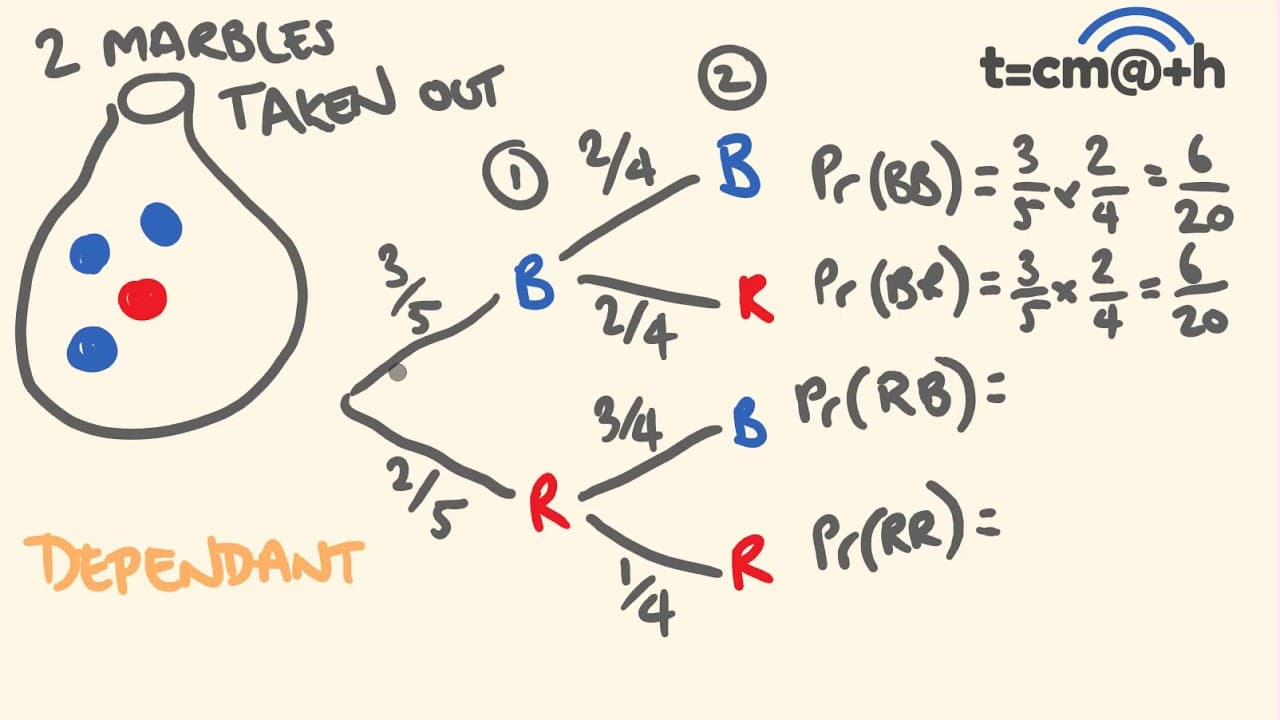
- 🌲 Tree diagrams are useful tools to visualize and calculate probabilities in multi-event scenarios.
Install to Summarize YouTube Videos and Get Transcripts
Explore YouTube Video Summarizer or Get YouTube Transcript Extractor
Questions & Answers
Q: What are the product and addition rules in probability?
The product rule states that the probability of two or more events occurring together is found by multiplying their individual probabilities. The addition rule is used when events are mutually exclusive, and their total probability is calculated by adding their individual probabilities.
Q: How do independent and dependent events affect probability calculations?
Independent events are not affected by each other, leading to straightforward probability calculations. Dependent events, however, change probabilities based on previous outcomes, requiring careful consideration in calculations.
Q: Why is replacement important in probability calculations?
Replacement affects whether events are considered independent or dependent. Without replacement, events become dependent, altering probabilities based on previous outcomes.
Q: How do tree diagrams help in understanding probability over multiple events?
Tree diagrams visually represent possible outcomes of events, helping in calculating probabilities step by step and highlighting the relationships between events.
Summary & Key Takeaways
-
Explains how to calculate probabilities over multiple events like coin flips and marble drawings using product and addition rules.
-
Emphasizes the difference between independent and dependent events in probability calculations.
-
Provides detailed examples with tree diagrams to illustrate the concept effectively.
Read in Other Languages (beta)
Share This Summary 📚
Summarize YouTube Videos and Get Video Transcripts with 1-Click
Try YouTube Summary with ChatGPT & Claude or YouTube Transcript Generator
Explore More Summaries from tecmath 📚

Summarize YouTube Videos and Get Video Transcripts with 1-Click
Try YouTube Summary with ChatGPT & Claude or YouTube Transcript Generator