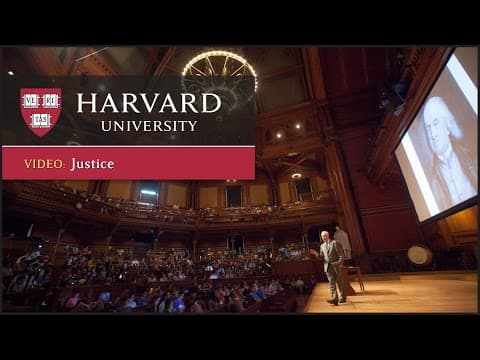
Justice with Michael Sandel - CCCB: Bioethics: Testing utilitarianism

Transcript
Read and summarize the transcript of this video on Glasp Reader (beta).
Install to Summarize YouTube Videos and Get Transcripts
Explore YouTube Video Summarizer or Get YouTube Transcript Extractor
Summary
In this scenario, you are presented with a moral dilemma as a transplant surgeon. You have five patients in need of different organ transplants to survive, and there are no organ donors available. The solution seems to be a healthy donor who is currently sleeping in the next room. The question is whether you would be willing to harm the healthy donor and save the lives of the five patients.
Questions & Answers
Q: Would you be willing to harm a healthy person in order to save the lives of five patients who are in desperate need of organ transplants?
This question poses a significant moral dilemma. While the immediate instinct might be to save the lives of the five patients, the act of intentionally causing harm to a healthy individual raises serious ethical concerns. It forces us to question whether the end justifies the means and whether it is permissible to harm one person for the greater good of saving multiple lives.
Q: What are some possible arguments in favor of sacrificing the healthy donor to save the five patients?
One possible argument could be derived from utilitarian ethics, which focuses on maximizing overall happiness or well-being. In this scenario, sacrificing the healthy donor ultimately saves more lives, leading to a greater overall benefit. From a purely numerical standpoint, the lives of five individuals might outweigh the life of one healthy donor. Additionally, some might argue that it is the responsibility of the transplant surgeon to prioritize the lives of their patients above all else.
Q: What are some counterarguments against sacrificing the healthy donor?
One counterargument lies in the principle of individual autonomy and the importance of informed consent. Harming the healthy donor without their consent violates their rights and autonomy as a person. Furthermore, it is essential to consider the long-term consequences of such actions. If the medical community condones or allows the intentional harm of healthy individuals for the greater good, it may lead to a slippery slope where more unethical practices become normalized.
Q: Could there be alternatives to sacrificing the healthy donor in this situation?
Yes, there might be alternatives to consider. One option could be to prioritize finding organ donors for the five patients in need, either through expanding the search or through further efforts to increase organ donation rates. Another approach could involve exploring alternative medical treatments or therapies that may keep the patients stable until suitable organ donors are found. Thus, it is important to exhaust all possible options before resorting to the extreme measure of targeting a healthy individual.
Q: How would you weigh the value of multiple lives against the life of the healthy donor?
This is a complex question that requires careful deliberation. It involves assessing the intrinsic value of life and the ethical principles guiding our decisions. While multiple lives might hold more numerical value, each life is unique and irreplaceable. Therefore, it is essential to consider the value we place on the autonomy and dignity of individuals, as well as the potential psychological and societal impact of intentionally causing harm to a healthy person.
Q: What ethical principles should a transplant surgeon consider in such a scenario?
A transplant surgeon should consider principles such as beneficence, non-maleficence, autonomy, and justice. Beneficence urges professionals to act in a way that promotes the well-being and best interests of their patients. Non-maleficence dictates that one should avoid causing harm. Autonomy emphasizes respect for individuals and their right to make informed decisions about their own bodies. Justice ensures fairness and equality in the distribution of medical resources. Balancing these principles can guide a transplant surgeon in making ethically sound decisions.
Q: What are the potential consequences of sacrificing the healthy donor for the five patients?
Sacrificing the healthy donor may potentially result in a range of consequences. From an individual perspective, the healthy donor loses their life without giving consent, violating their autonomy and human rights. On a broader scale, it may erode public trust in the medical profession and organ transplantation. Additionally, allowing the sacrifice raises moral and legal questions about the boundaries of medical practice and the role of healthcare professionals in making life-or-death decisions.
Q: Is there a possibility of a middle ground in this scenario?
It is possible to explore middle ground options. One potential approach could involve discussing the situation with the healthy donor, presenting them with the potential to save multiple lives through organ donation. Affording them the opportunity to make an informed decision not only respects their autonomy but also acknowledges the gravity of the situation. Engaging in open communication and exploring alternatives provides a way to balance the needs and rights of all individuals involved.
Q: How can healthcare organizations and governments address the shortage of organs for transplantation?
Healthcare organizations and governments can employ various strategies to tackle the shortage of organs for transplantation. This can include raising public awareness about the importance of organ donation and addressing misconceptions. Implementing policies that incentivize organ donation, such as opt-out systems, where individuals are presumed to be donors unless they specifically choose not to be, can significantly increase the number of available organs. Collaborating with international organizations and improving transplant logistics can also help optimize the utilization and fair distribution of organs.
Q: What are the broader ethical implications of this scenario?
The broader ethical implications extend beyond the immediate scenario. It raises questions about the morality of using one person's body to save another's life without their consent. It also delves into the delicate balance between individual rights and societal benefit. More broadly, it forces us to consider how we as a society prioritize and allocate limited medical resources, and what principles should guide those decisions.
Takeaways
This scenario presents a profound moral dilemma for a transplant surgeon. While the instinct to save multiple lives is understandable, it brings into focus the complexities of ethical decision-making. Sacrificing a healthy donor without their consent raises significant ethical concerns, challenging the principles of autonomy, non-maleficence, and justice. Exploring alternatives and considering long-term consequences is crucial in making ethically sound decisions in scenarios where the stakes are high. Additionally, addressing the shortage of organs for transplantation requires collaborative efforts from healthcare organizations, governments, and society as a whole.
Read in Other Languages (beta)
Share This Summary 📚
Summarize YouTube Videos and Get Video Transcripts with 1-Click
Try YouTube Summary with ChatGPT & Claude or YouTube Transcript Generator
Explore More Summaries from Harvard University 📚



Summarize YouTube Videos and Get Video Transcripts with 1-Click
Try YouTube Summary with ChatGPT & Claude or YouTube Transcript Generator