How Can Fine-Tuning Make Your LLM an Expert at Writing YouTube Titles?
TL;DR
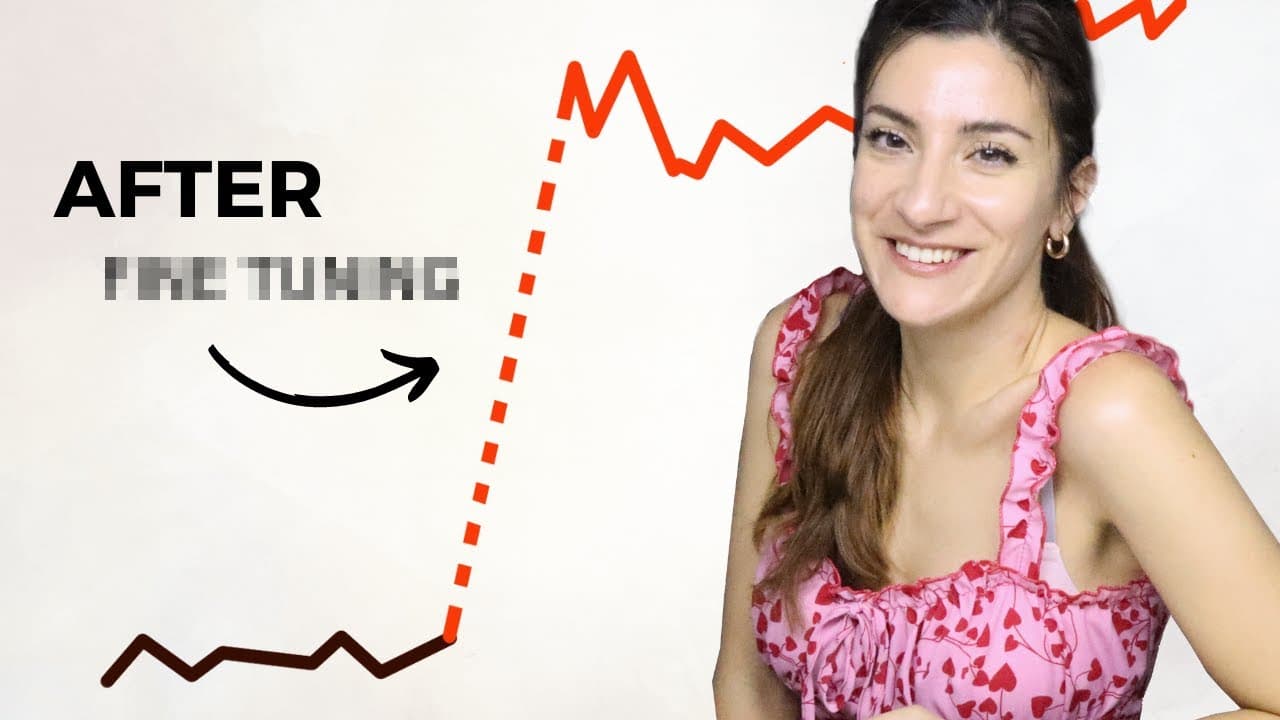
Fine-tuning can make an LLM better at a specific task by adapting a pretrained model to a chosen dataset through supervised learning. The walkthrough fine-tunes the 7-billion-parameter Llama 2 using around 100 good YouTube titles, parameter-efficient fine-tuning, and quantization in Google Colab. Read on for the required dataset structure, libraries, model settings, and training concepts.
Transcript
since I discovered chai GPT I've been trying to use it for generating YouTube titles and thumbnails but these attempts would usually lead to a spectacular failure because charging PT sounds as unique as a corporate leaflet and it's always one of these words uncover Unleashed unlock the hidden potential or creativity and so on you don't even need an... Read More
Key Insights
- ❓ Fine-tuning language models improves performance on specific tasks.
- 🌥️ PFT enables efficient training of large language models on consumer GPUs.
- ❓ Quantization reduces model size and improves efficiency.
- 🚨 Merging base models with adapters customizes language models.
- 🥠 Guidelines for creating and using fine-tuned language models for YouTube titles.
- ❓ The importance of structured datasets in supervised training.
- 🥠 Accessing and saving fine-tuned models on Hugging Face Hub.
Install to Summarize YouTube Videos and Get Transcripts
Explore YouTube Video Summarizer or Get YouTube Transcript Extractor
Questions & Answers
Q: How can you fine-tune an LLM to generate better YouTube titles?
Create or find a dataset of strong titles, format it for supervised learning, and use it to fine-tune a pretrained model. The demonstrated setup uses around 100 good YouTube titles to customize the 7-billion-parameter Llama 2 model.
Q: What is fine-tuning a language model?
Fine-tuning adapts a pretrained foundational model to perform a new task or improve its performance on a specific dataset. The process typically uses supervised learning with examples selected for the desired task.
Q: What dataset format is needed for supervised fine-tuning?
A structured dataset must follow a consistent format. The examples described use two columns: one for instructions and another for responses.
Q: What libraries are used to fine-tune Llama 2 in Google Colab?
The setup installs Hugging Face Transformers, xFormers, Datasets, TRL, and the PFT library. Bitsandbytes and Accelerate are also used to quantize the model.
Q: How does parameter-efficient fine-tuning work?
PFT fine-tunes a small number of additional model parameters or weights while freezing most of the pretrained model. This reduces the hardware and energy demands compared with fine-tuning the entire LLM and allows a large model to be fine-tuned on a regular consumer GPU.
Q: What is LoRA in LLM fine-tuning?
LoRA, or low-rank adaptation, is a specific fine-tuning method discussed in the walkthrough. It focuses on freezing the pretrained model weights while the model is adapted for the chosen task.
Q: Why is quantization used when fine-tuning an LLM?
Quantization reduces the number of bits used to represent model parameters, lowering the model's memory footprint and power consumption while allowing faster training. Full-precision models typically use 32-bit floating-point numbers, while quantized models use 4-bit or 8-bit integers.
Q: How much smaller is the quantized Llama 2 model?
In the demonstrated setup, the quantized version is around 7 gigabytes. The original full-precision version is around 27 gigabytes.
Summary & Key Takeaways
-
Introduction to fine-tuning language models for YouTube titles.
-
Explaining the process of fine-tuning language models using LLM and PFT.
-
Step-by-step guide on how to create a custom fine-tuned model for YouTube titles.
Read in Other Languages (beta)
Share This Summary 📚
Summarize YouTube Videos and Get Video Transcripts with 1-Click
Try YouTube Summary with ChatGPT & Claude or YouTube Transcript Generator
Explore More Summaries from Maya Akim 📚
Summarize YouTube Videos and Get Video Transcripts with 1-Click
Try YouTube Summary with ChatGPT & Claude or YouTube Transcript Generator