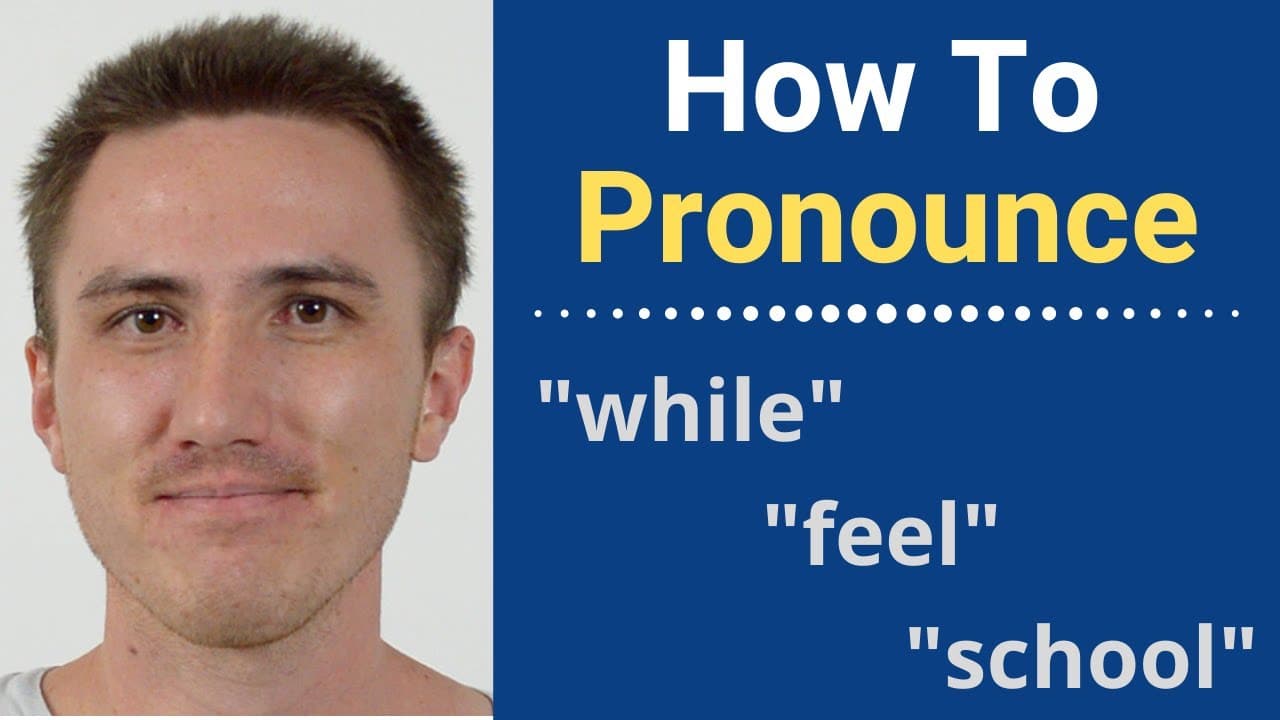
How to Pronounce While, Feel, School, Ruin, Rule
TL;DR
Pronounce while and feel with two vowel sounds connected by a Y glide, and pronounce school, ruin, and rule with two vowel sounds connected by a W glide. Avoid reducing each word to a single vowel sound. Listen for both sounds, identify the glide, and repeat each complete word several times to practice the intended pronunciation.
Transcript
What's up, guys? Today, I'm gonna teach you how to pronounce some more difficult words in English. After watching this video, you'll be able to pronounce these words like a native speaker. Before we start, remember to subscribe to the channel, click on the bell, and follow us on Instagram. You ready? Okay, so I'm gonna teach you how to pronounce fi... Read More
Key Insights
- A diphthong is a syllable containing two different vowel sounds. English learners may mispronounce diphthongs when they produce only one sound, so recognizing both vowel components is the foundation of the pronunciation method demonstrated in the lesson.
- While contains two vowel sounds rather than one. Its sounds are connected with a Y glide, and the lesson recommends listening closely for that glide before repeating the complete word several times to establish the intended pronunciation.
- Feel is presented as another common word with two vowel sounds. It uses the same Y glide discussed for while, so learners are directed to notice the connecting sound and practice the word repeatedly instead of reducing its vowel movement.
- School contains two different vowel sounds connected by a W glide. The lesson emphasizes that the word does not have only one vowel sound and asks learners to listen specifically for the W connection before repeating the full pronunciation.
- Ruin contains two distinct vowel sounds and can be particularly tricky for learners. Its sounds are joined with a W glide, which becomes clearer when attention is directed toward the second part of the word during careful listening and repetition.
- Rule contains two vowel sounds connected by a W glide. The pronunciation exercise isolates the second portion of the word, draws attention to the connecting W sound, and then returns to repeated practice of the complete word.
- Glide sounds connect the two vowel sounds in the five featured words. The lesson assigns a Y glide to while and feel, while school, ruin, and rule are taught with a W glide that learners should identify by listening closely.
- Repeated speaking practice follows every pronunciation explanation. After hearing the word, identifying its two vowel sounds, and noticing its glide, learners repeat the complete word several times to reinforce the pronunciation pattern demonstrated by the instructor.
Install to Summarize YouTube Videos and Get Transcripts
Explore YouTube Video Summarizer or Get YouTube Transcript Extractor
Questions & Answers
Q: What is a diphthong in English pronunciation?
A diphthong is a syllable that contains two different vowel sounds. The lesson says learners often mispronounce diphthongs because they produce them with only one sound. Correct practice therefore begins by listening for both vowel sounds and noticing the glide that connects them, rather than treating the vowel portion as a single, unchanged sound.
Q: How do you pronounce the word while correctly?
While should be pronounced with two vowel sounds, not reduced to the single-sound version identified as incorrect in the lesson. A Y glide connects its two vowel sounds. To practice, listen closely for that Y connection, focus on the second sound described as yle, and then repeat the complete word several times with the same movement between sounds.
Q: How do you pronounce the word feel correctly?
Feel contains two vowel sounds joined by a Y glide. The lesson contrasts the correct form with a common incorrect pronunciation that fails to produce the intended vowel movement. Listen carefully for the Y connection, notice the second sound described as yle, and repeat the whole word several times while preserving both vowel sounds rather than using only one.
Q: How do you pronounce the word school correctly?
School should contain two different vowel sounds connected by a W glide. The lesson stresses that its vowel is not simply one sound. Listen closely for the W connection and for the second portion described as hool. Then repeat the entire word several times, maintaining both vowel sounds and the glide instead of using the simplified pronunciation identified as incorrect.
Q: How do you pronounce the word ruin correctly?
Ruin is pronounced with two distinct vowel sounds and a W glide connecting them. The lesson identifies this word as particularly tricky for students and draws attention to the second sound, described as win. Careful practice involves hearing both vowel sounds, noticing the W connection, and repeating the complete word several times without collapsing the sounds together.
Q: How do you pronounce the word rule correctly?
Rule contains two different vowel sounds and uses a W glide between them. The lesson asks learners to listen for both sounds and identifies the second portion as hool. To practice the intended pronunciation, notice the W connection clearly and repeat the whole word several times, avoiding the one-sound pronunciation that the lesson presents as incorrect.
Q: Which words in the lesson use a Y glide sound?
While and feel use a Y glide to connect their two vowel sounds. For both words, the lesson directs learners to listen closely for this connecting sound and pay attention to the second portion, described as yle. Repeating each complete word several times helps practice the transition instead of pronouncing its vowel portion as only one sound.
Q: Which words in the lesson use a W glide sound?
School, ruin, and rule use a W glide to connect two vowel sounds. The lesson highlights the glide separately in each example, then asks learners to repeat the complete word several times. The practice goal is to hear both distinct vowel sounds and retain the W connection rather than simplifying each word into a single vowel sound.
Summary & Key Takeaways
-
Diphthongs contain two different vowel sounds within a syllable, although learners may pronounce them as if they contained only one. The lesson addresses this problem through five frequently mispronounced words: while, feel, school, ruin, and rule. Each example is broken down by its two vowel sounds and connecting glide sound.
-
While and feel use a Y glide to connect their two vowel sounds. The lesson asks learners to listen closely for that connecting sound, pay attention to the second portion of each word, and repeat the complete pronunciation several times. This method is intended to prevent either word from becoming a single vowel sound.
-
School, ruin, and rule use a W glide between their vowel sounds. Each word is presented with an incorrect and correct pronunciation, followed by focused listening and repeated speaking practice. The central technique is to hear two distinct vowel sounds, notice the W connection, and reproduce the full word without simplifying it.
Read in Other Languages (beta)
Share This Summary 📚
Summarize YouTube Videos and Get Video Transcripts with 1-Click
Try YouTube Summary with ChatGPT & Claude or YouTube Transcript Generator
Explore More Summaries from Listening Time 📚





Summarize YouTube Videos and Get Video Transcripts with 1-Click
Try YouTube Summary with ChatGPT & Claude or YouTube Transcript Generator