How to Build a SaaS with Lovable and Supabase
TL;DR
Define the product, user flows, pages, features, and requirements before asking AI to build a SaaS. Treat Lovable as the developer and yourself as the product manager, then use basic knowledge of the frontend, server, and database to guide development, diagnose problems, and connect Supabase for authentication and persistent user data.
Transcript
this was a really special episode I had Ras Mike on and we teach you he teaches you how to get the most out of AI to build your SAS startup and we actually go through a new tool called lovable uh which not many people have talked about but we teach you how to use lovable to go and create a SAS startup in minutes but also one that people will love y... Read More
Key Insights
- Clear product specifications are the foundation of effective AI-assisted development. The builder should define the core product, required features, pages, assets, and user flows before prompting, because the model cannot reliably infer an unspoken product vision from a short request.
- A product manager is responsible for defining the market, customer, problem, value proposition, requirements, road map, launch timing, and supporting materials. The role also connects user experience, technology, and business considerations while communicating decisions to the people responsible for building the product.
- AI models do not know what the founder has imagined. They predict responses from their training, so vague requests can produce incorrect features or an entirely different result. Precise written requirements reduce ambiguity and make the generated application more likely to match the founder's intentions.
- Product management depends heavily on documentation and communication. Recording decisions, writing follow-up notes, advocating for users, and translating input from business and user experience stakeholders into clear requirements are practical skills that directly improve the instructions supplied to an AI development tool.
- A functional SaaS has a client side, a server side, and a data storage side. The client side presents the interface, the server handles APIs, calculations, and business logic, and the database preserves information such as accounts and user-created notes.
- Basic knowledge of web technologies helps users diagnose AI-generated applications. Bolt begins with React and Vite, while v0 uses Next.js under the hood. Recognizing the technologies selected by a tool gives the builder useful context when a generated feature fails or behaves unexpectedly.
- A database provides persistence and connects stored information to the correct user. For example, notes or tasks must remain available after a person logs out and returns, which requires the application to store the data and associate it with that person's account.
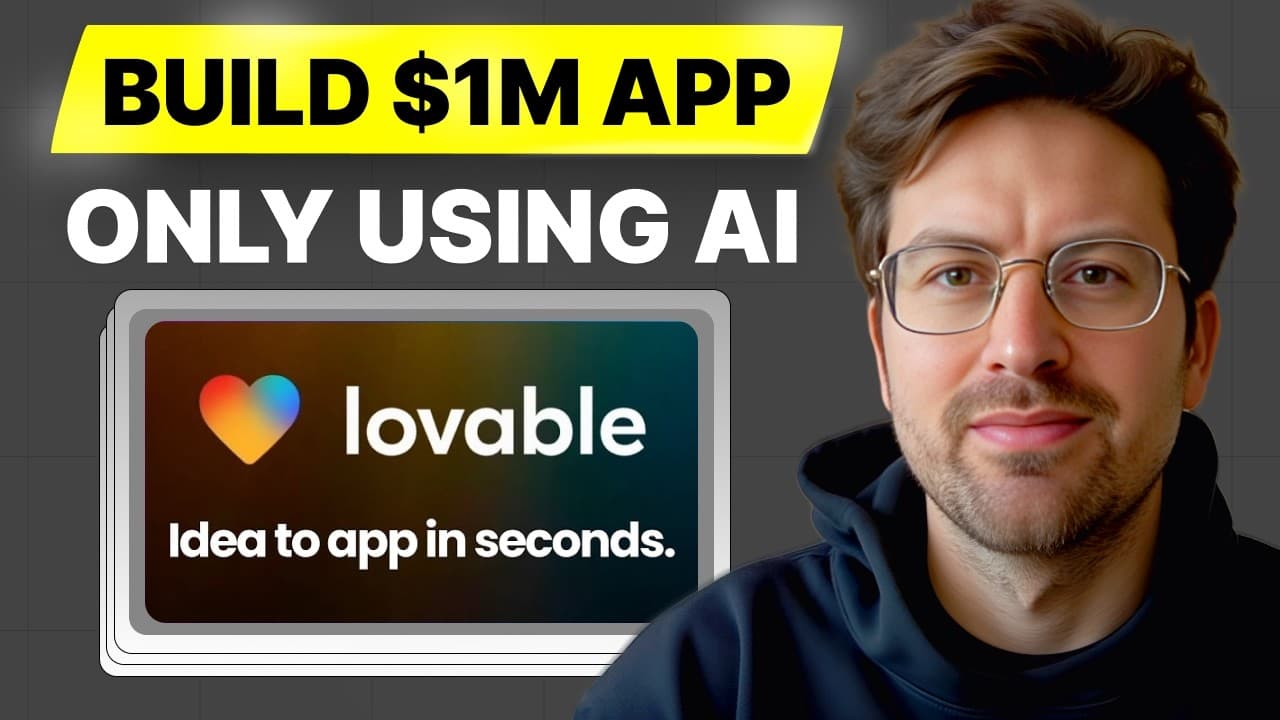
- The Lovable demonstration combines product definition, design, authentication, note creation, and data storage. Supabase supports the authentication and persistence portions of the note-taking application, while Lovable is used to build and refine the product through guided AI-assisted development.
Install to Summarize YouTube Videos and Get Transcripts
Explore YouTube Video Summarizer or Get YouTube Transcript Extractor
Questions & Answers
Q: How should you prepare before asking AI to build a SaaS?
Define the product before writing the build prompt. Specify the intended customer, the problem, the value proposition, the required pages, the major features, and the complete user flows. Include relevant assets and design expectations. The AI model does not know what is in your mind, so detailed requirements give it a usable specification instead of forcing it to guess from a vague idea.
Q: Why should an AI SaaS founder think like a product manager?
A product manager turns a broad idea into information that a developer can act on. For AI-assisted development, that means defining the market and customer, documenting decisions, mapping user flows, describing requirements, and connecting business, technology, and user experience needs. Because the AI acts like the builder, the founder must communicate the intended product clearly enough for that builder to produce the correct result.
Q: Why do vague AI prompts produce the wrong application?
Vague prompts omit decisions that the model needs, including the number of pages, authentication requirements, account behavior, feature details, and user flows. The model cannot access the founder's private vision, so it predicts what the request might mean. Even human developers can build the opposite of what a product manager intended when requirements are poorly communicated, and AI tools face the same problem.
Q: What are the three main parts of a functional SaaS?
A functional SaaS contains a client side, a server side, and a data storage side. The client side is the visible interface where users interact with the product. The server handles business logic, APIs, calculations, and other processing. The database stores accounts and user-created information so that the application can retrieve the correct data during later sessions.
Q: What does the frontend do in an AI-built SaaS application?
The frontend, also called the client side, is the part of the application that a user sees and interacts with. It includes the visible website and its interface. AI development tools may generate this layer with technologies such as React, Vite, or Next.js. Understanding that the frontend controls visible interactions helps the builder separate interface problems from server or database problems.
Q: Why does a SaaS application need a database?
A SaaS application needs a database to preserve user information after a session ends. If a person creates a note or a task, that content must be stored and associated with the correct account. When the person logs out and later logs back in, the application retrieves the same information. Without this persistence layer, user-created content would not reliably remain available.
Q: How are Lovable and Supabase used to create the note-taking tool?
Lovable is used to build and refine the note-taking application through AI-assisted instructions. The demonstrated process covers the tool's interface, product design, user experience, authentication, note creation, and storage. Supabase is integrated for authentication and persistent data, allowing users to have accounts and retain the notes they create. The finished flow is then shown in a working demonstration.
Q: How can basic web knowledge improve AI-assisted development?
Basic web knowledge helps a founder identify which part of the application is failing. A visual or interaction problem may belong to the client side, a processing issue may involve the server, and missing information may involve the database. Knowing that tools can use React, Vite, Next.js, and Supabase also provides useful vocabulary for giving clearer instructions and investigating generated results.
Summary & Key Takeaways
-
Successful AI-assisted SaaS development begins with product management. The founder must define the customer, problem, value proposition, features, pages, requirements, and user flows clearly. A vague request leaves the model guessing, while a detailed product specification gives it the information needed to build something closer to the intended product.
-
A functional SaaS contains three major sections: the client side that users see, the server side that handles business logic and APIs, and the database that stores persistent information. Understanding these sections helps a founder identify whether an issue belongs to the interface, application logic, authentication, or stored user data.
-
The episode demonstrates building a note-taking tool for founders with Lovable and Supabase. The process includes considering design and user experience, connecting authentication, creating notes, storing those notes, and presenting a working demonstration. The central lesson is to act as a product manager first and an AI-assisted builder second.
Read in Other Languages (beta)
Share This Summary 📚
Summarize YouTube Videos and Get Video Transcripts with 1-Click
Try YouTube Summary with ChatGPT & Claude or YouTube Transcript Generator
Explore More Summaries from Greg Isenberg 📚

Summarize YouTube Videos and Get Video Transcripts with 1-Click
Try YouTube Summary with ChatGPT & Claude or YouTube Transcript Generator