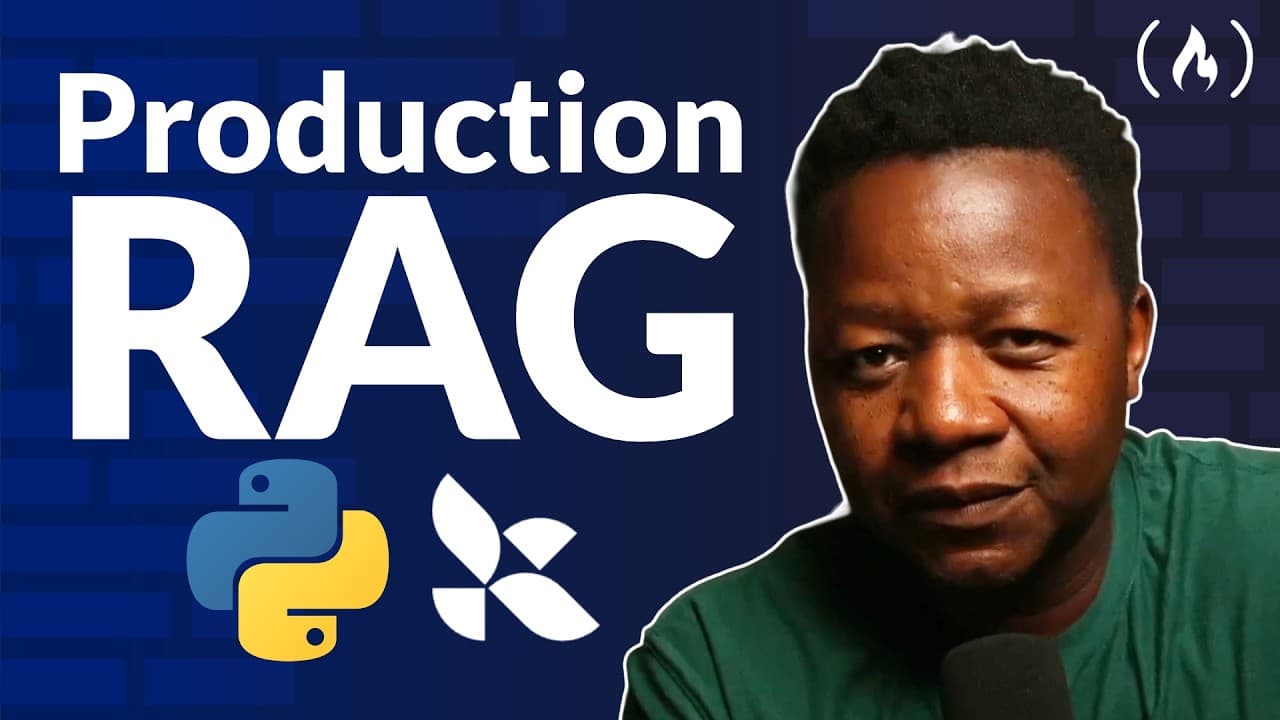
How Do You Build and Optimize Production RAG with LangChain and Vector Databases?
TL;DR
Build a production-grade RAG system by grounding responses in retrieved documents, debugging its five main failure modes, optimizing retrieval quality, and scaling the pipeline securely. The course moves from documents, chunks, embeddings, and vector stores to a complete RAG system and advanced approaches such as agentic RAG, GraphRAG, contextual retrieval, and multimodal RAG. Read on to understand the components and practices that make RAG reliable in production.
Transcript
Master the transition from simple prototypes to production-grade rag systems by addressing the critical scaling, debugging, and security challenges that standard tutorials often ignore. This comprehensive course covers the entire rag pipeline from vector database optimization and observability to advanced agentic and multimodal architectures. You'l... Read More
Key Insights
- RAG systems often fail in production due to five main issues: bad chunking, embedding mismatches, retrieval noise, context overflow, and hallucination.
- Chunking is crucial for maintaining context; bad chunking leads to disjointed context and incomplete retrievals.
- Embedding models and chat models serve different purposes; embedding models output vectors while chat models generate text.
- The Chroma database workflow involves generating embeddings for queries and comparing them with stored document embeddings to find relevant documents.
- Overlap in chunking ensures that context at boundaries isn't lost, which is vital for accurate retrieval.
- Hybrid search combines different retrieval methods to improve accuracy and relevance of results.
- Observability and optimization are key to scaling RAG systems effectively in a production environment.
- Advanced RAG topics include agentic RAG, GraphRAG, and multimodal RAG, which enhance the system's reasoning and retrieval capabilities.
Install to Summarize YouTube Videos and Get Transcripts
Explore YouTube Video Summarizer or Get YouTube Transcript Extractor
Questions & Answers
Q: How do you build and optimize a production-grade RAG system?
Start with the core pipeline of documents, chunks, embeddings, a vector store, and a retriever that finds relevant documents for each user query. Then debug the five main failure modes, optimize retrieval quality, add observability, and scale the system while addressing security challenges.
Q: How does a basic RAG pipeline generate an answer?
A user query drives a retriever that finds relevant documents from a vector store. The retrieved context and unchanged question are combined in a prompt, passed to a large language model, and then processed with an output parser when control or customization of the response is needed.
Q: Why does RAG reduce hallucination?
RAG grounds large language model responses in relevant documents retrieved from a database. The prompt can require the model to answer only from that context and say it does not have enough information when the answer is absent.
Q: What are the five main failure modes of RAG systems?
The five failure modes identified in the course are bad chunking, embedding mismatches, retrieval noise, context overflow, and hallucination. The course focuses on why RAG breaks and how to fix each of these problems.
Q: Why are chunking and overlap important in RAG systems?
Chunking divides documents into units that can be embedded, indexed, and retrieved. Proper chunking preserves context, while overlap helps prevent information at chunk boundaries from being lost.
Q: What role do embeddings and vector stores play in RAG?
Embeddings represent documents and queries as vectors for semantic comparison. A vector store holds indexed document embeddings so the retriever can identify relevant documents for a user’s question.
Q: How should a RAG prompt handle missing information?
The prompt should instruct the model to answer only from the retrieved context. If that context does not contain the answer, the model should say that it does not know or does not have enough information instead of inventing a response.
Q: Which advanced RAG architectures does the course cover?
The course covers agentic RAG, GraphRAG, contextual retrieval, and multimodal RAG as part of its cutting-edge stack. These topics follow the foundation, failure analysis, quality optimization, production scaling, and complete-system sections.
Summary & Key Takeaways
-
To build production-ready RAG systems, it's essential to address common failures such as bad chunking and embedding mismatches. The course provides a comprehensive guide on optimizing vector databases and developing advanced architectures to ensure robust AI applications.
-
Chunking and embeddings play a critical role in the RAG pipeline, affecting retrieval accuracy and system performance. Proper chunking preserves context, while embeddings transform queries into vectors for effective semantic search.
-
The course covers advanced topics like agentic RAG and GraphRAG, which improve retrieval and reasoning capabilities. Observability and optimization are crucial for scaling RAG systems, ensuring they remain efficient and reliable in production.
Read in Other Languages (beta)
Share This Summary 📚
Summarize YouTube Videos and Get Video Transcripts with 1-Click
Try YouTube Summary with ChatGPT & Claude or YouTube Transcript Generator
Explore More Summaries from freeCodeCamp.org 📚


Summarize YouTube Videos and Get Video Transcripts with 1-Click
Try YouTube Summary with ChatGPT & Claude or YouTube Transcript Generator