How to Implement Policy Gradients in TensorFlow 2
TL;DR
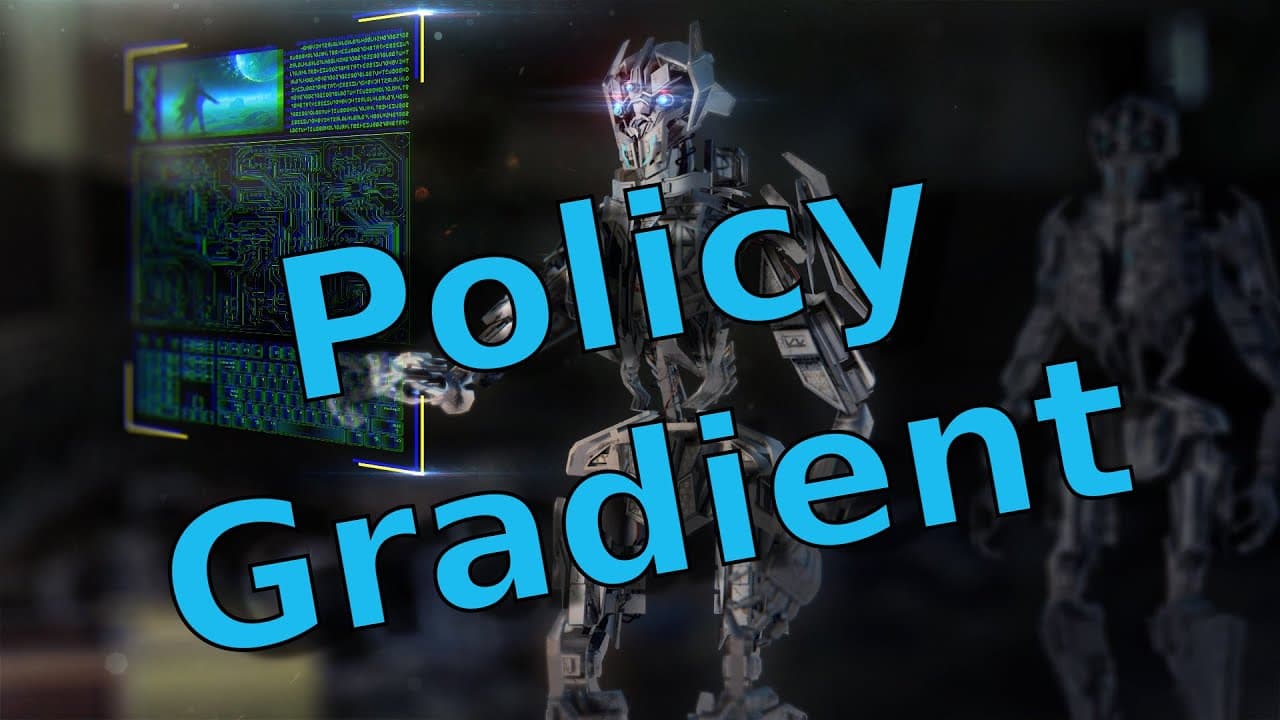
To implement the policy gradient algorithm in TensorFlow 2, start by creating a policy gradient network using Keras. This algorithm allows an agent to learn from interactions in an environment by approximating the action probabilities and maximizing future rewards through a Monte Carlo method, efficiently calculated using TensorFlow's gradient tape.
Transcript
welcome back everybody in today's tutorial you are going to learn how to code the policy gradient algorithm in tensorflow 2. you don't need any prior exposure to reinforcement learning you just have to follow along let's get started before we begin a word from our sponsor this video is of course sponsored by my udemy courses where i show you how to... Read More
Key Insights
- 👻 TensorFlow 2's gradient tape allows for efficient calculation of gradients in the policy gradient algorithm.
- 🚱 The policy gradient algorithm approximates the agent's policy by maximizing the probability of selecting profitable actions while maintaining non-zero probabilities for other actions.
- 🍉 The discounted sum of future rewards helps account for uncertainty and the long-term consequences of the agent's actions.
Install to Summarize YouTube Videos and Get Transcripts
Explore YouTube Video Summarizer or Get YouTube Transcript Extractor
Questions & Answers
Q: What is the policy gradient algorithm?
The policy gradient algorithm approximates the agent's policy, which is a mathematical function that determines how the agent acts in an environment. It assigns probabilities to each action based on the agent's states.
Q: How is the policy gradient network implemented?
The policy gradient network is implemented using Keras and consists of fully connected layers. The network takes the state of the environment as input and outputs a probability distribution over the available actions.
Q: What is the significance of the discounted sum of future rewards in policy gradient learning?
The discounted sum of future rewards is used to calculate the agent's expected return at each time step. It helps account for the uncertainty and potential long-term consequences of the agent's actions, allowing the agent to learn to maximize its total score over time.
Q: Why is the mini-batch approach not used in this policy gradient implementation?
This implementation uses a Monte Carlo method, where the agent learns at the end of each episode by interacting with the environment. The mini-batch approach, which learns at each time step, is not utilized in this specific implementation.
Summary & Key Takeaways
-
This tutorial teaches how to implement the policy gradient algorithm in TensorFlow 2, specifically for the Lunar Lander environment.
-
It covers the creation of the policy gradient network using Keras and explains the significance of the network's layers.
-
The agent class is implemented to handle actions, rewards, and memory, and a learning function is included to update the agent's policy based on experiences.
-
The main loop is coded to play multiple episodes and track scores, with a plot learning function to visualize the agent's progress.
Read in Other Languages (beta)
Share This Summary 📚
Summarize YouTube Videos and Get Video Transcripts with 1-Click
Try YouTube Summary with ChatGPT & Claude or YouTube Transcript Generator
Explore More Summaries from Machine Learning with Phil 📚



Summarize YouTube Videos and Get Video Transcripts with 1-Click
Try YouTube Summary with ChatGPT & Claude or YouTube Transcript Generator