How to automate content with n8n and Claude
TL;DR
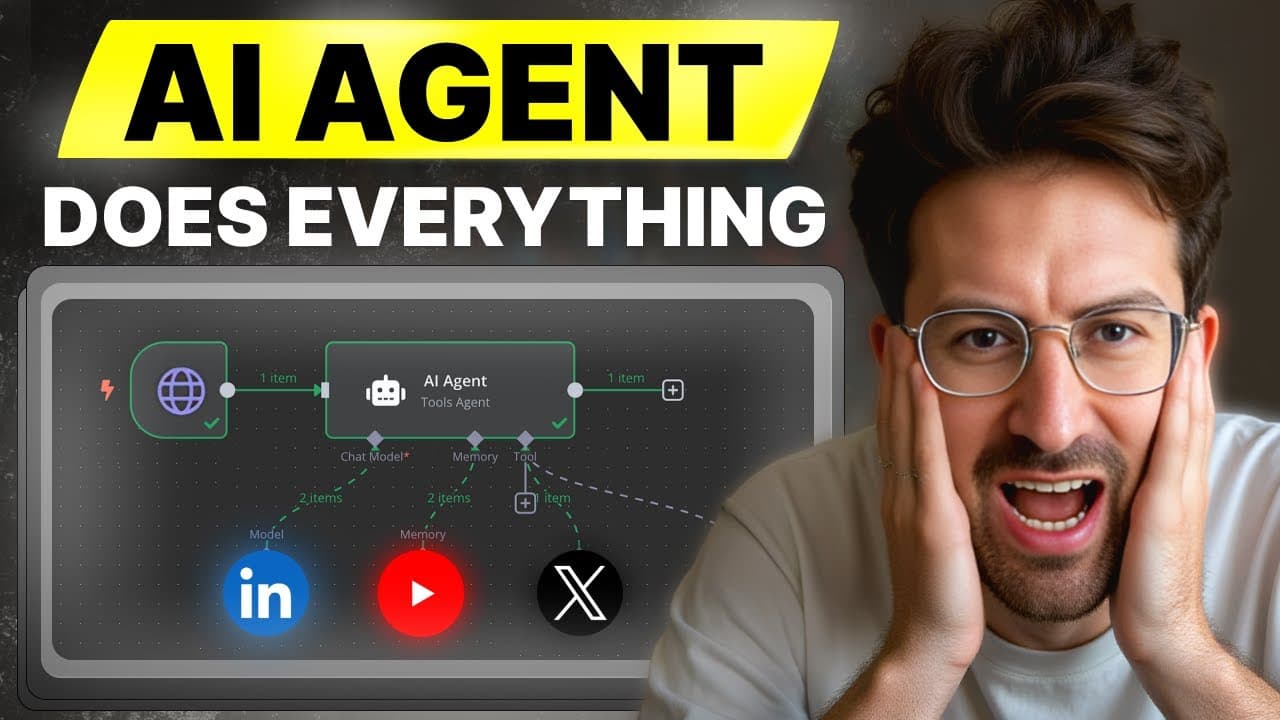
The workflow automates content research, idea generation, and posting using n8n and AI tools, saving 10 to 15 hours weekly. It scrapes top YouTube and X content, transcribes what matters, generates fresh angles, and creates images for posts, with an optional human review step before publishing.
Transcript
What if you can automate your marketing team with AI agents and just have content on autopilot? I know it sounds like it's out of the future, and I was skeptical, too. But I had Mr. Vibe Marketing on the pot again to break down and share his entire NAND workflow with how to create content on autopilot that actually gets likes and comments. So, uh, ... Read More
Key Insights
- N8N orchestrates end-to-end content automation by coordinating data gathering, analysis, idea generation, and publishing steps in a single workflow.
- The system sources content from YouTube and X to build a rich dataset, ensuring ideas are grounded in existing high-performing material while avoiding direct copying.
- AI agents are used to generate fresh content ideas and angles from the collected data, enabling faster ideation and more varied outputs.
- A research step verifies and augments ideas with real-world stats, trends, and use cases to support claims and reduce hallucinations.
- OpenRouter is used to access multiple LLMs, increasing flexibility and allowing experimentation with different models for better results.
- Claude is employed for content creation, illustrating how different AI tools can be stacked within a single automation pipeline.
- An optional human review step is available before publishing, balancing automation with quality control and brand safety.
- The workflow is designed to save time for marketers, potentially freeing up 10 to 15 hours weekly by automating scraping, idea generation, and publishing.
- More videos from this channel:
- More from this channel: Greg Isenberg
Install to Summarize YouTube Videos and Get Transcripts
Explore YouTube Video Summarizer or Get YouTube Transcript Extractor
Questions & Answers
Q: What is the main goal of the n8n AI Content Agent workflow?
The main goal is to automate content creation by scraping top performing content from YouTube and X, processing it with several LLMs to generate original ideas, and automatically posting on LinkedIn with an optional human review. This setup aims to save significant time for marketers while maintaining quality control and relevance to the target audience.
Q: How does the workflow gather data for content ideas?
The workflow scrapes top videos on YouTube and posts on X related to the topic, then transcribes and compiles this data into one large text block. This research phase provides context, hooks, and themes that feed the content idea generator and help create angles that resonate with audiences.
Q: What role does Appify play in the process?
Appify acts as the scraping tool within the workflow, enabling data collection from various online sources like YouTube, X, and possibly other platforms. It provides the API calls used by the n8n nodes to retrieve content data, which is then analyzed and transformed by the AI agents.
Q: What is the function of the content idea generator agent?
The content idea generator agent scans the merged data block from the research phase and proposes fresh, marketing related ideas that go beyond simple replication of existing content. It generates short titles, scroll stopping hooks, recommended formats, and angles that offer a unique point of view for scaling marketing with AI.
Q: How is reliability ensured in generated content?
A separate research agent fetches real world stats, trends and case studies to back up claims and prevent hallucinations. This step provides verifiable data that can be incorporated into the final content, helping to ground suggestions in actual marketing insights.
Q: What platforms and models are involved in the AI stack?
The workflow uses OpenRouter to access multiple LLMs and includes Claude for content creation. The combination allows testing across models and selecting outputs that best fit the user’s style, with the ability to swap models or prompts for different topics and audiences.
Q: Is there a human involvement in publishing content?
Yes, there is an optional human review step before publishing. This allows the editor to refine the final post, ensure accuracy, and tailor the message to the brand voice, while still benefiting from the speed and scale provided by automation.
Q: What practical outcomes can viewers expect from implementing this workflow?
Viewers can expect to save a substantial amount of time on content creation by automating research, idea generation, and posting. The workflow provides a ready-to-use template, prompts, and steps to tailor the system to any niche, potentially enabling faster experimentation with content angles and formats.
Summary & Key Takeaways
-
The video demonstrates an end-to-end AI content automation pipeline built in n8n, which gathers data from YouTube and X, processes it with LLMs, and generates publishable content with images. It emphasizes a research phase to inform idea generation and includes a review step before posting.
-
The workflow employs Appify for scraping, OpenRouter to access multiple LLMs, and Claude for content creation, showcasing how automation can streamline content marketing while preserving human oversight for quality control.
-
The presenter highlights practical tips and prompts as well as a downloadable workflow template to help viewers replicate the system and tailor it to their niche and audience.
Read in Other Languages (beta)
Share This Summary 📚
Summarize YouTube Videos and Get Video Transcripts with 1-Click
Try YouTube Summary with ChatGPT & Claude or YouTube Transcript Generator
Explore More Summaries from Greg Isenberg 📚

Summarize YouTube Videos and Get Video Transcripts with 1-Click
Try YouTube Summary with ChatGPT & Claude or YouTube Transcript Generator