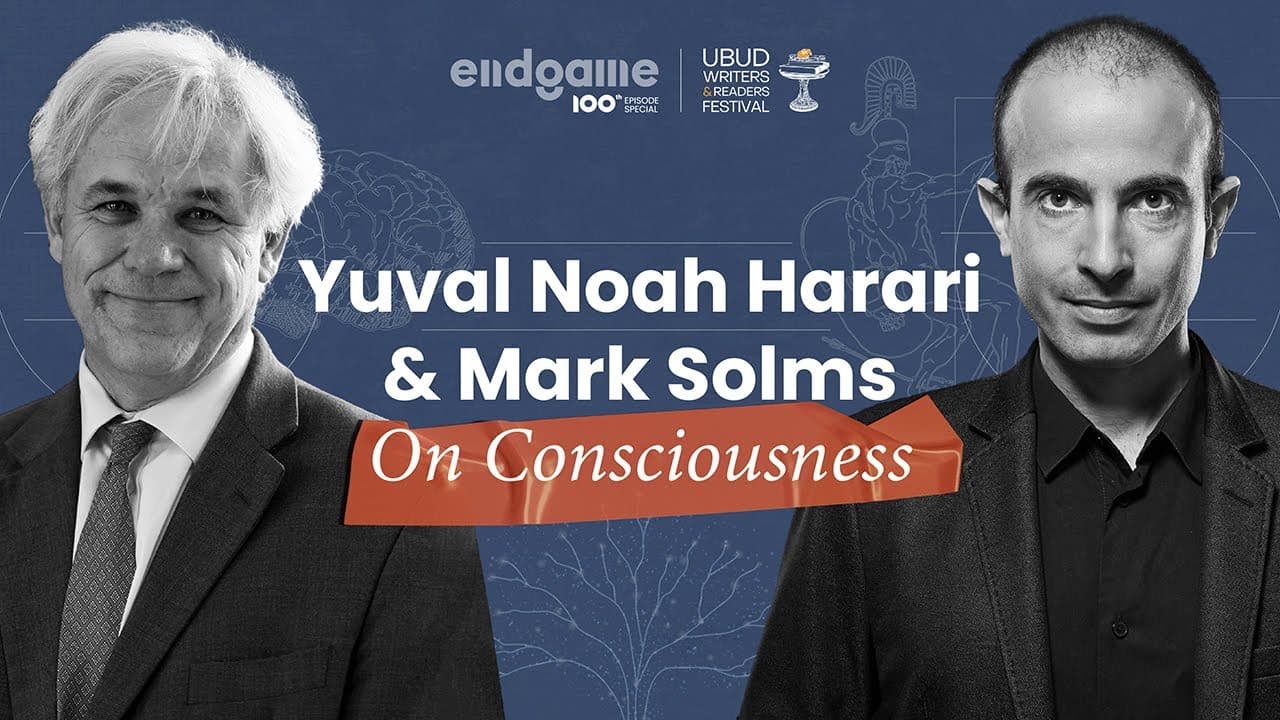
Yuval Noah Harari & Mark Solms: Dawn of Future Consciousness | Endgame #100 | UWRF2022
TL;DR
Discussion on humanity's future, consciousness, and technological risks.
Transcript
Ancient tradition is, again, an example of how we don't need to look only to technology or to science in order to advance the cause of humanity and indeed, of the planet as a whole. I think that for every dollar and every minute that we invest in developing artificial intelligence, we also have to invest at least every dollar and every minute in de... Read More
Key Insights
- Ancient wisdom, like meditation and psychoanalysis, can enhance our understanding of consciousness and compassion, balancing the rapid technological advancements.
- Human beings possess a unique capacity to create intersubjective realities, such as money and nations, which exist in collective imaginations.
- The evolution of consciousness allowed creatures to register internal states, enabling voluntary actions and adaptation to unexpected developments.
- Social media amplifies divisive narratives by exploiting deep-seated emotional triggers, undermining democratic conversations.
- Artificial intelligence and consciousness pose existential risks if misused by corporations and governments for control and power.
- Democracy is an ongoing conversation requiring strong self-correcting mechanisms, beyond mere electoral processes.
- Human morality is centered on reducing suffering, emphasizing compassion over adherence to external laws or ideologies.
- Technological advancements risk diminishing essential human qualities like compassion, if not balanced with self-awareness and ethical considerations.
Install to Summarize YouTube Videos and Get Transcripts
Explore YouTube Video Summarizer or Get YouTube Transcript Extractor
Questions & Answers
Q: What is the difference between the mind and the brain according to Mark Solms?
Mark Solms explains that the mind and the brain are two perspectives of the same entity. The mind is the subjective experience of being alive, while the brain is the physical organ that enables this experience. The brain registers the body's states and the external world, acting as an intermediary.
Q: How does Yuval Noah Harari describe the uniqueness of human minds?
Yuval Noah Harari highlights the human mind's ability to create intersubjective realities, like money and nations, which exist in collective imaginations. This capacity allows humans to cooperate in large numbers, unlike animals, and is the basis of human history and societal structures.
Q: What are the potential risks of artificial intelligence according to Mark Solms?
Mark Solms expresses concern that artificial intelligence, particularly artificial consciousness, could be used detrimentally if not ethically managed. The development of artificial feelings poses risks, including the creation of sentient beings with rights, and the potential for misuse by corporations and governments.
Q: How does social media impact democratic conversations?
Social media disrupts democratic conversations by prioritizing divisive narratives that trigger emotional responses, such as anger and fear, to capture attention. This undermines the ability to hold constructive dialogues, essential for democracy, leading to polarization and conflict.
Q: What role does meditation play in understanding consciousness?
Meditation enhances self-awareness by directing attention inward, allowing individuals to observe their thoughts and emotions without judgment. This practice helps in understanding the subconscious mind, promoting wisdom, and fostering compassion, which is crucial for personal and societal well-being.
Q: How can humanity enhance compassion according to Yuval Noah Harari?
Yuval Noah Harari suggests investing in developing the good qualities of our minds, like compassion, alongside technological advancements. Ancient practices, such as meditation and psychoanalysis, offer effective methods to cultivate compassion and improve moral actions by reducing suffering.
Q: What is the significance of self-correcting mechanisms in democracy?
Democracy relies on self-correcting mechanisms, such as free press, independent courts, and academia, to maintain ongoing conversations and correct mistakes. These mechanisms ensure that democracy is not merely about elections but about continuous dialogue and adaptation to changing circumstances.
Q: How does Yuval Noah Harari view the future risks of technological advancements?
Yuval Noah Harari warns that technological advancements, like AI and bioengineering, pose existential risks by potentially enabling the re-engineering of human bodies and minds. This could lead to a permanent alteration of human evolution, necessitating ethical considerations and balanced development.
Summary & Key Takeaways
-
Yuval Noah Harari and Mark Solms discuss the evolution of consciousness and its impact on humanity, emphasizing the need to balance technological advancements with ancient wisdom practices like meditation and psychoanalysis.
-
The conversation explores the unique human ability to create intersubjective realities, such as money and nations, and highlights the risks posed by artificial intelligence and social media in amplifying divisive narratives.
-
Harari and Solms stress the importance of compassion and self-awareness in shaping a future where technology serves humanity, advocating for democracy as an ongoing conversation with robust self-correcting mechanisms.
Read in Other Languages (beta)
Share This Summary 📚
Summarize YouTube Videos and Get Video Transcripts with 1-Click
Try YouTube Summary with ChatGPT & Claude or YouTube Transcript Generator
Explore More Summaries from Gita Wirjawan 📚




Summarize YouTube Videos and Get Video Transcripts with 1-Click
Try YouTube Summary with ChatGPT & Claude or YouTube Transcript Generator