20.4 Integrate adt and adx
TL;DR
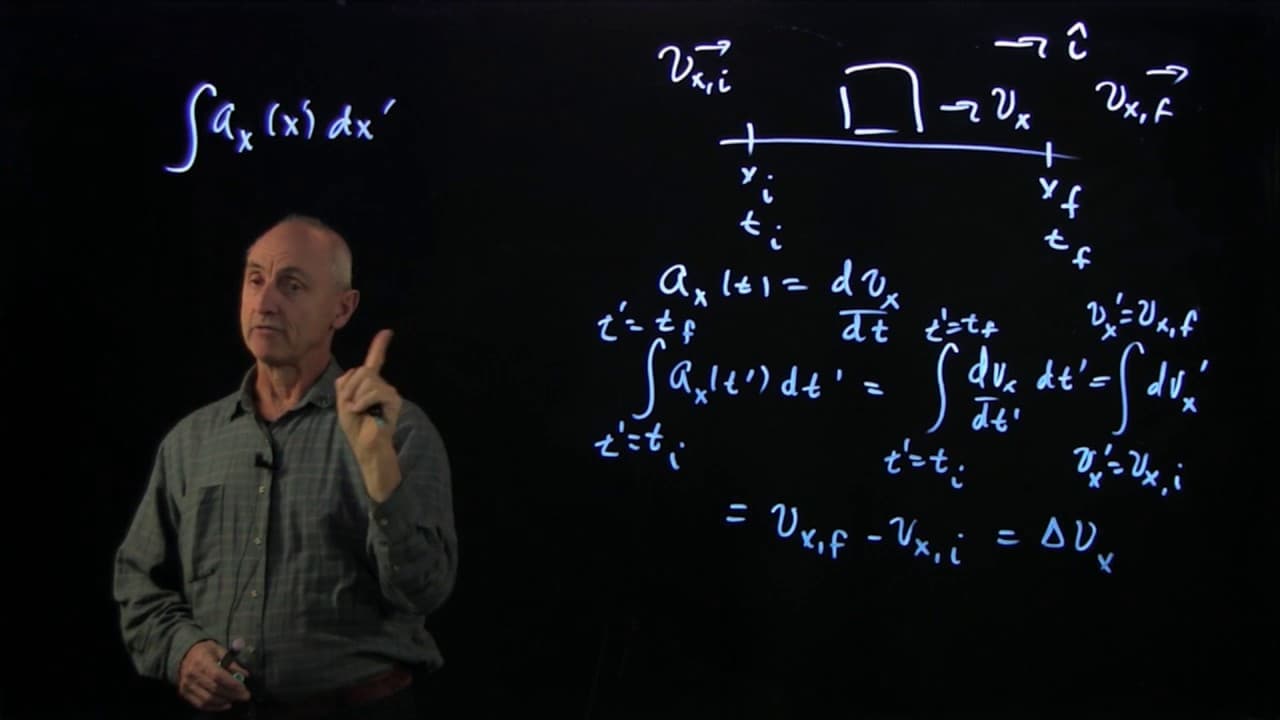
Integrating acceleration with respect to time yields a change in velocity, while integrating acceleration with respect to space results in 1/2 times the change in the x component of velocity squared.
Transcript
I'd like to now show you two mathematical facts about how we integrate quantities of motion. Suppose we have an object, let's call this the i hat direction, and it's moving, and it has an x component of velocity. And suppose it starts at some initial position and goes at some final position. And in the initial position, it was at time ti, and the f... Read More
Key Insights
- 🫡 Integrating acceleration with respect to time gives the change in velocity.
- 💱 Integrating acceleration with respect to space gives 1/2 times the change in the x component of velocity squared.
- 🧑🏭 Understanding these integration facts is essential for analyzing the concept of work in physics.
- 🫡 The change in velocity is obtained by integrating acceleration with respect to time, while the change in kinetic energy is obtained by integrating acceleration with respect to space.
- 🫡 Different integration variables are used for integrating acceleration with respect to time and space.
- 💱 The integration result for acceleration with respect to time is the change in the x component of velocity.
- 💱 The integration result for acceleration with respect to space is 1/2 times the change in the x component of velocity squared.
Install to Summarize YouTube Videos and Get Transcripts
Explore YouTube Video Summarizer or Get YouTube Transcript Extractor
Questions & Answers
Q: What does integrating acceleration with respect to time yield?
Integrating acceleration with respect to time gives the change in velocity. This means that by integrating the derivative of the x component of velocity with respect to time, we can determine how the velocity changes over a given time interval.
Q: What is the result of integrating acceleration with respect to space?
Integrating acceleration with respect to space yields 1/2 times the change in the x component of velocity squared. This means that by integrating the product of the x component of acceleration and the differential of x component of velocity with respect to time, we can determine how the square of the x component of velocity changes over a given displacement interval.
Q: How are the integration variables changed when integrating acceleration with respect to time and space?
When integrating acceleration with respect to time, a change of variables is made to make the integration variable refer to the x component of velocity. On the other hand, when integrating acceleration with respect to space, a change of variables is made to make the integration variable refer to the x component of displacement.
Q: What are the implications of these two integration facts?
These integration facts are crucial for analyzing the concept of work. When integrating acceleration with respect to time, we can determine how the velocity, and thus the motion of an object, changes over time. When integrating acceleration with respect to space, we can determine the change in kinetic energy, which is related to the work done by forces and follows from Newton's second law.
Summary & Key Takeaways
-
Integrating acceleration with respect to time gives the change in velocity.
-
Integrating acceleration with respect to space gives 1/2 times the change in the x component of velocity squared.
-
These facts are essential for analyzing the concept of work and applying Newton's second law.
Read in Other Languages (beta)
Share This Summary 📚
Summarize YouTube Videos and Get Video Transcripts with 1-Click
Try YouTube Summary with ChatGPT & Claude or YouTube Transcript Generator
Explore More Summaries from MIT OpenCourseWare 📚
Summarize YouTube Videos and Get Video Transcripts with 1-Click
Try YouTube Summary with ChatGPT & Claude or YouTube Transcript Generator