L14.8 Inferring the Unknown Bias of a Coin and the Beta Distribution
TL;DR
Bayesian analysis of coin flips and the unknown bias of a coin using Beta distributions.
Transcript
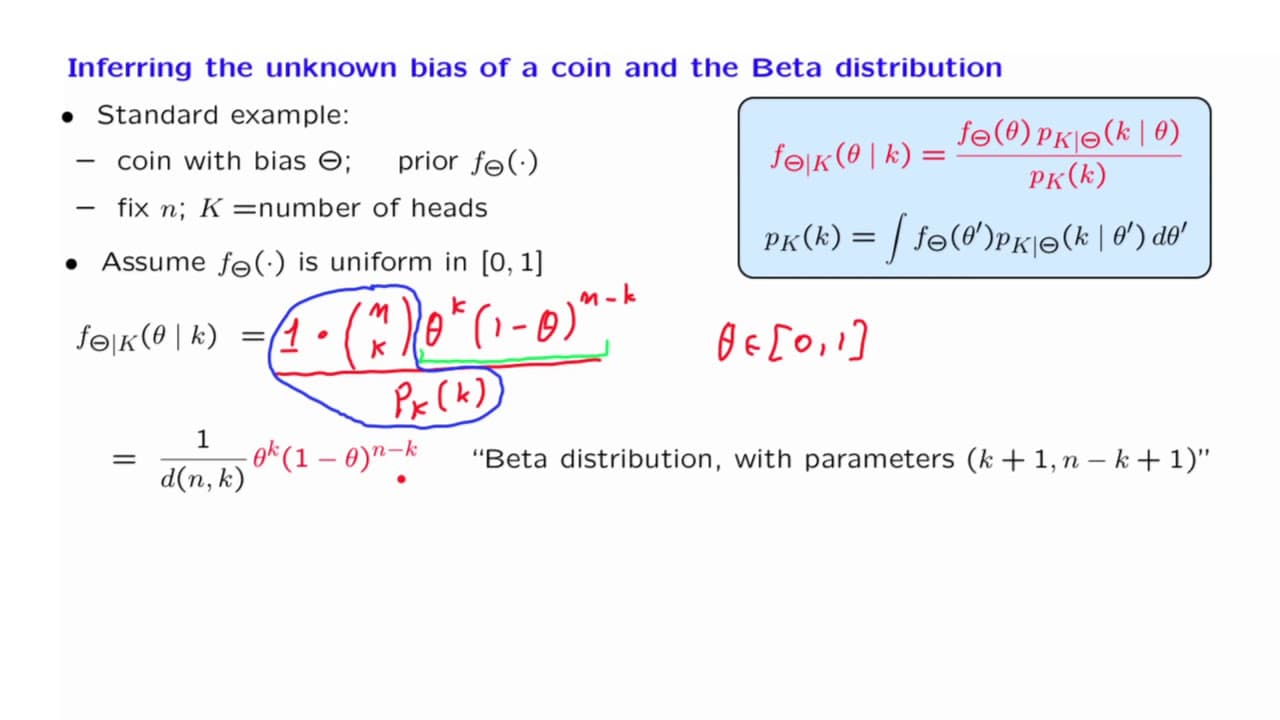
We will now go through an example that involves a continuous unknown parameter, the unknown bias of a coin and discrete observations, namely, the number of heads that are observed in a sequence of coin flips. This is an example that we will start in some detail now, and we will also revisit later on. And in the process, we will also have the opport... Read More
Key Insights
- 🐬 Bayesian analysis can be applied to coin flips with an unknown bias.
- ❓ The prior probability distribution reflects the prior knowledge or beliefs about the unknown bias.
- 💁 The posterior distribution, calculated using the Bayes rule, provides updated information about the unknown bias.
- 💁 The posterior distribution in this coin flip example is a Beta distribution, which has a specific form defined by its parameters.
- ❓ Beta distributions have the property that if the prior distribution is a Beta distribution, the posterior will also be a Beta distribution.
- 🤕 The parameters of the posterior Beta distribution depend on the prior parameters and the number of observed heads in the coin flips.
- 👻 Bayesian inference allows for updating beliefs and making inferences as more data is collected.
Install to Summarize YouTube Videos and Get Transcripts
Explore YouTube Video Summarizer or Get YouTube Transcript Extractor
Questions & Answers
Q: What is the unknown parameter in the coin flip example?
The unknown parameter is the bias of the coin, which represents the probability of getting a head in each flip.
Q: How is the unknown bias treated in Bayesian inference?
The unknown bias is treated as a random variable and assigned a prior probability distribution.
Q: What information is needed to calculate the posterior distribution in Bayesian inference?
The prior distribution, the probability of observing a certain number of heads given the bias, and the normalizing constant.
Q: What is the significance of the Beta distribution in this example?
The posterior distribution of the unknown bias is a Beta distribution, which allows for recursive updating as more observations are obtained.
Summary & Key Takeaways
-
The example involves a coin with an unknown bias treated as a random variable with a prior probability distribution.
-
The number of heads observed in a sequence of coin flips is recorded to make inferences about the unknown bias.
-
The Bayes rule is used to calculate the posterior distribution of the unknown bias, which is a Beta distribution.
Read in Other Languages (beta)
Share This Summary 📚
Summarize YouTube Videos and Get Video Transcripts with 1-Click
Try YouTube Summary with ChatGPT & Claude or YouTube Transcript Generator
Explore More Summaries from MIT OpenCourseWare 📚


Summarize YouTube Videos and Get Video Transcripts with 1-Click
Try YouTube Summary with ChatGPT & Claude or YouTube Transcript Generator