Lecture 18: Gluing Algorithms
TL;DR
Explores algorithms for folding polygons into convex polyhedra.
Transcript
PROFESSOR: All right, let's get started. We are continuing our theme of folding polygons into convex polyhedra. Let's do a quick reminder, we're talking about gluing up the boundary of a polygon to itself. And we were representing that with gluing trees last time. So I want to do an actual example of a gluing tree. So this is how you make a cube ou... Read More
Key Insights
- The lecture focuses on folding polygons into convex polyhedra using gluing trees, which are helpful in visualizing and analyzing the folding process.
- Alexandroff gluings ensure no crossing and maintain a topological sphere, with 270-degree curvature at cube vertices.
- Combinatorial bounds and algorithms are discussed, including decision, enumeration, and counting for polygon foldings.
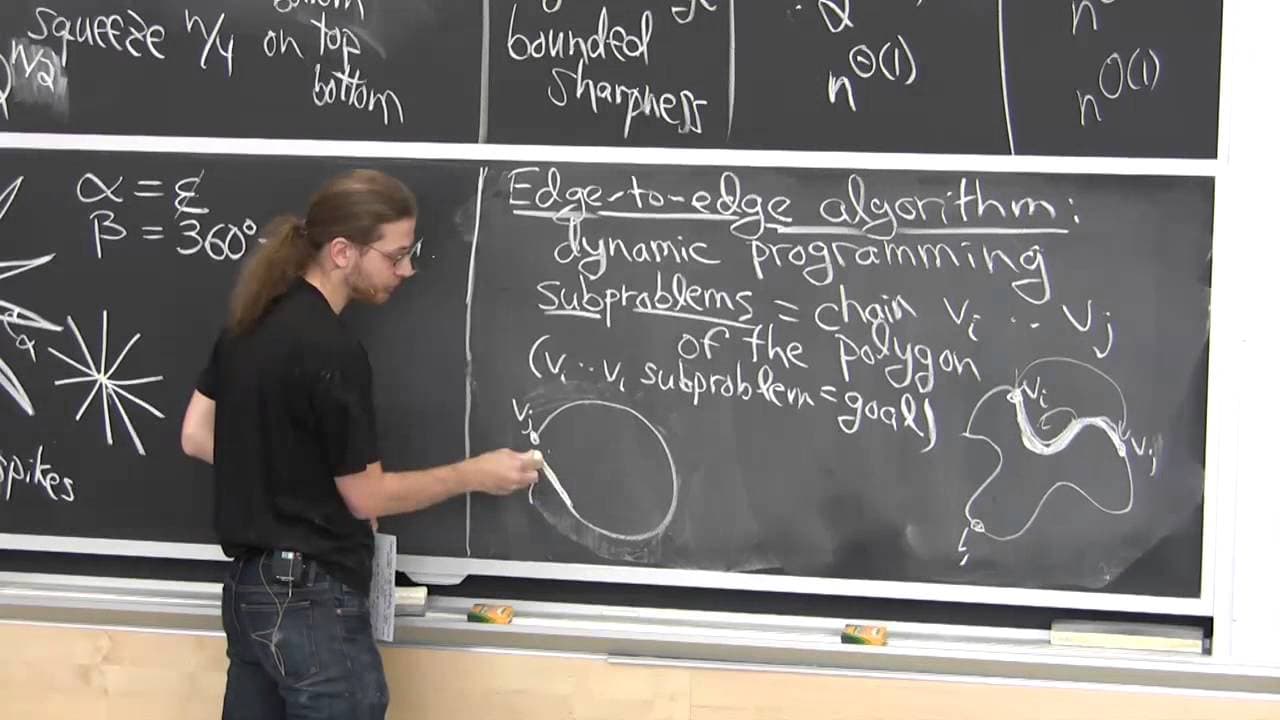
- Edge-to-edge gluings are explored with polynomial algorithms for bounded sharpness polygons, while general gluings can be exponential.
- Dynamic programming is employed in algorithms to solve sub-problems by minimizing angles at vertices, leading to polynomial time solutions for decision problems.
- The lecture introduces the concept of bounded sharpness, limiting reflex angles to ensure polynomial bounds on gluing types.
- Examples of various gluings are provided, demonstrating the practical application of the discussed algorithms.
- Rolling belts are addressed, showing their role in creating infinite gluing possibilities, while bounded sharpness helps in avoiding them.
Install to Summarize YouTube Videos and Get Transcripts
Explore YouTube Video Summarizer or Get YouTube Transcript Extractor
Questions & Answers
Q: What is the significance of gluing trees in the lecture?
Gluing trees are significant in the lecture as they provide a visual and analytical method to understand how polygons can be folded into convex polyhedra. They help in representing the gluing process, ensuring no crossing occurs and maintaining a topological sphere, which is crucial for Alexandroff gluings. By visualizing the folding process, gluing trees assist in proving combinatorial bounds and developing algorithms for decision, enumeration, and counting of polygon foldings.
Q: How does the lecture address edge-to-edge gluings?
The lecture addresses edge-to-edge gluings by discussing algorithms that utilize dynamic programming to solve sub-problems. In edge-to-edge gluings, whole edges of polygons are glued to other whole edges, and the lecture presents a polynomial time decision algorithm for such cases. By minimizing angles at vertices, the algorithm efficiently determines if an edge-to-edge gluing is possible, providing a practical solution for polygons with bounded sharpness.
Q: What role does bounded sharpness play in the lecture?
Bounded sharpness plays a crucial role in the lecture by limiting the reflex angles of polygons, ensuring that they do not exceed a constant value less than 360 degrees. This constraint helps in avoiding infinite gluing possibilities, such as rolling belts, and ensures that the number of combinatorially distinct gluings remains polynomial. Bounded sharpness allows for the development of efficient algorithms for enumerating and deciding polygon foldings, making it a practical consideration in gluing problems.
Q: How are dynamic programming techniques used in the algorithms?
Dynamic programming techniques are used in the algorithms to solve sub-problems by breaking down the main problem into smaller, manageable parts. For each sub-problem, the algorithm stores solutions that minimize the angles glued at vertices, ensuring the most efficient path to a solution. By solving sub-problems in order of increasing chain length, dynamic programming allows for the efficient determination of possible gluings, particularly in edge-to-edge cases, resulting in polynomial time decision algorithms.
Q: What are rolling belts, and how do they affect gluing possibilities?
Rolling belts are configurations that allow for infinite gluing possibilities by enabling a continuous variation of the gluing pattern along a polygon. They occur when there is flexibility in how edges can be glued, leading to an infinite number of potential gluings. In the lecture, rolling belts are discussed as a challenge in creating finite gluing possibilities, but they can be avoided by ensuring bounded sharpness, which limits reflex angles and constrains the number of possible gluings to a polynomial count.
Q: What examples of gluings are provided in the lecture?
The lecture provides examples of gluings, including the folding of a Latin Cross into various polyhedra, such as cubes, tetrahedra, and octahedra. These examples demonstrate the application of the discussed algorithms in practical scenarios, showing how different convex polyhedra can be formed from a single polygon. The examples highlight the diversity of possible gluings and the effectiveness of the algorithms in enumerating and deciding these configurations, even when considering non-edge-to-edge gluings.
Q: How does the lecture address the challenge of infinite gluing possibilities?
The lecture addresses the challenge of infinite gluing possibilities by introducing the concept of bounded sharpness, which limits reflex angles and prevents configurations like rolling belts. By constraining the angles in a polygon, the number of combinatorially distinct gluings becomes polynomial, allowing for efficient enumeration and decision algorithms. Additionally, the lecture discusses how dynamic programming can be used to handle sub-problems efficiently, even in cases with potentially infinite configurations.
Q: What is the outcome of the lecture's exploration of gluing algorithms?
The outcome of the lecture's exploration of gluing algorithms is a comprehensive understanding of how polygons can be folded into convex polyhedra through various gluing configurations. The lecture presents algorithms for edge-to-edge gluings, general gluings, and bounded sharpness cases, providing both theoretical insights and practical applications. By addressing challenges like rolling belts and infinite possibilities, the lecture offers solutions for efficiently enumerating and deciding possible gluings, contributing to advancements in geometric folding problems.
Summary & Key Takeaways
-
The lecture delves into the challenge of folding polygons into convex polyhedra, using gluing trees to visualize and analyze the folding process. Alexandroff gluings are introduced, ensuring no crossing and maintaining a topological sphere with specific curvature at vertices.
-
Combinatorial bounds and algorithms are discussed, focusing on decision, enumeration, and counting for polygon foldings. Edge-to-edge gluings are explored with polynomial algorithms for bounded sharpness polygons, while general gluings can be exponential.
-
Dynamic programming is employed in algorithms to solve sub-problems by minimizing angles at vertices, leading to polynomial time solutions for decision problems. Bounded sharpness limits reflex angles, ensuring polynomial bounds on gluing types, while rolling belts show infinite possibilities.
Read in Other Languages (beta)
Share This Summary 📚
Summarize YouTube Videos and Get Video Transcripts with 1-Click
Try YouTube Summary with ChatGPT & Claude or YouTube Transcript Generator
Explore More Summaries from MIT OpenCourseWare 📚



Summarize YouTube Videos and Get Video Transcripts with 1-Click
Try YouTube Summary with ChatGPT & Claude or YouTube Transcript Generator