Building Black Holes in a Lab
TL;DR
Analog black holes help us study real black holes safely.
Transcript
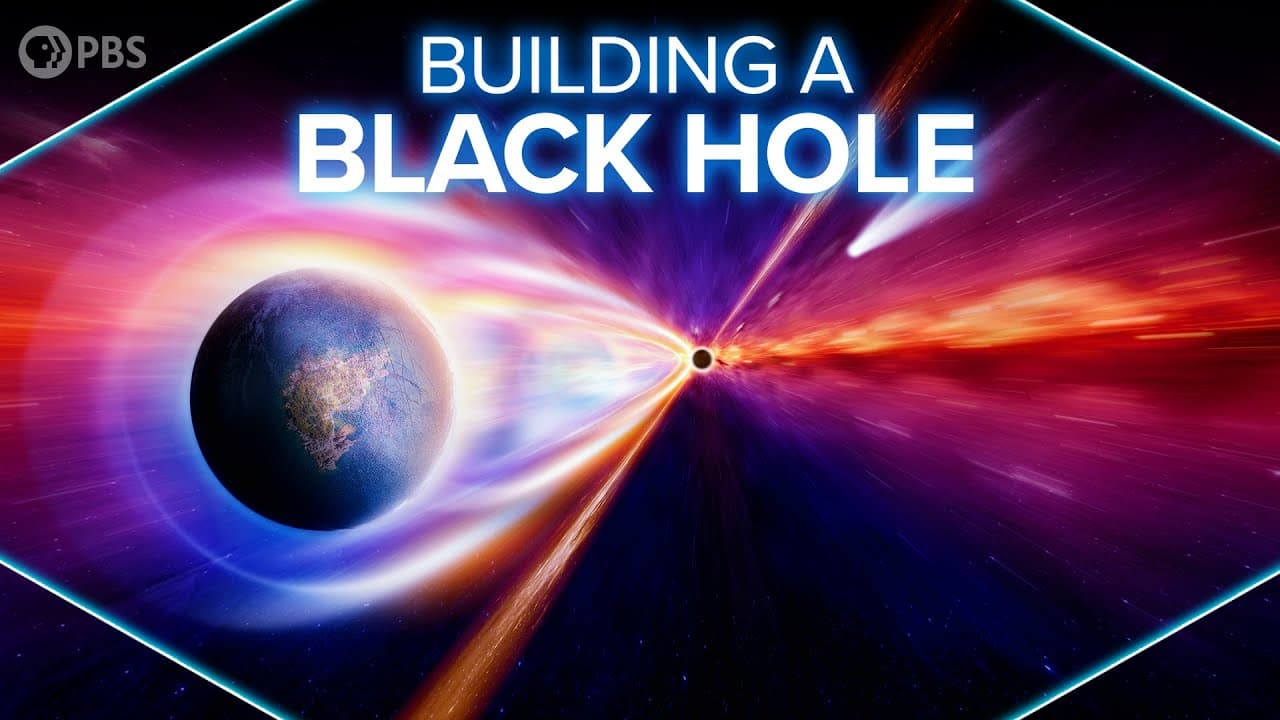
Black holes are very real, but our understanding of them remains highly theoretical. If only we could build one in the lab. Oh wait, we can. Black holes are about the worst subjects for direct study in the universe. First there’s the whole thing about never being able to see inside one beneath the inescapable event horizon. Then there’s the fact th... Read More
Key Insights
- Black holes are difficult to study directly due to their distance and small size, but analog black holes provide a safe and practical alternative for research.
- Analog black holes replicate black hole behaviors using physical systems that mimic the mathematical properties of real black holes.
- Bill Unruh's 1972 thought experiment laid the foundation for using fluid dynamics as an analogy for black holes, leading to the study of analog black holes.
- Analog black holes can demonstrate Hawking radiation, a phenomenon where black holes emit radiation, by observing similar effects in fluid systems.
- Experiments with water tanks and Bose-Einstein condensates have successfully simulated black hole behaviors, providing insights into quantum effects like Hawking radiation.
- The Penrose process and superradiance, phenomena associated with rotating black holes, can be studied using analog systems like water vortices.
- Quantum optical analogs use materials to slow light, creating apparent horizons and offering another method to study black hole dynamics in a controlled environment.
- The debate continues on how much analog black holes can truly reveal about real black holes, with some scientists viewing them as complementary evidence and others remaining skeptical.
Install to Summarize YouTube Videos and Get Transcripts
Explore YouTube Video Summarizer or Get YouTube Transcript Extractor
Questions & Answers
Q: How do analog black holes help in studying real black holes?
Analog black holes provide a safe and practical way to study the behaviors of real black holes by replicating their properties using physical systems. These analogs allow scientists to observe phenomena like Hawking radiation and the Penrose process in a controlled environment, offering insights that are difficult to obtain from actual black holes due to their distance and small size.
Q: What is the significance of Bill Unruh's thought experiment in black hole research?
Bill Unruh's thought experiment in 1972 established the concept of using fluid dynamics as an analogy for black holes. This foundational idea led to the study of analog black holes, where physical systems are used to mimic the mathematical properties of real black holes. Unruh's work has been instrumental in developing methods to study black hole behaviors in a laboratory setting.
Q: What are some methods used to create analog black holes?
Analog black holes are created using various methods, such as water tanks and Bose-Einstein condensates. In water tanks, currents and vortices are used to simulate black hole behaviors, while Bose-Einstein condensates involve cooling gases to near absolute zero to observe quantum effects. These methods allow researchers to study phenomena like Hawking radiation and the Penrose process in a controlled environment.
Q: How does Hawking radiation relate to analog black holes?
Hawking radiation, a phenomenon where black holes emit radiation, can be studied using analog black holes. In these systems, researchers observe similar effects, such as perturbations in fluid dynamics or quantum states, which mimic Hawking radiation. This provides valuable insights into the quantum mechanical effects associated with real black holes, which are otherwise difficult to study directly.
Q: What is the Penrose process, and how is it studied in analog systems?
The Penrose process is a phenomenon associated with rotating black holes, where rotational energy is transferred to particles or waves passing close by. Analog systems, such as water vortices, can replicate this process by creating ergo-regions where surface ripples are dragged in circles. These systems allow scientists to study superradiance and other effects related to rotating black holes in a laboratory setting.
Q: What role do Bose-Einstein condensates play in analog black hole research?
Bose-Einstein condensates (BECs) are used in analog black hole research to simulate quantum effects associated with black holes. By cooling gases to near absolute zero, researchers can observe quantum phenomena on a macroscopic scale. Experiments with BECs have successfully demonstrated Hawking-like radiation, providing strong experimental evidence for the quantum mechanical effects predicted in real black holes.
Q: How do quantum optical analogs contribute to black hole research?
Quantum optical analogs use materials to slow light, creating apparent horizons that mimic the behavior of black holes. These systems offer another method to study black hole dynamics in a controlled environment. While they provide valuable insights, quantum optical analogs are still approximations and may not fully capture the extreme dynamics of actual black holes, but they remain an important tool in black hole research.
Q: What are the differing views on the effectiveness of analog black holes in understanding real black holes?
There is a debate among scientists about the effectiveness of analog black holes in understanding real black holes. Some view analogs as valuable tools that offer complementary evidence for phenomena like Hawking radiation, while others remain skeptical, arguing that analog systems cannot fully capture the unique dynamics of actual black holes. Despite differing opinions, analog black holes continue to be a crucial aspect of black hole research.
Summary & Key Takeaways
-
Analog black holes are physical systems that mimic the properties of real black holes, allowing scientists to study their behaviors in a controlled environment. These analogs have provided insights into phenomena like Hawking radiation and the Penrose process, contributing to our understanding of black holes.
-
Bill Unruh's thought experiment in 1972 established the concept of using fluid dynamics as an analogy for black holes. By studying water vortices and Bose-Einstein condensates, researchers have simulated black hole behaviors and observed effects analogous to Hawking radiation.
-
While some scientists argue that analog black holes offer valuable insights into real black holes, others remain skeptical about their ability to fully capture the extreme dynamics of actual black holes. Despite this, analog black holes remain a crucial tool in black hole research.
Read in Other Languages (beta)
Share This Summary 📚
Summarize YouTube Videos and Get Video Transcripts with 1-Click
Try YouTube Summary with ChatGPT & Claude or YouTube Transcript Generator
Explore More Summaries from PBS Space Time 📚



Summarize YouTube Videos and Get Video Transcripts with 1-Click
Try YouTube Summary with ChatGPT & Claude or YouTube Transcript Generator