Why Are Humans Mismatched With Modern Life?
TL;DR
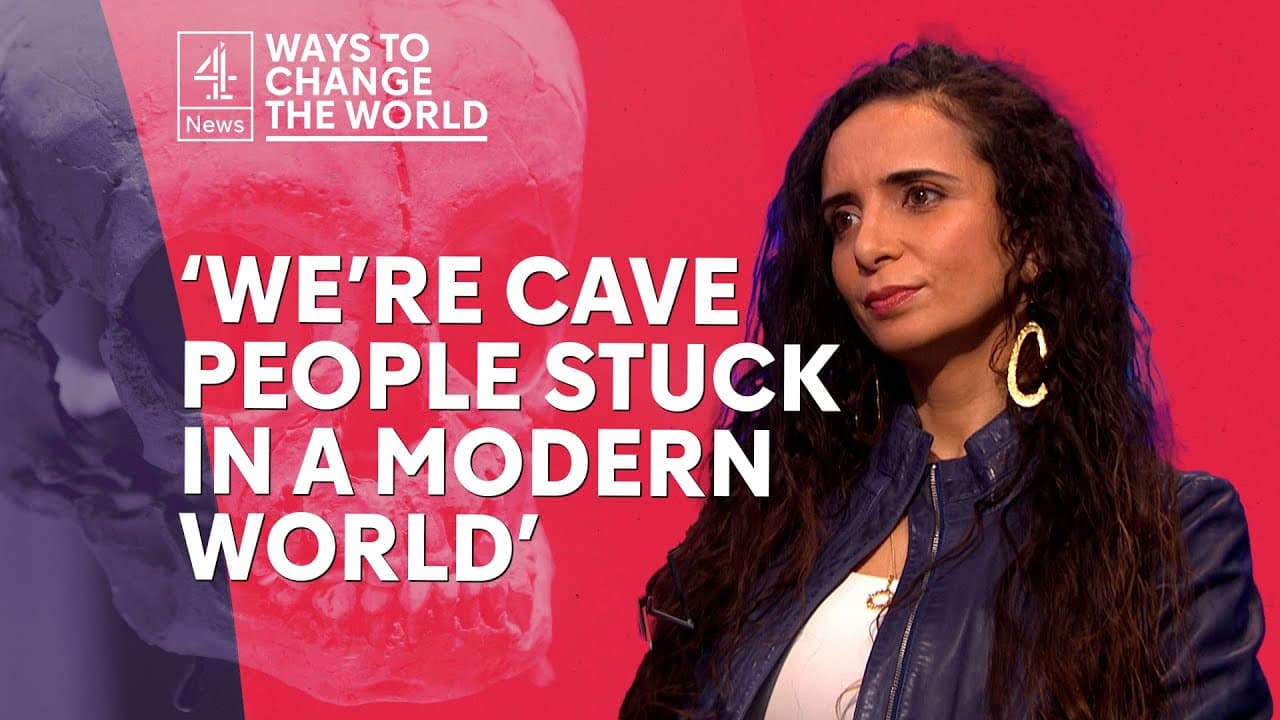
Humans evolved for small, cooperative communities, not farming, cities, or the rapid technological changes of recent centuries. Ella Al-Shamahi argues that this mismatch helps explain many modern problems, while humanity’s unusual capacity for friendliness, cooperation, and resilience offers grounds for hope, even if biological evolution cannot adapt quickly enough to solve them.
Transcript
studying human evolution, you cannot help but be impressed with our species. I mean, we're a nightmare of species at the same time, don't get me wrong, but time and time again, we are resilient against all odds. And every single person listening to this is literally the result of thousands of people who against all odds survived. I have a lot of ho... Read More
Key Insights
- Paleoanthropology is the study of humanity in deep time, including early civilizations and early humans. Because physical remains are scarce, researchers construct broader accounts from limited evidence and must communicate many conclusions with cautious terms such as “maybe” and “perhaps.”
- Ancient DNA is a major source of evidence about human origins because it can resolve questions that fossils alone leave uncertain. DNA evidence established that Neanderthals and Homo sapiens interbred, changing how researchers understand relationships among the human groups that once coexisted.
- Species categories are useful human frameworks rather than divisions that nature consistently follows. The biological species concept is only one of more than 20 species concepts, and interbreeding among ancient human groups makes their taxonomy more complicated than simple labels suggest.
- A world containing only one human species is unusual in the longer history of humanity. For hundreds of thousands of years, Homo sapiens shared Earth with several other human species, while the last 20,000 years represent a departure from that earlier pattern.
- Homo floresiensis was a human species about one meter tall with a brain comparable in size to a chimpanzee’s. It stood upright, made fire and stone tools, and lived on an Indonesian island alongside giant marabou storks, stegodons, and giant rats.
- Brain size alone does not explain why Homo sapiens survived while other human species disappeared. Neanderthals had brains of a similar size, and Al-Shamahi argues that friendliness, sociality, and exceptional cooperation offered Homo sapiens a more consequential evolutionary advantage.
- Human intelligence and language may be consequences of selection for cooperation rather than isolated evolutionary goals. On this account, increasingly capable brains and communication helped humans maintain the social relationships that made large-scale collaboration and collective survival possible.
- Modern life is poorly matched to the conditions in which humans evolved. Al-Shamahi contrasts small communities of roughly 150 familiar people with farming, cities, and recent technological upheaval, arguing that civilization brings extraordinary benefits while also contributing to serious problems.
Install to Summarize YouTube Videos and Get Transcripts
Explore YouTube Video Summarizer or Get YouTube Transcript Extractor
Questions & Answers
Q: What does a paleoanthropologist study?
A paleoanthropologist studies humanity across deep time, especially early humans and ancient societies rather than comparatively recent periods such as the Roman era. The discipline works with limited physical remains and uses them to reconstruct broader accounts of human origins, behavior, and relationships. Because the evidence is incomplete, responsible interpretations often contain qualifications such as “maybe” or “perhaps,” although DNA now provides stronger support for some conclusions.
Q: How has ancient DNA changed the study of human evolution?
Ancient DNA has allowed researchers to answer questions that remained difficult to settle using bones and artifacts alone. The clearest example discussed is whether Homo sapiens and Neanderthals interbred. Once ancient DNA became available, their interbreeding could be established directly. The evidence has also helped researchers describe a past in which several different human species existed at the same time and interacted with one another.
Q: Why are ancient human species difficult to classify?
Ancient human species are difficult to classify because nature does not necessarily conform to the frameworks people create. The familiar biological species concept focuses on whether individuals can produce fertile offspring, but the discussion notes that more than 20 species concepts exist. Evidence that different ancient human groups interbred further complicates their boundaries, even though taxonomy remains a useful way to identify and compare clearly different human populations.
Q: Did multiple human species live at the same time?
Several human species once lived on Earth at the same time, and that coexistence was normal for hundreds of thousands of years. The current situation, in which only one human species remains, is described as historically unusual and characteristic of roughly the last 20,000 years. Groups mentioned include Homo sapiens, Neanderthals, Homo erectus, and Homo floresiensis, the small human commonly nicknamed the hobbit.
Q: What was Homo floresiensis like?
Homo floresiensis was a small human species that stood about one meter tall and had a brain roughly the size of a chimpanzee’s. Despite those features, it walked upright, made fire, and produced stone tools, so Al-Shamahi describes it as fully human. It lived on an Indonesian island with unusually large marabou storks, small elephant-like stegodons, and giant rats, creating an environment that sounds fantastical but was real.
Q: Why did Homo sapiens survive other human species?
No single explanation is universally accepted among paleoanthropologists, but Al-Shamahi favors exceptional friendliness and cooperation as crucial advantages. Brain size by itself is insufficient because Neanderthals had brains similar in size to those of Homo sapiens. Her account proposes that highly cooperative social behavior supported survival, while improved language and intelligence developed partly because they helped people communicate, maintain relationships, and collaborate more effectively.
Q: Why are humans poorly adapted to modern life?
Humans evolved in small communities where people knew one another and many members were relatives, not in farming societies, cities, or environments transformed by recent technology. Al-Shamahi argues that this mismatch contributes to problems in modern behavior and social organization. Civilization still provides major benefits, including art, creativity, medicine, and support for many more people, but those gains do not remove the tension between inherited human traits and current conditions.
Q: Will biological evolution adapt humans to modern life?
Al-Shamahi does not expect biological evolution to provide the answer to humanity’s modern mismatch. She argues that natural selection has become extremely weak, particularly in the West, because medicine and science now address conditions that would previously have affected survival or reproduction. Infertility is her strongest example: it can now be treated scientifically, so it is no longer selected against in the same direct way.
Summary & Key Takeaways
-
Paleoanthropology reconstructs humanity’s deep past from limited remains, so its conclusions often include uncertainty. Ancient DNA has strengthened the field by resolving questions that fossils alone could not settle, including whether Homo sapiens and Neanderthals interbred, while also revealing a past world populated by several distinct human species.
-
Homo sapiens may have survived because of exceptional friendliness and cooperation rather than brain size alone. Al-Shamahi presents intelligence and language as possible consequences of selection for highly social behavior. Humanity’s ability to work together could therefore be the cornerstone of its evolutionary success and continuing resilience.
-
Modern civilization delivers art, creativity, technology, medicine, and support for far larger populations, but it also places humans in conditions unlike those in which they evolved. Al-Shamahi argues that biological evolution now operates very weakly, particularly in the West, leaving cultural and scientific responses to address this mismatch.
Read in Other Languages (beta)
Share This Summary 📚
Summarize YouTube Videos and Get Video Transcripts with 1-Click
Try YouTube Summary with ChatGPT & Claude or YouTube Transcript Generator
Explore More Summaries from Channel 4 News 📚






Summarize YouTube Videos and Get Video Transcripts with 1-Click
Try YouTube Summary with ChatGPT & Claude or YouTube Transcript Generator