How Are Quasiparticles Different From Particles?
TL;DR
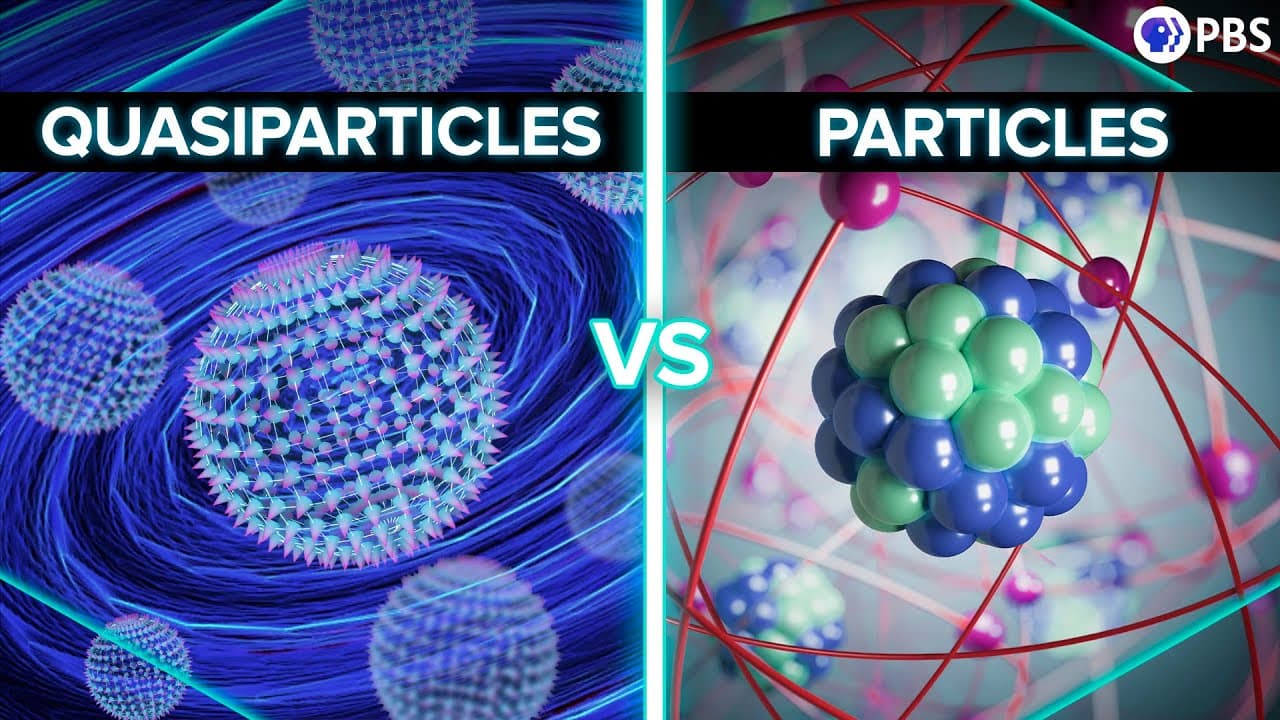
Quasiparticles are emergent phenomena crucial for modern technology.
Transcript
Thank you to Magellan TV for supporting PBS. The device you’re watching this video on is best understood by thinking about positive and negative charges moving around a circuit of diodes and transistors. But the only elementary particle actually flowing in the circuit are the negatively charged electrons. And yet those flowing positive charges are ... Read More
Key Insights
- Quasiparticles are emergent phenomena that facilitate the understanding and functioning of modern technology, like transistors and diodes.
- Electron holes are quasiparticles with an effective positive charge, crucial for the operation of semiconductor devices.
- Phonons, as quanta of vibrational energy, play a key role in heat and sound transmission in solid materials.
- Superconductivity is enabled by Cooper pairs, which are quasiparticles formed by electron pairing mediated by phonons.
- Quasiparticles can form complex hierarchies, similar to how composite particles are formed from elementary particles.
- The understanding of quasiparticles is fundamental for the development of technologies like superconductors and transistors.
- Quasiparticles like magnons and skyrmions are important for the emerging field of spintronics.
- Quasiparticles, while not 'real' like elementary particles, are indispensable for modeling physical processes in various materials.
Install to Summarize YouTube Videos and Get Transcripts
Explore YouTube Video Summarizer or Get YouTube Transcript Extractor
Questions & Answers
Q: What are quasiparticles and why are they important?
Quasiparticles are emergent phenomena that arise from the collective behavior of particles in a system. They are important because they provide a simplified way to model and understand complex physical processes in materials, such as the behavior of semiconductors and the transmission of heat and sound. Quasiparticles are crucial for the development and functioning of modern technologies like transistors, diodes, and superconductors.
Q: How do electron holes function as quasiparticles in semiconductors?
Electron holes function as quasiparticles in semiconductors by representing the absence of an electron in a filled valence band. They have an effective positive charge and can move through the lattice, allowing for the flow of current. This movement of electron holes is essential for the operation of semiconductor devices like diodes and transistors, as it facilitates the control and direction of electrical currents.
Q: What role do phonons play in solid materials?
Phonons are quasiparticles that represent quantized vibrational energy in a crystal lattice. They play a crucial role in the transmission of heat and sound in solid materials. As quanta of vibrational modes, phonons facilitate the transfer of thermal energy and influence the thermal conductivity of materials. Understanding phonons is essential for modeling the behavior of heat and sound at the quantum level, and they are important for managing heat in electronic devices.
Q: How do Cooper pairs enable superconductivity?
Cooper pairs enable superconductivity by forming pairs of electrons that are bound together by phonons. At very low temperatures, these pairs can move through a lattice without resistance, as they occupy the same quantum state and do not have enough energy to excite phonons. This results in zero electrical resistance, allowing for the potential development of technologies like magnetic levitation and superfast trains. Cooper pairs are an example of how quasiparticles can drastically alter the properties of a material.
Q: What is the significance of quasiparticles in the field of spintronics?
In the field of spintronics, quasiparticles like magnons and skyrmions play a significant role. Spintronics focuses on the spin of electrons rather than their charge, and these quasiparticles represent quantized spin waves and stable topological configurations, respectively. They are crucial for developing new technologies that rely on electron spin manipulation, offering potential advancements in data storage, processing, and energy efficiency. The study of quasiparticles in spintronics could lead to revolutionary changes in electronic devices.
Q: How do quasiparticles form complex hierarchies similar to composite particles?
Quasiparticles can form complex hierarchies similar to composite particles through the interactions and collective behaviors of simpler quasiparticles. For instance, Cooper pairs are formed by the pairing of electrons mediated by phonons, and rotons in superfluids are enabled by Cooper pairs. This hierarchical structure allows for the emergence of new properties and phenomena, providing insights into the behavior of materials at the quantum level and enabling the development of advanced technologies.
Q: Why are quasiparticles considered indispensable for modeling physical processes?
Quasiparticles are considered indispensable for modeling physical processes because they simplify the complex interactions within a material by representing collective excitations as individual entities. This allows scientists and engineers to predict and understand the behavior of materials, such as semiconductors and superconductors, more effectively. By treating emergent phenomena as quasiparticles, it becomes easier to develop models that accurately describe the properties and behaviors of complex systems, facilitating technological advancements.
Q: What potential future technologies could be enabled by the discovery of new quasiparticles?
The discovery of new quasiparticles could enable future technologies that are as transformative as superconductors and transistors. For example, advances in quantum computing, energy-efficient electronics, and novel materials with unique properties could be realized. Quasiparticles could lead to breakthroughs in communication technologies, data storage, and energy transmission. As researchers continue to explore and understand quasiparticles, the potential for innovative applications and technologies that harness their unique properties is vast and promising.
Summary & Key Takeaways
-
Quasiparticles are emergent phenomena that arise from the collective behavior of particles in a system, such as electron holes in semiconductors and phonons in crystal lattices. They enable the functioning of electronic devices and are essential for understanding phenomena like superconductivity.
-
Electron holes and phonons are examples of quasiparticles that play crucial roles in the behavior of semiconductors and the transmission of heat and sound in solids. These quasiparticles facilitate the modeling of complex physical processes at the quantum level.
-
Cooper pairs, which are quasiparticles formed by the pairing of electrons mediated by phonons, enable superconductivity. This phenomenon allows for zero electrical resistance at very low temperatures, leading to potential applications in technologies like magnetic levitation and superfast trains.
Read in Other Languages (beta)
Share This Summary 📚
Summarize YouTube Videos and Get Video Transcripts with 1-Click
Try YouTube Summary with ChatGPT & Claude or YouTube Transcript Generator
Explore More Summaries from PBS Space Time 📚






Summarize YouTube Videos and Get Video Transcripts with 1-Click
Try YouTube Summary with ChatGPT & Claude or YouTube Transcript Generator