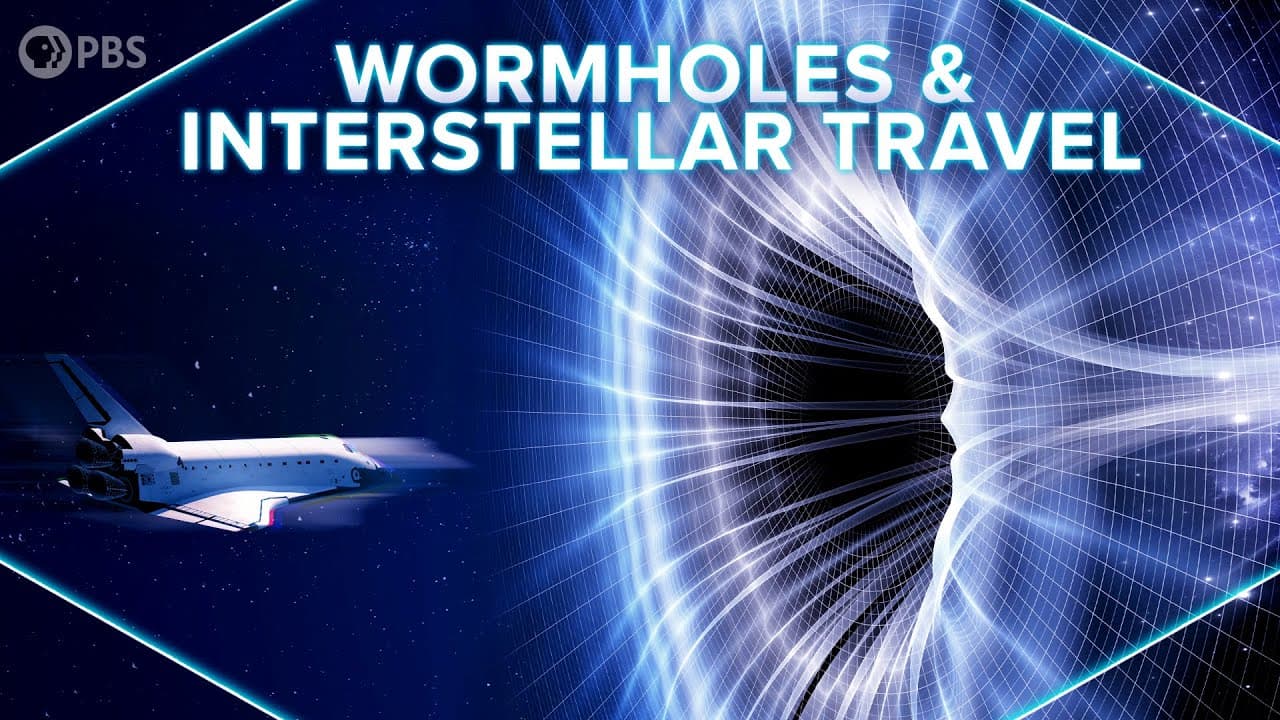
Can Wormholes Enable Fast Travel Between Stars?
TL;DR
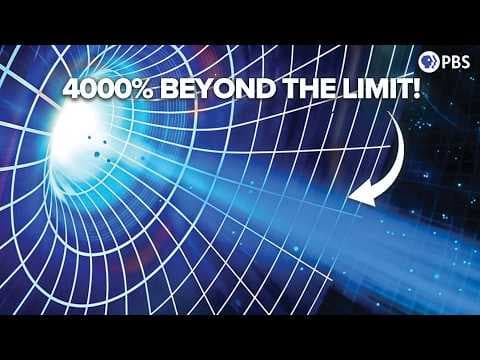
Wormholes are theoretically proposed solutions in general relativity that could connect distant regions of space, but they are currently deemed impractical for travel due to their rapid collapse and the need for exotic matter. This exotic matter, necessary to keep a wormhole open, has not been observed and violates known energy conditions. While quantum-level wormholes might exist, amplifying them for practical use remains a significant challenge.
Transcript
From Stargate to Interstellar, wormholes have long been one of our favorite method for traveling across fictional universes. But they've also been a very serious field of study for some of the greatest minds over the last century. So what is the holdup? When do we get to wormhole ourselves out of here? In 1915, Karl Schwarzschild discovered a solut... Read More
Key Insights
- Wormholes have been a popular concept in science fiction but are also a serious subject of scientific study, with key contributions from minds like Einstein and Schwarzschild.
- The Schwarzschild solution to Einstein's equations initially suggested the possibility of wormholes, but these were later shown to be non-traversable due to their rapid collapse.
- Traversable wormholes would require exotic matter with negative energy density to keep them open, a type of matter not yet discovered or understood.
- The Casimir effect, which involves negative energy density, is a speculative mechanism for keeping wormholes open but is currently impractical due to its weak nature.
- Theoretical physicists have explored various wormhole geometries, such as the cubic wormhole, to avoid harmful high-energy regions for travelers.
- Natural wormholes might exist at the quantum level, appearing and disappearing in spacetime foam, but amplifying them to usable sizes remains a significant challenge.
- The ER=EPR conjecture suggests a link between wormholes and quantum entanglement, offering insights into the nature of spacetime rather than practical travel solutions.
- The concept of wormholes continues to inspire scientific inquiry and fiction, despite the many unresolved challenges and paradoxes they present.
Install to Summarize YouTube Videos and Get Transcripts
Explore YouTube Video Summarizer or Get YouTube Transcript Extractor
Questions & Answers
Q: What is the Schwarzschild solution's significance in wormhole theory?
The Schwarzschild solution to Einstein's equations of general relativity was pivotal in suggesting the possibility of wormholes. It describes a gravitational hole that could act as a two-sided funnel, potentially connecting different regions of spacetime. However, these Schwarzschild wormholes are not traversable, as they collapse too quickly for anything, even light, to pass through.
Q: Why are traversable wormholes considered theoretically possible but practically unfeasible?
Traversable wormholes are theoretically possible as they are solutions to Einstein's equations, but they require exotic matter with negative energy density to remain open. This type of matter has not been observed and violates the energy conditions of general relativity, making practical construction and use of such wormholes currently unfeasible.
Q: How does the Casimir effect relate to wormhole stabilization?
The Casimir effect is a phenomenon where two closely placed conducting plates create a region of negative energy density due to blocked quantum vacuum components. This negative energy density is theorized to stabilize a wormhole by counteracting its natural tendency to collapse. However, the effect is very weak and impractical for stabilizing macroscopic wormholes with current technology.
Q: What are the challenges associated with using quantum-level wormholes for travel?
Quantum-level wormholes may exist in the spacetime foam, where the geometry and topology of spacetime fluctuate. However, amplifying these wormholes to macroscopic scales suitable for travel is a significant challenge. It would require advanced technology to stabilize them with exotic matter, which itself presents unresolved theoretical and practical issues.
Q: What is the ER=EPR conjecture, and how does it relate to wormholes?
The ER=EPR conjecture, proposed by Leonard Susskind and Juan Maldecina, suggests a relationship between Einstein-Rosen bridges (wormholes) and quantum entanglement (EPR). It posits that entangled particles are connected by microscopic wormholes, providing a potential explanation for quantum entanglement. This conjecture offers insights into the fundamental nature of spacetime rather than practical wormhole travel.
Q: What role does exotic matter play in wormhole theory?
Exotic matter is crucial in wormhole theory as it is theorized to keep a wormhole open by exerting outward pressure, counteracting the natural collapse. It requires negative energy density, which violates general relativity's energy conditions. The existence of exotic matter remains speculative, with no empirical evidence, posing a major hurdle for practical wormhole construction.
Q: Are there any natural occurrences of wormholes that could be utilized?
Natural wormholes might exist at the quantum level within spacetime foam, where spacetime's geometry and topology fluctuate. However, these are transient and microscopic, making them unusable for travel without significant technological advancements to stabilize and amplify them. The feasibility of utilizing such natural wormholes remains purely speculative at this point.
Q: How has fiction influenced the scientific study of wormholes?
Fiction has popularized wormholes as a means of interstellar travel, inspiring scientific exploration of their theoretical possibilities. Notable works like Carl Sagan's 'Contact' have prompted scientists like Kip Thorne to derive equations for traversable wormholes, blending scientific rigor with imaginative concepts. This cross-pollination between fiction and science continues to drive interest and research in wormhole physics.
Summary & Key Takeaways
-
Wormholes, initially theoretical constructs from Einstein's general relativity, have intrigued scientists and science fiction enthusiasts alike. Schwarzschild's solution hinted at their existence, but practical traversability remains elusive due to rapid collapse and the need for exotic matter.
-
Efforts to design traversable wormholes have centered around exotic matter, which could theoretically keep a wormhole open. However, such matter violates energy conditions of general relativity and has not been observed, making these designs speculative.
-
Quantum-level wormholes might exist in spacetime foam, but amplifying them is beyond current capabilities. Theoretical links between wormholes and quantum entanglement offer potential insights into spacetime, though practical applications for travel are distant.
Read in Other Languages (beta)
Share This Summary 📚
Summarize YouTube Videos and Get Video Transcripts with 1-Click
Try YouTube Summary with ChatGPT & Claude or YouTube Transcript Generator
Explore More Summaries from PBS Space Time 📚
Summarize YouTube Videos and Get Video Transcripts with 1-Click
Try YouTube Summary with ChatGPT & Claude or YouTube Transcript Generator