Why Price Action Trading Fails and What to Do Instead
TL;DR
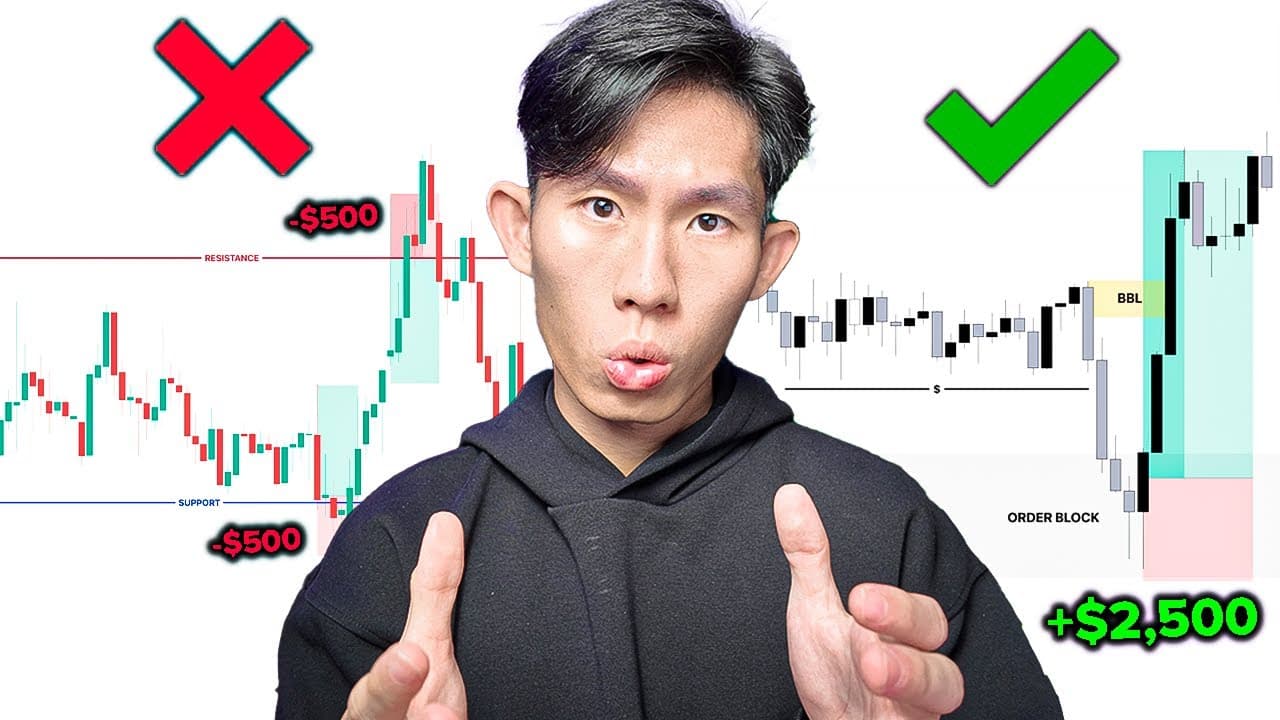
Price action trading is subjective because two traders can read the same chart oppositely, one seeing a double bottom and another a double top, leading to inconsistent results. After three years and blowing multiple accounts, this trader switched to a rules-based 'market mechanics' system built around consistency rather than pattern interpretation.
Transcript
I spent 3 years trading pure price action and it almost made me quit trading altogether. Today I will finally explain why I gave it up, the mistakes it caused and how switching to my market mechanics system completely changed my trading results. Now, first of all, quick little disclaimer. I'm not saying that price action does not work. Okay, I know... Read More
Key Insights
- Price action trading is subjective because two traders can interpret the identical chart in opposite ways, one reading a double bottom and buying while another reads a double top and sells, guaranteeing that one loses.
- The core problem is captured in the acronym SIN, where S stands for subjectivity, I stands for inconsistency, and inconsistency is caused directly by subjectivity and a lack of mechanical rules.
- Consistent profits are impossible when your actions are inconsistent, since taking a different set of actions each time you approach a chart cannot produce a repeatable, reliable outcome over time.
- The trader spent three years on pure price action and it almost made him quit, blowing multiple accounts and losing his entire life savings before deciding to find another approach.
- A brief early success turning $500 into over $10,000 in five days was wiped out in a single trade after he got complacent and margin called, proving the fragility of undisciplined trading.
- Mark Douglas's idea that consistent winners think differently from everyone else inspired the shift, since if 95% of traders lose using retail strategies, doing the opposite of the majority may be the edge.
- Price action is attractive to beginners mainly because it is simple, relying only on support, resistance, trend lines, and candlestick patterns without complex or weird indicators cluttering the chart.
- The trading industry markets a false promise that memorizing candlestick cheat sheets and drawing lines will reveal exactly where price reverses and make traders profitable, which the speaker calls untrue.
Install to Summarize YouTube Videos and Get Transcripts
Explore YouTube Video Summarizer or Get YouTube Transcript Extractor
Questions & Answers
Q: Why does the trader say price action trading is subjective?
Price action trading is subjective because two traders can look at the exact same chart and interpret it in opposite ways. One trader sees a double bottom and enters a buy expecting price to break the neckline upward, while another sees a double top and enters a sell. Since the market can only move one way, the two traders using the same strategy get opposite results, with one effectively handing his profits to the other.
Q: What does the SIN acronym stand for in this video?
SIN is the acronym the trader created to describe the problems with price action. S stands for subjectivity, meaning two traders can interpret the same chart differently and take opposite actions. I stands for inconsistency, which he says is caused directly by that subjectivity and by a lack of mechanical rules. He frames it as a sin to trade with your emotions and remain unprofitable when profitability is possible.
Q: How did the trader first get into price action trading?
A friend introduced him to trading as a way to make money online, claiming he could make $500 just by clicking buy and sell buttons. At the time he earned less than $1,000 doing odd jobs like waiting tables and temperature screening during the COVID era at $7 to $10 an hour. Enticed by the offer, he dove into Forex and found price action first because it is the most common retail strategy when you search how to trade online.
Q: What happened when the trader turned $500 into $10,000?
At one point he turned $500, which was all he had in his trading account, into over $10,000 in the span of five days. He believed he had discovered the holy grail and that it was simple: just identify lines and patterns on charts. But he got complacent and lost the entire $10,000 in one trade, getting margin called. This proved to him that making money was possible but his approach was flawed.
Q: Why did the trader decide to do the opposite of most traders?
He came across a Mark Douglas quote saying consistent winners think differently from everyone else. This gave him an aha moment. He reasoned that if everyone trades chart patterns, trend lines, and support and resistance, and statistics say 95% of traders lose, then following the majority leads to losing. Instead he chose to do what is psychologically uncomfortable and outside his comfort zone to achieve the results of consistent winners and profit from others' downfall.
Q: Does the trader say price action does not work at all?
No, he explicitly says he is not claiming price action does not work. He acknowledges many traders are insanely profitable trading just candlestick patterns, and some trade wedges and triangle patterns and make more money than he does. He clarifies he is not shaming any strategy or forcing anyone to change. He simply developed his own system, market mechanics, that works better for him based on his six years of personal experience, calling it a documentary not a sermon.
Q: Why can inconsistent actions not produce consistent profits?
The trader argues that many traders search for consistent profits while their actions remain inconsistent. He asks how anyone can expect consistent profits when their strategy is inconsistent and they perform a different set of actions each time they approach a chart or start trading. Without mechanical rules, the subjective interpretation of charts leads to varying decisions, so the outcomes cannot be reliably repeated, making steady profitability impossible under a discretionary price action approach.
Q: What losses did the trader experience before changing his approach?
After his early wins, he got stuck in a vicious cycle of depositing money and losing everything. He would make small gains but often ended months with negative P&L of negative $1,000 or negative $2,000, and those losses added up. He deposited another $500 after his big loss, grew it to about $3,000, then lost it all. Eventually he lost all his life savings and had literally no money in his bank account, reaching rock bottom before deciding to find another way.
Summary & Key Takeaways
-
The trader spent three years on pure price action after a friend pitched it as easy money during COVID, when he earned $7 to $10 an hour at odd jobs. He learned support, resistance, trend lines, and candlestick patterns because they were simple and required no weird indicators.
-
Early wins built confidence, including turning $500 into over $10,000 in five days, but complacency wiped that account in one trade. He then cycled through repeated deposits and losses, ending months with negative P&L until he lost all his life savings and hit rock bottom.
-
A Mark Douglas quote that consistent winners think differently prompted him to reject the majority approach. He built a 'market mechanics' system and framed price action's flaws with the acronym SIN: subjectivity, where traders read the same chart oppositely, and inconsistency, which prevents consistent profits.
Read in Other Languages (beta)
Share This Summary 📚
Summarize YouTube Videos and Get Video Transcripts with 1-Click
Try YouTube Summary with ChatGPT & Claude or YouTube Transcript Generator
Explore More Summaries from The Trading Geek 📚
Summarize YouTube Videos and Get Video Transcripts with 1-Click
Try YouTube Summary with ChatGPT & Claude or YouTube Transcript Generator