How to Perform Sentiment Analysis Using TensorFlow 2.0?
TL;DR
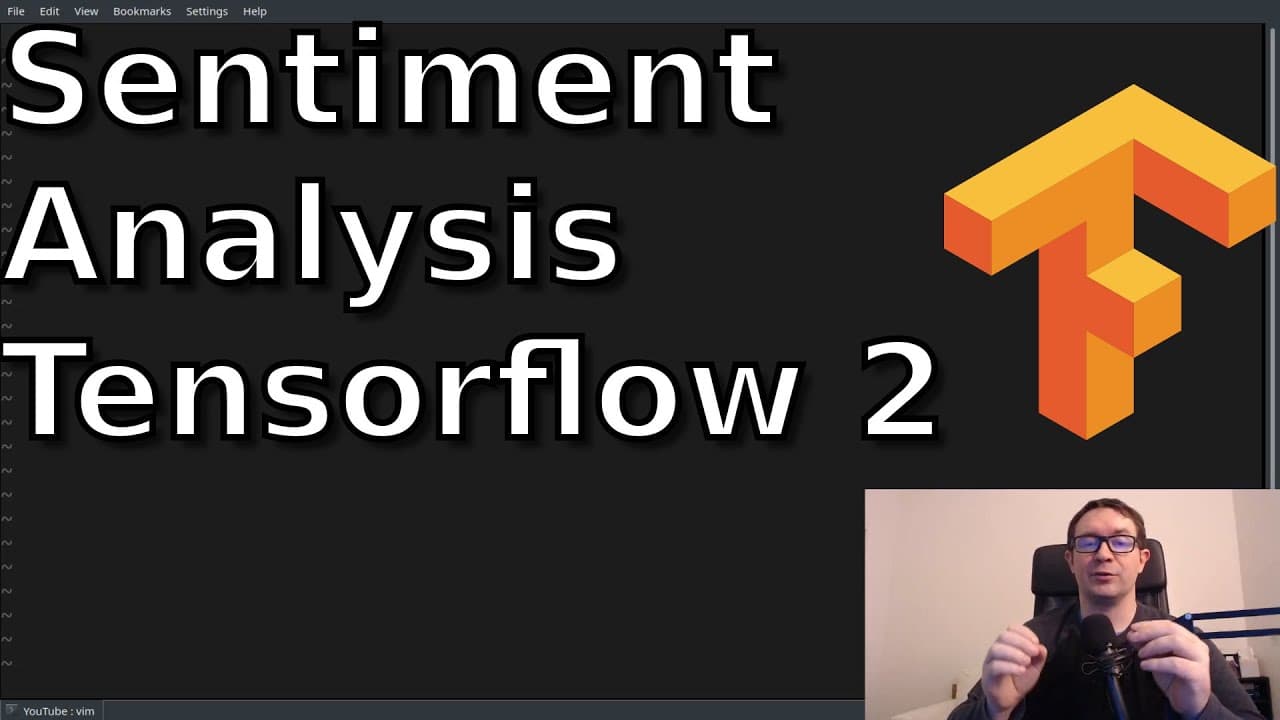
To perform sentiment analysis with TensorFlow 2.0, you need to load an IMDB dataset and preprocess the data, including encoding and padding. Create a sequential model with a bi-directional LSTM layer, train the model using binary cross-entropy loss, and evaluate it on sample reviews to predict sentiment probabilities effectively.
Transcript
in this tutorial you are gonna learn how to do it send them a classification with tensorflow 2.0 let's get started before we begin a couple of notes first of all it would be very helpful if you have already seen my previous video on doing word embeddings in tensorflow 2.0 because we're gonna be borrowing heavily from the concepts I presented in tha... Read More
Key Insights
- 🔑 Word embeddings are essential for sentiment analysis, as they enable the model to capture relationships between words.
- ❓ Preprocessing steps like data loading, padding, and encoding are crucial for preparing the data for sentiment analysis tasks.
- 😃 The choice of model architecture, such as including bi-directional LSTM layers, can improve the model's performance.
- 🚂 Training the model with multiple epochs can enhance accuracy, but the complexity of the model affects training time.
- ❓ Evaluating the model's predictions on sample reviews provides insights into the accuracy and effectiveness of the sentiment analysis model.
- 👤 TensorFlow 2.0 offers an efficient and user-friendly framework for implementing sentiment analysis tasks.
Install to Summarize YouTube Videos and Get Transcripts
Explore YouTube Video Summarizer or Get YouTube Transcript Extractor
Questions & Answers
Q: What is the purpose of an encoder in sentiment analysis?
The encoder associates each word with an n-dimensional vector, creating a relationship between words for better analysis and understanding of the text.
Q: How does the model handle different lengths of input reviews?
The model pads the reviews with zeros to match the length of the longest review, ensuring consistency in input dimensions.
Q: What type of activation function is used in the final layer of the model?
The final layer uses a sigmoid activation function, which outputs a probability between 0 and 1 for the review being positive.
Q: What is the significance of using a bi-directional LSTM layer?
A bi-directional LSTM layer processes the input in both forward and backward directions, capturing contextual information from left and right contexts of each word.
Summary & Key Takeaways
-
The tutorial introduces the basics of sentiment analysis and the concept of word embeddings.
-
The content provides step-by-step instructions on loading the IMDB dataset, preprocessing the data, and creating a sentiment analysis model.
-
The tutorial demonstrates how to train the model and evaluate its performance on sample reviews.
Read in Other Languages (beta)
Share This Summary 📚
Summarize YouTube Videos and Get Video Transcripts with 1-Click
Try YouTube Summary with ChatGPT & Claude or YouTube Transcript Generator
Explore More Summaries from Machine Learning with Phil 📚




Summarize YouTube Videos and Get Video Transcripts with 1-Click
Try YouTube Summary with ChatGPT & Claude or YouTube Transcript Generator