Introduction to Pressure & Fluids - Physics Practice Problems
TL;DR
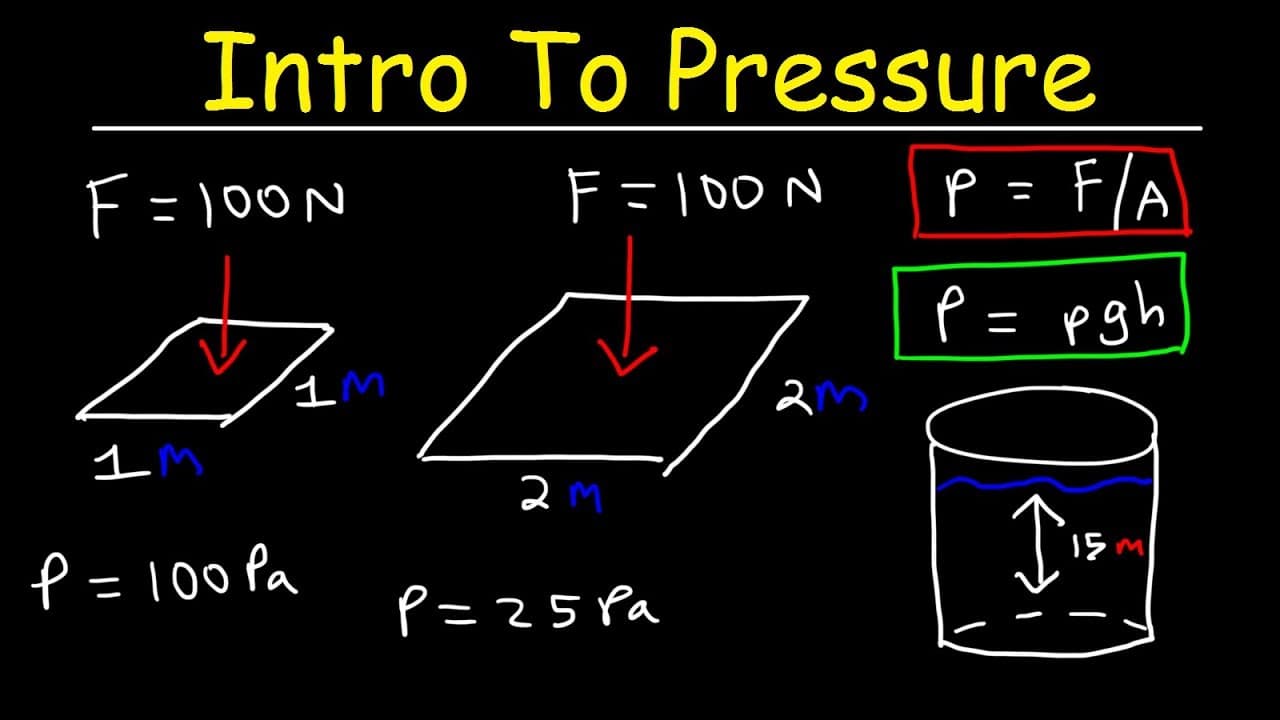
Pressure is the force divided by the area, and it can be increased by increasing the force or decreasing the area.
Transcript
in this lesson we're going to talk about pressure pressure is force divided by area in physics the standard unit of pressure is pascals one pascal is one newton per square meter and one kilopascal is a thousand pascals and one atm or atmospheric pressure is 101.3 kilopascals so those are some units that you want to keep in mind so whenever you exer... Read More
Key Insights
- 🗂️ Pressure is defined as force divided by area and is measured in pascals.
- 🥺 Increasing force leads to an increase in pressure, while increasing the area decreases pressure.
- ❓ In fluid systems, pressure is determined by the fluid's density, gravitational acceleration, and depth.
- 💦 Specific gravity is a measurement of density relative to water's density and can be used to calculate the density of a substance.
- ☺️ The pressure exerted by a fluid at a certain depth can be calculated using the equation: pressure = density x gravity x depth.
Install to Summarize YouTube Videos and Get Transcripts
Explore YouTube Video Summarizer or Get YouTube Transcript Extractor
Questions & Answers
Q: What is pressure and how is it measured?
Pressure is the force exerted over a given area. It is measured in pascals, with one pascal being one newton per square meter.
Q: How does increasing the force affect pressure?
Increasing the force applied increases the pressure exerted, as pressure is directly related to force.
Q: How does increasing the area affect pressure?
Increasing the area over which the force is applied decreases the pressure, as pressure is inversely related to area.
Q: Can you provide an example to illustrate the relationship between force, area, and pressure?
Sure! If we have a force of 100 newtons and apply it over a one-square-meter area, the pressure would be 100 pascals. If we double the dimensions and increase the area to four square meters, the pressure would decrease to 25 pascals.
Q: How do you calculate the pressure exerted by an object on a surface?
To calculate the pressure, you need to divide the force exerted by the object (weight) by the area of the surface it is in contact with.
Summary & Key Takeaways
-
Pressure is force divided by area, and it is measured in pascals.
-
Increasing the force applied increases the pressure, while increasing the area decreases the pressure.
-
Pressure is related to both force and area, with a direct relationship to force and an inverse relationship to area.
Read in Other Languages (beta)
Share This Summary 📚
Summarize YouTube Videos and Get Video Transcripts with 1-Click
Try YouTube Summary with ChatGPT & Claude or YouTube Transcript Generator
Explore More Summaries from The Organic Chemistry Tutor 📚
Summarize YouTube Videos and Get Video Transcripts with 1-Click
Try YouTube Summary with ChatGPT & Claude or YouTube Transcript Generator