What Makes Sagrada Familia the World's Oldest Ongoing Project?
TL;DR
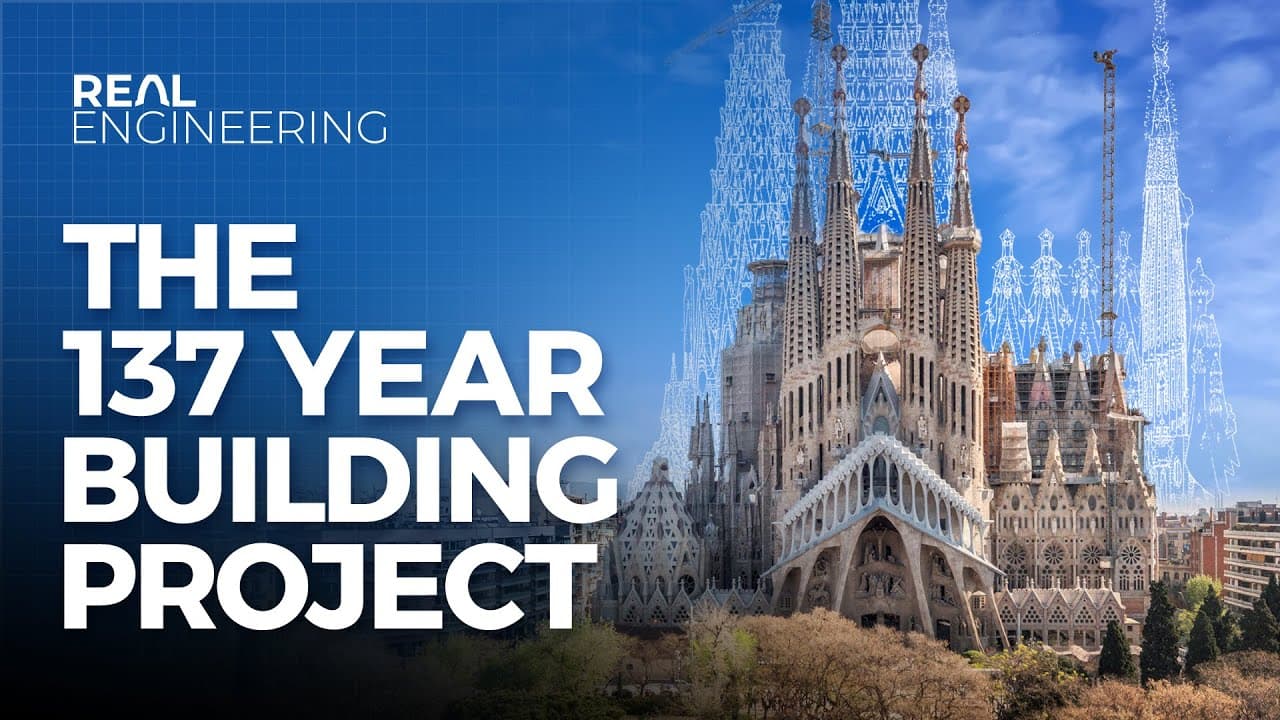
Sagrada Familia, begun in 1882, is the world's oldest ongoing construction project due to its complex design and ambitious vision by Antoni Gaudí. The project has faced many challenges, including the Spanish Civil War and the destruction of original models, but modern technology and increased tourist funding are set to lead to its completion by 2026.
Transcript
This episode of Real Engineering is brought to you by Brilliant. A problem solving website that teaches you to think like an Engineer. Barcelona is a city characterized by regimental city blocks and wide linear streets. A departure from the narrow winding streets of most European cities. Yet nestled in these rigid streets are some of the most uniqu... Read More
Key Insights
- Antoni Gaudí's architectural style is heavily inspired by nature, using natural forms and structures to create unique and innovative designs.
- The Sagrada Familia, Gaudí's magnum opus, began construction in 1882 and remains unfinished, reflecting the complexity and ambition of its design.
- Gaudí used unconventional methods, such as string models, to design complex structures that maintained structural integrity through compression.
- The construction of Sagrada Familia has spanned generations, incorporating advances in technology and materials to continue Gaudí's vision.
- The Spanish Civil War and the destruction of Gaudí's original models posed significant challenges to the continuation of the project.
- Modern technology, including 3D modeling and CNC machines, has accelerated construction and allowed for more precise craftsmanship.
- Funding for the Sagrada Familia has shifted from sporadic donations to a steady flow from tourism, enabling continued progress on the project.
- Despite changes and challenges, the Sagrada Familia remains a testament to Gaudí's genius and a celebration of spirituality through architecture.
Install to Summarize YouTube Videos and Get Transcripts
Explore YouTube Video Summarizer or Get YouTube Transcript Extractor
Questions & Answers
Q: What inspired Gaudí's architectural style?
Antoni Gaudí's architectural style was heavily inspired by nature. He believed that originality consisted of returning to the origins, and he applied this philosophy by using natural forms and structures as the blueprint for his designs. His work celebrated nature, life, and spirituality, incorporating complex curves and intertwining parabolic forms that defied conventional architectural rules.
Q: How did Gaudí design complex structures without modern technology?
Gaudí used innovative methods, such as string models, to design complex structures. By hanging strings and adding weights, he could map out lines of thrust, ensuring that structures maintained structural integrity through compression. This technique allowed him to create intricate designs without the aid of modern computational analysis, relying on a deep understanding of the interplay between art and engineering.
Q: What challenges did the Sagrada Familia face after Gaudí's death?
After Gaudí's death in 1926, the Sagrada Familia faced significant challenges, including the outbreak of the Spanish Civil War and the destruction of Gaudí's original models by anarchists. These events complicated the completion of the project, as designers had to piece together shattered models and continue the work without the guidance of the original architect. Despite these obstacles, the project persisted, drawing on new generations of engineers and craftsmen.
Q: How has modern technology impacted the construction of Sagrada Familia?
Modern technology has significantly accelerated the construction of the Sagrada Familia. Advances such as 3D modeling software and CNC machines have allowed for more precise craftsmanship and efficient assembly of complex structures. These technologies have enabled the project to progress at a faster pace, with the use of tensioned steel bars and pre-assembled stone panels reducing construction time and enhancing structural integrity.
Q: What role does tourism play in funding the Sagrada Familia?
Tourism plays a crucial role in funding the continued construction of the Sagrada Familia. Once reliant on sporadic donations, the project now benefits from a steady cash flow generated by millions of tourists who visit the iconic site each year. This reliable source of funding supports the purchase of materials and the employment of workers, ensuring that Gaudí's vision can be realized.
Q: How has the availability of materials affected the construction process?
The availability of materials, particularly Montjuïc stone, has posed challenges to the construction of the Sagrada Familia. As the original quarry's resources dwindled, alternative sources of sandstone and granite had to be found, leading to variations in color and texture. Despite these challenges, the project has continued, incorporating materials from various regions to maintain the aesthetic and structural integrity of the cathedral.
Q: What is the significance of the Sagrada Familia's design?
The design of the Sagrada Familia is significant for its innovative integration of natural forms and architectural principles. Gaudí's work bridges art and science, using nature as a guide to create structures that are both aesthetically striking and structurally sound. The cathedral's design is a celebration of spirituality and a testament to Gaudí's genius, reflecting his belief in the interconnectedness of nature, mathematics, and divine inspiration.
Q: When is the Sagrada Familia expected to be completed?
The Sagrada Familia is expected to be completed by 2026, marking the 100th anniversary of Antoni Gaudí's death. This projected completion date reflects the advancements in technology and increased funding that have facilitated the construction process. Despite the challenges and changes over the years, the project aims to honor Gaudí's original vision and celebrate his contributions to architecture and engineering.
Summary & Key Takeaways
-
Antoni Gaudí's Sagrada Familia is a testament to his innovative architectural style, inspired by nature and utilizing complex forms to create a unique masterpiece. Despite being under construction for over 135 years, it remains unfinished, reflecting the project's complexity and ambition.
-
Gaudí's methods included using string models to design structures that maintained structural integrity through compression, a technique that allowed for the creation of intricate designs without modern computational tools. His work bridged art and science, celebrating nature and spirituality.
-
The construction of Sagrada Familia has faced numerous challenges, including the Spanish Civil War and the destruction of original models. However, modern technology and increased funding from tourism have facilitated progress, bringing Gaudí's vision closer to completion by 2026.
Read in Other Languages (beta)
Share This Summary 📚
Summarize YouTube Videos and Get Video Transcripts with 1-Click
Try YouTube Summary with ChatGPT & Claude or YouTube Transcript Generator
Explore More Summaries from Real Engineering 📚




Summarize YouTube Videos and Get Video Transcripts with 1-Click
Try YouTube Summary with ChatGPT & Claude or YouTube Transcript Generator