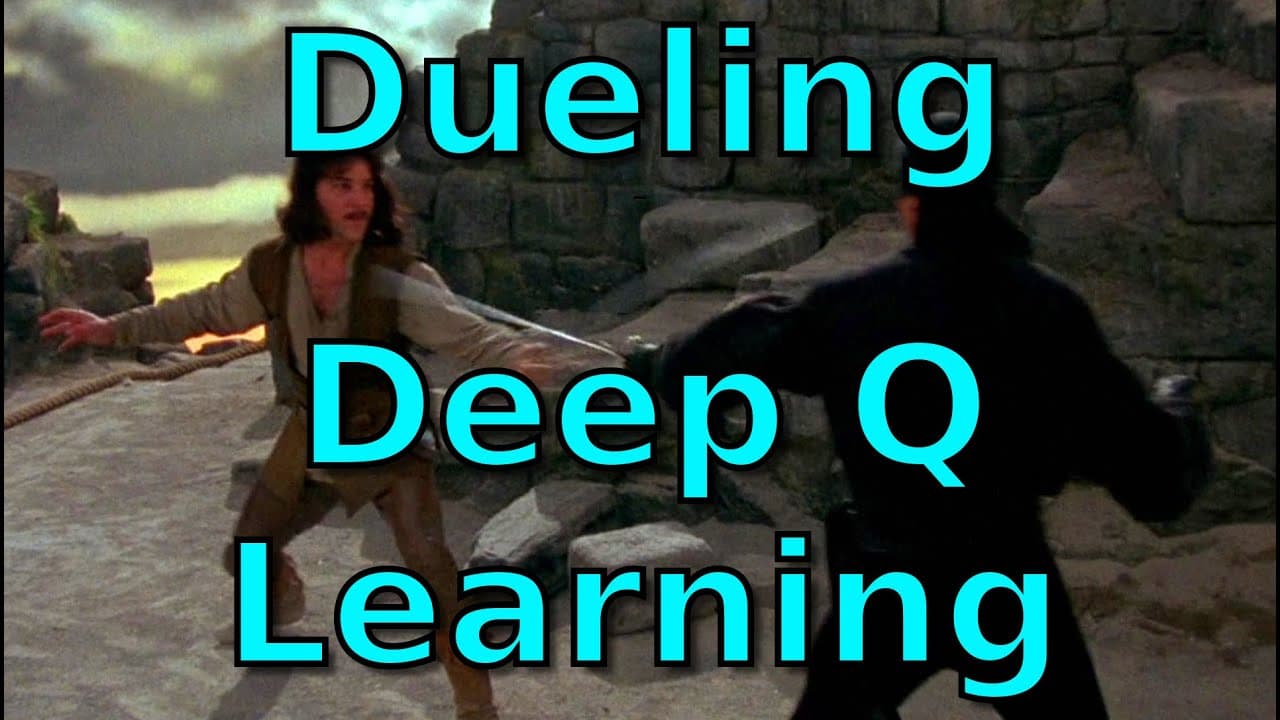
How to Implement Dueling Deep Q Learning in PyTorch
TL;DR
To implement a Dueling Deep Q Learning agent in PyTorch, start by creating a replay buffer for memory management. Use a linear deep Q network to separately compute value and advantage functions for accurate Q value estimation. The agent learns by sampling experiences and using mean squared error for backpropagation, improving performance through epsilon decay for exploration.
Transcript
welcome back everybody in today's tutorial you are gonna learn how to code a Dueling deep Q learning agent in PI torch you don't need any prior experience you don't need to know anything about reinforcement learning you just have to follow along let's get started so of course we begin with our imports will need OS to handle some file joining operat... Read More
Key Insights
- 🇶🇦 The dueling deep Q learning agent improves performance and stability compared to regular deep Q learning.
- 🍝 A replay buffer is essential for efficient learning by storing and reusing past experiences.
- 💻 The value and advantage functions in the agent help compute the Q values accurately.
- ❓ Epsilon decay encourages exploration in the agent's action selection strategy.
- 🎯 The replace target count parameter controls how often the target network weights are updated.
- 🌸 Mean squared error loss is commonly used for backpropagation in reinforcement learning.
- 🏛️ PyTorch provides useful functionalities for building and training neural networks.
Install to Summarize YouTube Videos and Get Transcripts
Explore YouTube Video Summarizer or Get YouTube Transcript Extractor
Questions & Answers
Q: What is the purpose of a replay buffer in reinforcement learning?
A replay buffer helps the agent remember and store past experiences, allowing for more efficient learning by randomly sampling and reusing the experiences during training.
Q: How does the dueling deep Q learning agent differ from regular deep Q learning?
The dueling deep Q learning agent uses separate streams for value and advantage functions, allowing for better representation of the state-action values. This improves performance and stability compared to regular deep Q learning.
Q: What is the role of the epsilon parameter in the agent?
Epsilon controls the exploration versus exploitation trade-off in the agent's action selection. It starts high and linearly decreases over time, encouraging the agent to take more random actions initially and gradually become more greedy.
Q: How does the agent update its target network weights?
The replace target count parameter determines how often the target network weights are updated. Every specified number of learning steps, the weights are copied from the evaluation network to the target network.
Summary & Key Takeaways
-
This tutorial covers the implementation of a Dueling Deep Q Learning agent in PyTorch.
-
It begins with importing necessary packages and creating a replay buffer class to handle memory.
-
The dueling deep Q learning agent uses a value function and an advantage function to compute the Q values.
-
A linear deep Q network is used as the function approximator, with separate streams for value and advantage.
-
The agent performs learning steps by sampling from the replay buffer and using mean squared error loss for backpropagation.
Read in Other Languages (beta)
Share This Summary 📚
Summarize YouTube Videos and Get Video Transcripts with 1-Click
Try YouTube Summary with ChatGPT & Claude or YouTube Transcript Generator
Explore More Summaries from Machine Learning with Phil 📚


Summarize YouTube Videos and Get Video Transcripts with 1-Click
Try YouTube Summary with ChatGPT & Claude or YouTube Transcript Generator