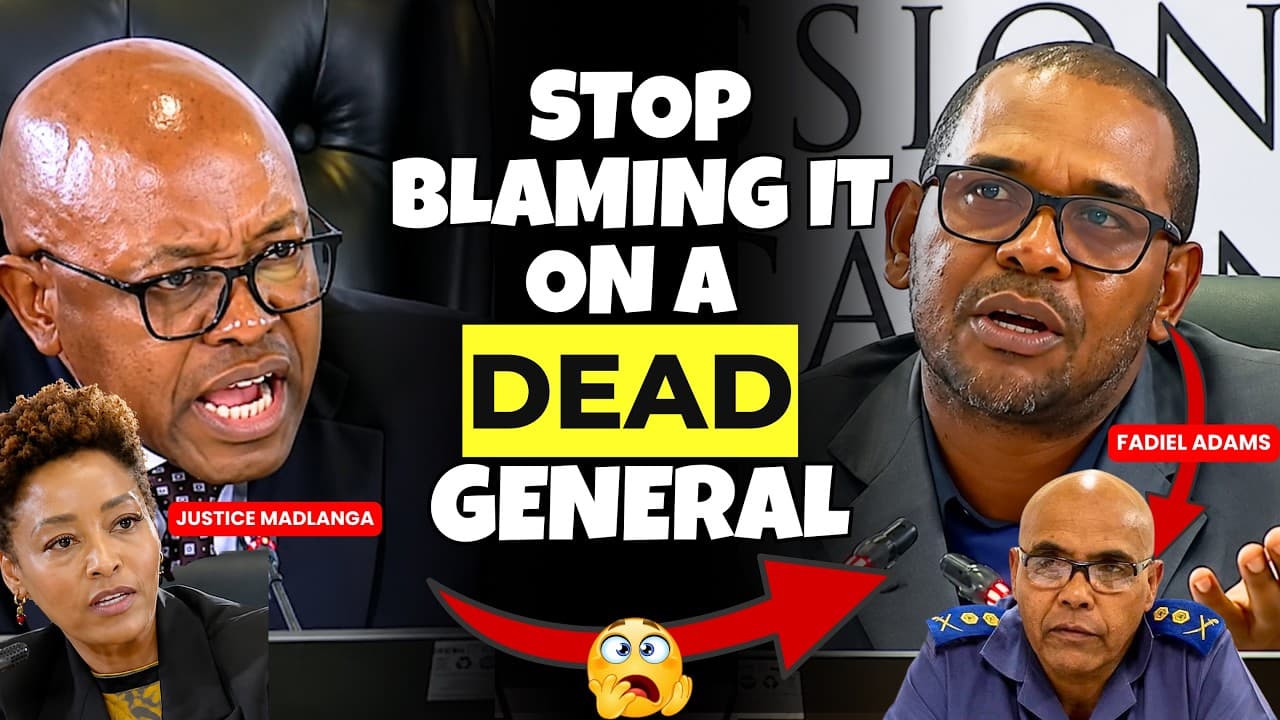
Why Was Andre Lincoln Named Only After His Death?
TL;DR
Andre Lincoln was named only after his death because Adams treated him as a confidential source and said he would not have identified him while he was alive. Adams also faced questions about forklift procurement records allegedly delivered under his office door, but he could not confirm that every displayed page came from the original envelope. Read on for the testimony’s key distinctions, disputed documents, and recording-review arrangements.
Transcript
Good morning, Miss Seagull. No. >> Good morning, chair. >> I must still greet you as a senior. Good morning, Miss. >> Morning, chair. Morning, commissioners. >> Good morning, uh, sir. >> Uh, good morning, chair. >> I'm not using your name because uh I'm surprised that we do not have Mr. Adams there. chair. Today we had subpoenaed um JMPD officer Mr... Read More
Key Insights
- Adams regarded General Andre Lincoln as a confidential source and acknowledged that he would not have revealed Lincoln’s identity while Lincoln was alive. This explains why Lincoln was attributed as the source only after his death, although the testimony remained subject to questioning before the commission.
- The envelope’s exact contents remained uncertain because Adams said the displayed bundle appeared to contain more paperwork than he remembered handing over. He confirmed that the documents were generally consistent with the material he submitted, but he could not verify every page with certainty.
- The forklift procurement application was among the documents Adams clearly recalled. When directed to pages 3499 and 3500, he identified the application as the record he remembered, providing a firmer recollection than he could offer for several later documents in the bundle.
- A handwritten page containing Adams’ former home address was not part of the material found in the envelope. Adams nevertheless confirmed that the writing was his, indicating that the page came from him even though it was not included in the original group of documents.
- The confidential information note triggered partial recognition from Adams because of its confidential marking. He initially said he did not recall it, then said the marking prompted his memory, but he remained unable to confirm every page within the continuous document.
- The commission arranged equal access to a recorded consultation involving Adams and Miss Ramsami. Adams could listen under supervision and identify relevant clips, while evidence leaders could also use portions connected to matters before the commission, protecting unrelated information about ongoing investigations.
- The consultation recording lasted about two and a half hours, including roughly 45 minutes without audio during an apparent break. The commission expected Adams to review the substantive material during tea and lunch before addressing any selected portions when proceedings reconvened.
- Adams linked irregularities that troubled him to his decision to lay a criminal case against IDAC. He also raised concern that discussing the documents could affect an ongoing investigation, and he asked the commission for guidance about how much he should disclose.
Install to Summarize YouTube Videos and Get Transcripts
Explore YouTube Video Summarizer or Get YouTube Transcript Extractor
Questions & Answers
Q: Why was Andre Lincoln identified only after his death?
Adams said General Andre Lincoln was a confidential source and acknowledged that he would not have revealed Lincoln’s identity while Lincoln was alive. Lincoln was therefore attributed as the source only after his death, and the commission questioned Adams about that timing.
Q: What documents did Adams associate with the envelope under his office door?
Adams associated the envelope with records concerning forklift procurement. The displayed bundle included a procurement application, bank confirmation, statement, purchase-related records, and a confidential information note, although he could not confirm that every page had been in the envelope.
Q: Did Adams confirm that every displayed page came from the envelope?
No. Adams said the bundle appeared to contain more paperwork than he remembered handing over, even though the records were generally consistent with the material he submitted. He recalled some documents more clearly than others and could not verify the entire bundle.
Q: Which procurement document did Adams clearly remember?
Adams clearly recalled the forklift procurement application shown on pages 3499 and 3500. His recognition of that application was firmer than his recollection of several later documents in the displayed bundle.
Q: Was the handwritten page containing Adams’ former home address part of the envelope?
Adams said the page containing his former home address was not among the materials found in the envelope. He nevertheless confirmed that the handwriting was his, distinguishing his authorship from the page’s alleged inclusion in the original documents.
Q: Did Adams remember the confidential information note?
His recollection was uncertain. Adams initially said he did not recall the note, but its confidential marking prompted some recognition. Even then, he could not confirm every page within the continuous document.
Q: How could Adams review the recorded consultation with Miss Ramsami?
The commission arranged for Adams to hear the entire recording in the presence of a commission representative and identify clips he wanted the commissioners to consider. Relevant portions could be played, while unrelated material involving ongoing investigations would remain protected.
Q: How long was the recorded consultation, and how much of it had no audio?
The consultation recording lasted about two and a half hours. Roughly 45 minutes contained no audio during an apparent break, so the commission expected Adams to review the substantive material during the tea and lunch adjournments.
Summary & Key Takeaways
-
Adams testified before the Madlanga Commission about documents allegedly delivered under his office door concerning forklift procurement. While reviewing pages 3499 to 3512, he recognized several records but repeatedly expressed uncertainty about whether every document shown had actually been inside the envelope or formed part of what he handed over.
-
The disputed material included a procurement application, bank confirmation, statement, purchase-related records, and a confidential information note. Adams initially questioned whether the bundle contained more paperwork than he had submitted. He recognized the confidential marking but could not confidently remember every page, creating uncertainty about the envelope’s exact original contents.
-
The broader questioning examined why General Andre Lincoln was named as Adams’ source only after Lincoln’s death, along with Adams’ disclosures to Parliament, investigators, IDAC, and the IGI. Adams said Lincoln had been treated as a confidential source and acknowledged that he would not have identified him while he was alive.
Read in Other Languages (beta)
Share This Summary 📚
Summarize YouTube Videos and Get Video Transcripts with 1-Click
Try YouTube Summary with ChatGPT & Claude or YouTube Transcript Generator
Explore More Summaries from OH Allegedly Podcast 📚
Summarize YouTube Videos and Get Video Transcripts with 1-Click
Try YouTube Summary with ChatGPT & Claude or YouTube Transcript Generator