Arthur Laffer on Why Taxes Matter for Entrepreneurs

TL;DR
Taxes change behavior because economics is all about incentives: tax something and you get less of it, subsidize something and you get more of it. Entrepreneurs must study taxes because people work to get paid after tax, not pre-tax, and you cannot tax an economy into prosperity. The Laffer Curve shows tax rates and total revenue both hit zero at 0% and 100% rates.
Transcript
you know kids do better when they go home to parents who have jobs the problem is that politicians aren't spending their own money the problem is they're spending your money you ask yourself the question why don't we tax people who work and pay people who don't work so if you follow value Tim and you will hear me talk about taxes a lot of people as... Read More
Key Insights
- Economics is fundamentally about incentives, and taxes change incentives: if you tax an activity you get less of it, and if you subsidize an activity you get more of it, the same way taxing smokers and speeders discourages those behaviors.
- The Laffer Curve is simply the relationship between tax rates and total revenues, combining two opposing forces Laffer calls the arithmetic effect and the economic effect, which always work in opposite directions.
- At a 100% tax rate there are zero tax revenues because nobody works when going to the office earns them a bill instead of a check, and at a 0% tax rate revenues are also zero even though people work like mad.
- Entrepreneurs must study taxes because people work to get paid after tax rather than pre-tax, so aligning incentives around after-tax income directly affects how a business and its employees behave.
- You cannot tax an economy into prosperity, a quote Laffer emphasizes as a core principle when evaluating whether tax policy actually generates the growth politicians promise.
- Federal taxes as a share of GDP run about 20%, sometimes 22%, and state and local taxes fall in that same range, making taxes a huge portion of total output, production, and incomes.
- The core question Laffer poses is why governments tax people who work and pay people who do not work, along with why we tax those who employ others and businesses that make good products at low cost, mainly to raise revenue to run government.
- Laffer's original napkin sketch of the curve, drawn for Donald Rumsfeld and Dick Cheney, is displayed at the Smithsonian next to Milton Friedman's briefcase, showing how the concept moved from a napkin into policy under President Reagan.
Install to Summarize YouTube Videos and Get Transcripts
Explore YouTube Video Summarizer or Get YouTube Transcript Extractor
Questions & Answers
Q: What is the Laffer Curve?
The Laffer Curve is simply the relationship between tax rates and total revenues. Laffer explains that tax rates have two effects on revenue: raising rates collects more revenue per dollar of tax base (the arithmetic effect), but it also makes the activity less attractive and shrinks the tax base (the economic effect). These two effects always work in opposite directions, which is why revenue does not rise indefinitely as rates climb.
Q: Why should entrepreneurs spend time studying taxes?
Entrepreneurs should study taxes because economics is all about incentives, and taxes change incentives. People work to get paid after tax, not pre-tax, so a business owner needs to understand how taxes affect the behavior of themselves and their employees. Laffer notes that if you tax something you get less of it and if you subsidize something you get more of it, so aligning incentives around after-tax outcomes matters directly to how a business performs.
Q: Why do tax revenues fall to zero at a 100% tax rate?
At a 100% tax rate there are zero tax revenues because nobody would work. Laffer illustrates this by asking how long you would work if every time you went to the office you received a bill instead of a check. The answer is not very long. With no incentive to earn income, the activity that generates taxable revenue disappears, so the government collects nothing even though the rate is at its maximum.
Q: How do taxes change economic incentives?
Taxes change incentives the same way any penalty or subsidy does: if you tax something you get less of it, and if you subsidize something you get more of it. Laffer compares this to taxing speeders to stop speeding and taxing smokers to stop smoking. He argues the same discouraging effect applies when you tax people who work, employ others, or make good products at low cost, though the effects are not identical across cases.
Q: What does 'you cannot tax an economy into prosperity' mean?
The phrase, a quote Laffer stands by, means that raising taxes does not create economic growth or wealth. Because taxes discourage the very activities that produce income and output, higher taxation cannot be the engine of a prosperous economy. Patrick Bet-David calls it a very powerful statement. It ties directly to Laffer's view that taxes change incentives and that people respond to after-tax rather than pre-tax rewards.
Q: How large a share of the economy do taxes represent?
According to Laffer, federal taxes as a share of GDP run about 20%, and at certain times maybe 22%. State and local taxes fall in that same range. Combined, taxes make up a huge portion of total output, production, and incomes. This scale is part of why he argues taxes matter so much to entrepreneurs and to the broader economy, since they influence such a large amount of economic activity.
Q: What is Arthur Laffer's background and experience?
Arthur Laffer earned a bachelor's degree from Yale and a PhD from Stanford. He took a year off during college to study at the University of Munich as a math major, where he encountered and fell in love with economics. His first academic job was at the University of Chicago, followed by USC. He served in the White House in 1972 as George Shultz's right-hand person and the first chief economist at the OMB, and later advised President Reagan for two terms.
Q: Where is Laffer's original napkin drawing of the curve now?
Laffer's original napkin, on which he drew the curve for Donald Rumsfeld and Dick Cheney, is now displayed at the Smithsonian. It sits next to Milton Friedman's briefcase. Laffer describes it as a unique place he used to visit every year on the 4th of July. President Reagan later took the concept and applied it, which is a large part of how the Laffer Curve became widely known in policy.
Summary & Key Takeaways
-
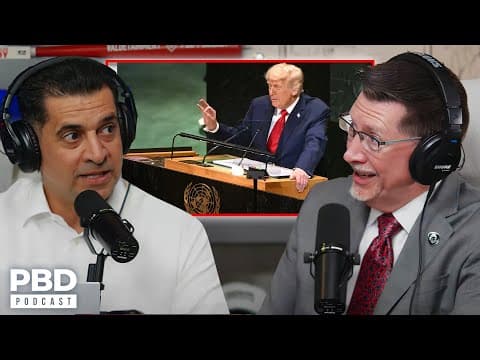
Arthur Laffer, the economist behind the Laffer Curve and a two-term economic advisor to President Reagan, explains to Patrick Bet-David why entrepreneurs should spend time studying taxes. His central point is that economics is about incentives and taxes change those incentives, so business owners must understand how taxes affect the behavior of themselves and their employees.
-
Laffer recounts his background: a bachelor's degree from Yale, a PhD from Stanford, a formative year studying at the University of Munich where he discovered economics, and roles at the University of Chicago and USC. He served in the White House in 1972 as George Shultz's right-hand person and the first chief economist at the OMB.
-
He explains the Laffer Curve as the relationship between tax rates and total revenue, driven by an arithmetic effect and an opposing economic effect. Revenue is zero at both 0% and 100% tax rates, because at 100% nobody works. His original napkin drawing sits in the Smithsonian beside Milton Friedman's briefcase.
Read in Other Languages (beta)
Share This Summary 📚
Summarize YouTube Videos and Get Video Transcripts with 1-Click
Try YouTube Summary with ChatGPT & Claude or YouTube Transcript Generator
Explore More Summaries from Valuetainment 📚





Summarize YouTube Videos and Get Video Transcripts with 1-Click
Try YouTube Summary with ChatGPT & Claude or YouTube Transcript Generator