What Foundations and Futures in AI Did LeCun Discuss?
TL;DR
LeCun argues that AI must learn from rich sensory data through self supervised learning, with supervised and reinforcement learning as smaller additives. He notes that scaling LLMs on text alone cannot reach human level intelligence because humans learn from high bandwidth vision and interaction. He emphasizes new techniques beyond simple prediction and highlights practical implications for AI research and industry.
Transcript
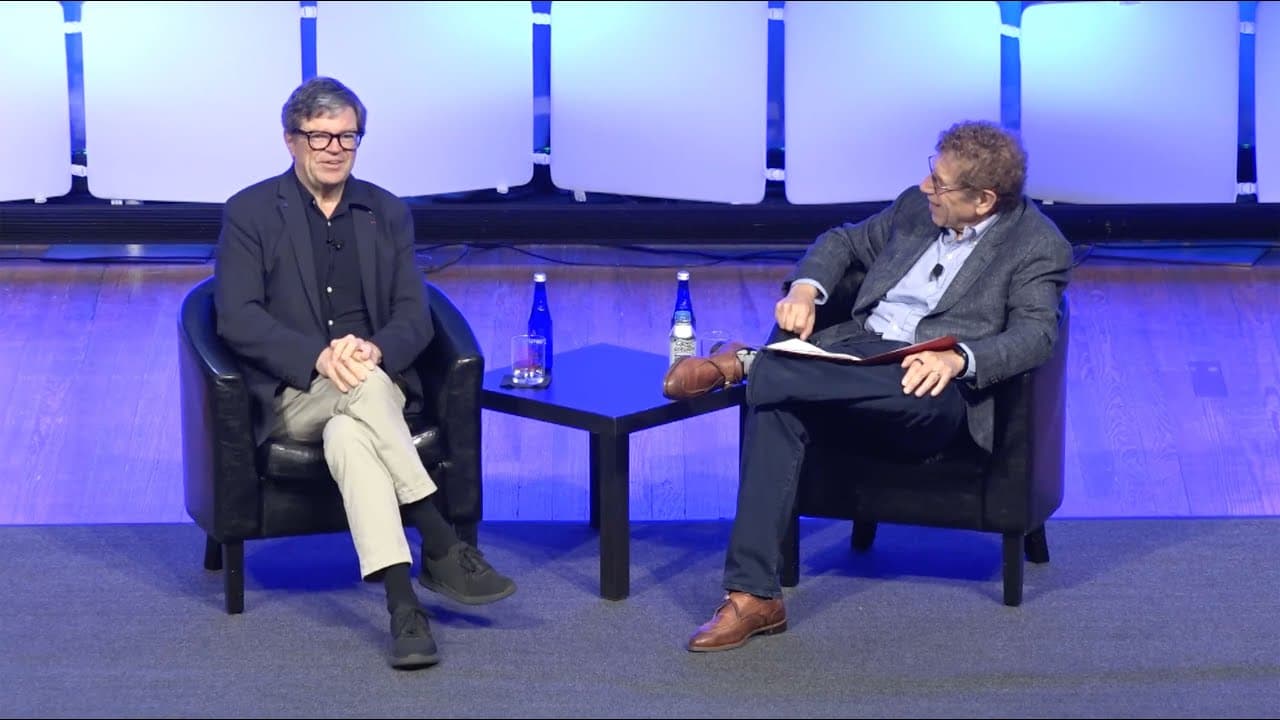
Good morning, everyone. I'm Mark Gorenberg. I'm Chair of the MIT Corporation and Founder of Zetta Venture Partners. It's a pleasure to be with all of you here today. I'm especially delighted to have the honor to welcome Yann LeCun to MIT. Yann is the Chief AI Scientist at Meta, professor at NYU, and one of the true pioneers of modern artificial int... Read More
Key Insights
- Self supervised learning should form the core of AI representation learning.
- Reinforcement learning is inefficient and should be used as a last resort.
- Text-only training cannot emulate human visual learning due to data bandwidth limits.
- The cake analogy explains how to balance learning paradigms for AI progress.
- Predictive learning and internal representation capture are crucial for generalization.
- Humans learn from high bandwidth sensory data, unlike current text-only models.
- Llama's rapid adoption demonstrates the impact of lightweight, accessible models.
- Scaling laws alone cannot achieve human-like intelligence without multimodal data and better training signals.
Install to Summarize YouTube Videos and Get Transcripts
Explore YouTube Video Summarizer or Get YouTube Transcript Extractor
Questions & Answers
Q: What is self supervised learning and why did LeCun advocate it as foundational?
Self supervised learning is about training a system to capture the internal dependencies of data without task specific labels, building a world representation from unlabeled observations. LeCun argues this approach provides a powerful foundation because it enables models to learn general representations from natural data, which can then be fine tuned for specific tasks, reducing reliance on labeled data and enabling broader generalization.
Q: Why does LeCun say reinforcement learning should be used sparingly?
Reinforcement learning is extremely inefficient because it requires a large number of trials to learn from interactions with the environment. LeCun emphasizes using reinforcement learning as a cherry on the cake, reserved for when other forms of learning have already built strong representations and capabilities, making RL useful only as a final boost rather than the primary learning method.
Q: What is the cake analogy LeCun uses to describe AI learning?
The cake analogy posits that AI intelligence is like a cake where the bulk, the cake itself, comes from self supervised or predictive learning; the icing represents supervised learning which guides task-specific performance; and the cherry on top stands for reinforcement learning which should be used minimally. This framing highlights a hierarchy of learning signals with the majority coming from unsupervised foundations.
Q: Why does LeCun believe text data alone is insufficient for human level AI?
LeCun notes that an LLM like Llama trained on text tokens processes on the order of 10^14 bytes, but a four year old is exposed to roughly the same amount of information through visual input in just 16,000 waking hours, about 10^14 bytes as well. This suggests that AI needs to learn from high bandwidth sensory data, such as vision, to approach human-like understanding.
Q: How does the token and byte comparison illustrate data requirements for AI?
The comparison shows that training on 30 trillion tokens, each about 3 bytes, results in roughly 10^14 bytes, which is akin to the data a young child experiences visually in early years. This gap indicates that relying solely on text data halves the richness of experiences an AI can learn from, underscoring the need for multimodal training signals.
Q: What role did Llama play in democratizing AI at Meta?
Llama started as a skunk works in Paris and evolved into a lightweight, efficient large language model that became central to Meta AI’s strategy. Its early success helped Meta’s leadership justify forming the GenAI organization, now the Meta Superintelligence Lab, to productize the model and broaden access to AI capabilities.
Q: What does LeCun say about training data scale versus learning efficiency?
He argues that simply scaling data and models is not sufficient because current methods require enormous labeled or unlabeled text data. The key is to improve how models learn from natural, high bandwidth data and to develop techniques beyond mere pretraining on large corpora, enabling more efficient, robust, and multimodal understanding.
Q: How does LeCun describe the historical shift from neural nets to deep learning?
He explains that early AI focused on expert systems with hand coded rules, while learning-based approaches faced a cold AI winter before the resurgence of deep learning. The shift included recognition of convolutional networks and the adoption of self supervised learning, which radically changed the field and led to modern AI capabilities.
Summary & Key Takeaways
-
LeCun explains the cake analogy where self supervised learning forms the bulk of AI intelligence, supervised learning is the icing, and reinforcement learning is the cherry. He argues current scaling of LLMs on text alone is insufficient to reach human level intelligence and that high bandwidth sensory data is essential.
-
He recounts his career path and the shift from neural nets to deep learning, stressing the importance of self supervision, predictive learning, and learning from natural data rather than relying solely on labeled data.
-
He compares data scales: a four year old sees about 10^14 bytes of visual data by early life, while an LLM on text processes about 10^14 bytes of tokens, highlighting the need for multimodal learning and more efficient training approaches.
Read in Other Languages (beta)
Share This Summary 📚
Summarize YouTube Videos and Get Video Transcripts with 1-Click
Try YouTube Summary with ChatGPT & Claude or YouTube Transcript Generator
Explore More Summaries from Massachusetts Institute of Technology (MIT) 📚
Summarize YouTube Videos and Get Video Transcripts with 1-Click
Try YouTube Summary with ChatGPT & Claude or YouTube Transcript Generator