How Can We Verify AI “Black Boxes”?, Computerphile
TL;DR
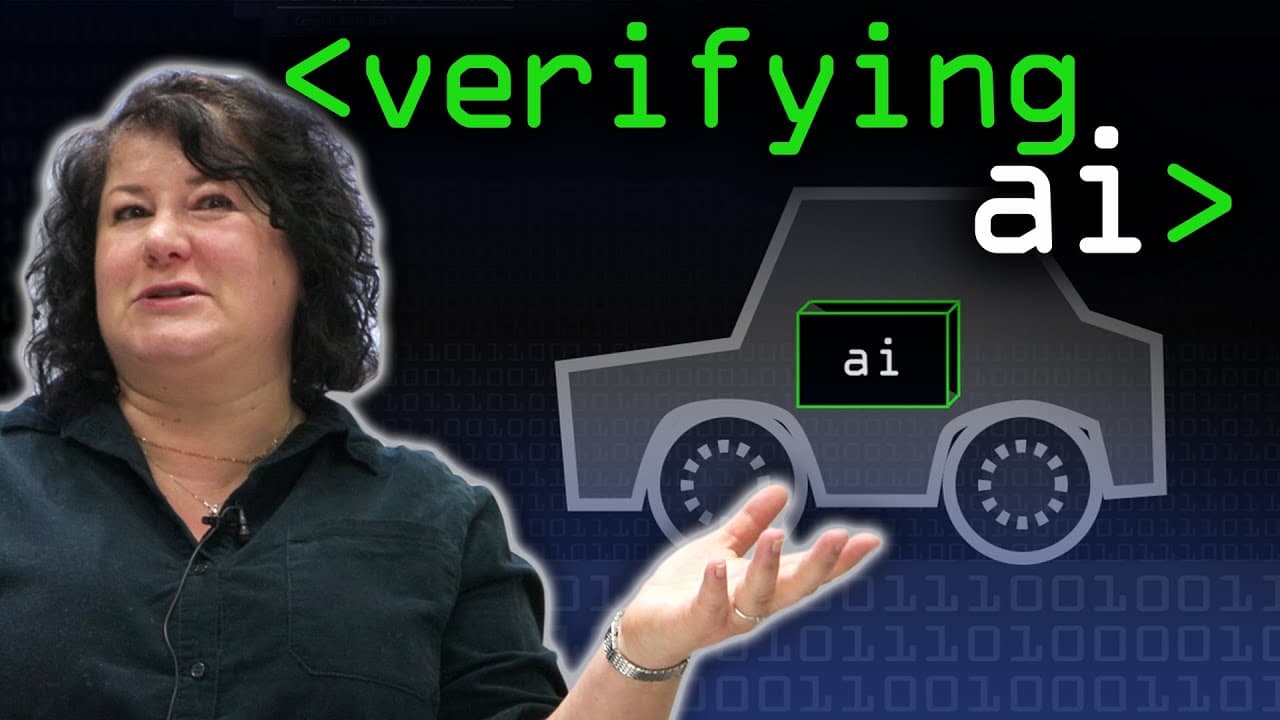
AI black boxes can be verified without opening them by finding the minimal subset of an input image that still produces the same classification. The proposed method repeatedly covers or removes image regions, revealing whether a system recognized a red panda from its face or relied on irrelevant cues such as the sky or background. These explanations support trust, debugging, and the discovery of misclassifications. Read on to understand the full step-by-step method.
Transcript
we are going to talk about explanations of a black box AI systems right so we have a black box system it does some magic inside and it gives us an output how do we know that this output is actually correct if you know the system installed in our self-driving car is not recognizing the obstacles correctly we're gonna crash I'm sure that you know man... Read More
Key Insights
- 🗃️ Explanations are crucial for building trust and confidence in black box AI systems, particularly in areas like self-driving cars.
- 🚠 Verifying the correctness of AI outputs and being able to debug and fix issues is important.
- 📬 Explanations can be generated without opening the black box by identifying the minimal subset of the image that influences the system's decision.
- ❓ The ability to give multiple explanations, considering different features of an object, is crucial for AI systems to align with human recognition.
- 🆘 Explanations can help uncover misclassifications and suggest improvements to training datasets.
- 🏆 The sanity of explanations can be checked by testing them on different images or scenarios.
- 🧑🏭 Explanations should aim to mimic human recognition, considering factors like symmetry and occlusions.
Install to Summarize YouTube Videos and Get Transcripts
Explore YouTube Video Summarizer or Get YouTube Transcript Extractor
Questions & Answers
Q: How can we verify an AI black box without opening it?
Test how its output changes as different parts of the input are covered or removed. The goal is to find a minimal subset of the image that is sufficient for the AI to produce the same classification, revealing which visual evidence influenced its decision.
Q: Why do black box AI systems need explanations?
Explanations help users judge whether an AI reached its output for sensible reasons and can increase trust and confidence in the system. They also help developers determine whether the system works correctly and identify problems that need debugging.
Q: How does the cardboard method explain an image classification?
The method covers regions of an image with cardboard and checks whether the AI retains its classification. Irrelevant regions are discarded iteratively, while influential regions are refined until a minimal sufficient part of the image remains.
Q: What does “minimal and sufficient” mean in this explanation method?
“Sufficient” means the visible image region still makes the AI return the same classification. “Minimal” means irrelevant areas have been removed until the explanation contains only a small region needed to preserve that result.
Q: How was the red panda classification checked?
Parts of the red panda image were progressively covered while the system's output was observed. A large part of the panda's head remained as the minimal sufficient region, suggesting that the network used the animal's face rather than an irrelevant cue such as a blue sky, tree background, or the day being Monday.
Q: How can a person check whether an AI explanation is sensible?
A person can inspect the minimal sufficient image region and ask whether it contains recognizable evidence for the classification. In the red panda example, seeing the panda's face made the explanation align with how a human might recognize the animal.
Q: Can this method explain classifications of images other than pandas?
Yes. The same cardboard method was applied to an image recognized as a Welsh Springer Spaniel, producing an area that was minimal and sufficient for that classification.
Q: How can these explanations help uncover AI misclassifications?
They show which part of an image drove the AI's decision, making it easier to see when the system relied on inappropriate evidence. The transcript introduces this as an application for investigating cases where a black box system assigns the wrong class.
Summary & Key Takeaways
-
Explanations play a vital role in building trust and confidence in AI systems, especially in the context of self-driving cars.
-
The ability to verify the correctness of AI outputs and debug them is essential for ensuring their reliability.
-
An explanation method is proposed using a minimal subset of the image that is sufficient for an AI system to recognize an object, without opening the black box.
Read in Other Languages (beta)
Share This Summary 📚
Summarize YouTube Videos and Get Video Transcripts with 1-Click
Try YouTube Summary with ChatGPT & Claude or YouTube Transcript Generator
Explore More Summaries from Computerphile 📚




Summarize YouTube Videos and Get Video Transcripts with 1-Click
Try YouTube Summary with ChatGPT & Claude or YouTube Transcript Generator