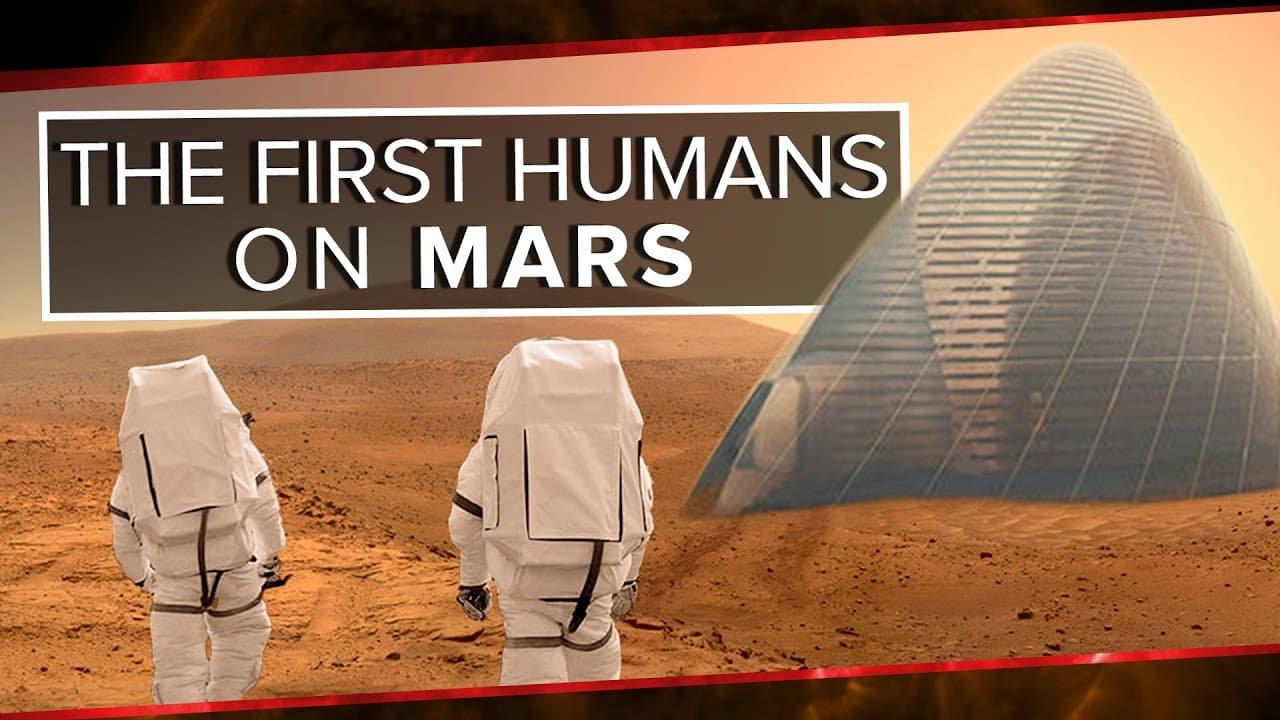
The First Humans on Mars
TL;DR
SpaceX aims to colonize Mars with 100 people in 10 years.
Transcript
[MUSIC PLAYING] MATTHEW O'DOWD: This episode is supported by Curiosity Stream. There's been a lot of talk lately about putting humans on Mars and even colonizing the red planet. Is this even possible? And what would that settlement actually look like? [MUSIC PLAYING] Mars is getting a lot of attention. NASA's new budget mandates a 25-year timescale... Read More
Key Insights
- Elon Musk's SpaceX plans to send 100 people to Mars to establish a self-sustaining colony, with the goal of safeguarding against human extinction.
- SpaceX's strategy involves reusable rocket components to transport fuel and passengers separately, allowing for a larger payload capacity.
- Initial Martian habitats might be inflatable, modular structures, or built using local materials, potentially utilizing lava tubes or 3D-printed structures.
- Radiation protection is crucial on Mars due to its thin atmosphere and lack of a magnetic field; thick roofs or underground habitats may be necessary.
- Water is abundant as ice on Mars and can be used for drinking, growing food, and producing oxygen, essential for sustaining life.
- Hydroponic farms could be used to grow food, requiring less water and offering better protection against radiation than traditional farming.
- Energy needs could be met with large solar arrays on Mars, though the effects of low gravity on human health remain uncertain.
- Economic viability and self-sufficiency are critical for the long-term success of a Martian colony, challenging its feasibility beyond initial enthusiasm.
Install to Summarize YouTube Videos and Get Transcripts
Explore YouTube Video Summarizer or Get YouTube Transcript Extractor
Questions & Answers
Q: What is the goal of Elon Musk's SpaceX program for Mars?
Elon Musk's SpaceX program aims to establish a self-sustaining colony on Mars, with the ultimate goal of safeguarding against human extinction. The plan involves sending 100 people at a time to Mars, using reusable rocket components to transport both passengers and fuel separately, allowing for a larger payload capacity.
Q: How does SpaceX plan to transport people and resources to Mars?
SpaceX plans to use a spacecraft launched into orbit by a rocket booster, which then returns to the launchpad to be loaded with fuel. This fuel is delivered to the orbiting spacecraft, enabling the four-month journey to Mars. The reusability of the rocket components is key, allowing for multiple trips and a larger payload capacity.
Q: What are the proposed solutions for radiation protection on Mars?
Radiation protection is crucial on Mars due to its thin atmosphere and lack of a magnetic field. Proposed solutions include living underground or constructing dense shelters from local materials. Prefabricated habitats with advanced radiation shielding and 3D-printed structures on the surface are also considered viable options.
Q: How will water be sourced and utilized on Mars?
Water is abundant on Mars as ice within the surface. It is essential for drinking, growing food, and potentially producing oxygen. The water can be used to create a breathable atmosphere by mixing it with Mars's nitrogen-argon atmosphere, after removing CO2, to provide a buffer gas topped with 20% oxygen.
Q: What are the energy solutions proposed for a Martian colony?
Energy needs on Mars could be met with giant solar arrays stretching across the Martian surface. Solar power is considered the simplest solution, providing the necessary energy for habitats, water processing, and hydroponic farming. The challenge lies in ensuring consistent energy supply given Mars's varying sunlight conditions.
Q: What are the potential health concerns for humans living on Mars?
One major health concern is the effect of Mars's low gravity, which is 0.38 times that of Earth. Prolonged exposure to low gravity could lead to bone mass loss, similar to what astronauts experience in zero gravity. Long-term solutions may involve creating artificial gravity environments, such as centrifuge cities, to mitigate these effects.
Q: What role does economic viability play in the success of a Martian colony?
Economic viability is crucial for the long-term success of a Martian colony. The settlement must be self-sufficient or economically productive enough to justify continued support from Earth. The feasibility of the colony depends on its ability to sustain itself without constant resupply missions, making economic considerations a significant challenge.
Q: How does the SpaceX plan for Mars compare to NASA's current plans?
NASA's current plans involve putting astronauts in orbit around Mars within 25 years, focusing on exploration rather than colonization. In contrast, SpaceX aims to establish a permanent settlement on Mars within 10 years, with a more ambitious timeline and goals, emphasizing the creation of a self-sustaining colony to ensure human survival.
Summary & Key Takeaways
-
Elon Musk's SpaceX aims to establish a self-sustaining colony on Mars, transporting 100 people at a time using reusable rocket components. The plan includes overcoming challenges like radiation, resource production, and low gravity effects.
-
Initial habitats on Mars may be inflatable or constructed using local materials, with radiation shielding being a priority. Water, essential for life, is abundant as ice and can be used for various purposes, including oxygen production.
-
Economic sustainability and self-sufficiency are crucial for the long-term success of a Martian colony. The project faces challenges, but its feasibility depends on technological advancements and economic considerations.
Read in Other Languages (beta)
Share This Summary 📚
Summarize YouTube Videos and Get Video Transcripts with 1-Click
Try YouTube Summary with ChatGPT & Claude or YouTube Transcript Generator
Explore More Summaries from PBS Space Time 📚





Summarize YouTube Videos and Get Video Transcripts with 1-Click
Try YouTube Summary with ChatGPT & Claude or YouTube Transcript Generator