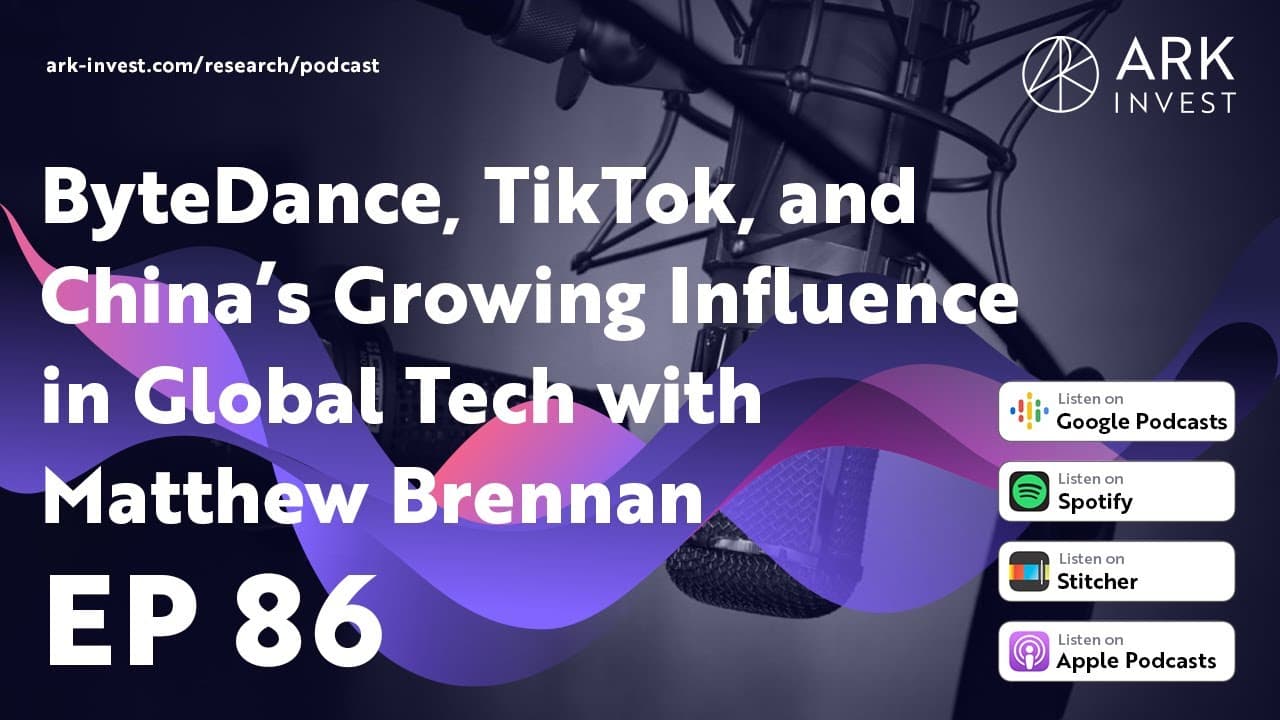
How Did TikTok Become a Global Tech Power?
TL;DR
TikTok achieved global success by combining a proven short-video format with ByteDance’s powerful recommendation technology. Music-driven challenges lowered the barrier to creating appealing content, while data about viewing behavior and video classification helped the platform refine recommendations, strengthen user engagement, and expand beyond the limitations faced by earlier apps such as Musical.ly and Vine.
Transcript
welcome to fyi the four-year innovation podcast this show offers an intellectual discussion on technologically enabled disruption because investing in innovation starts with understanding it to learn more visit arc dash invest dot com arc invest is a registered investment advisor focused on investing in disruptive innovation this podcast is for inf... Read More
Key Insights
- ByteDance’s foundational advantage was its recommendation engine, which powered strong retention before the company became associated with short video. Its Chinese news aggregator Toutiao reportedly kept average users engaged for about 45 to 60 minutes per day, ranking behind only WeChat in time spent on Chinese mobile devices.
- TikTok’s recognizable user experience originated before ByteDance entered short video. A small engineering team in a Paris basement created the combination of full-screen vertical clips, upward swiping, and music-driven content discovery in 2013, establishing the product pattern that later platforms adopted and expanded.
- TikTok is described as the international version of Douyin, while Douyin copied Musical.ly and Musical.ly copied an earlier app called Mindie. This lineage shows that TikTok’s success depended less on inventing the basic interface than on improving the technology, distribution, and engagement systems behind it.
- ByteDance entered short video after established competitors had already attracted users. Musical.ly was already prominent in Western markets, yet ByteDance paired a similar experience with a substantially stronger technical backend and recommendation system, which Matthew Brennan identifies as the largest single reason for TikTok’s greater impact.
- Musical.ly’s early growth accelerated after it embraced lip-syncing during the popularity of Lip Sync Battle and Dubsmash. The platform became especially popular with teenagers in Europe and North America, challenging the belief in China that Chinese teams could not understand or build successful social products for American teenagers.
- Challenges reduce the barrier to short-video creation by giving users a repeatable template. Instead of inventing an entirely new concept, participants can reproduce a popular dance, song, or meme in their own way, making creation easier while allowing related content to spread rapidly across the platform.
- Vine’s central difficulty was generating consistently interesting material, rather than teaching people how to record clips. Recording tools could be extremely simple, but users still needed ideas audiences wanted to watch. Musical.ly addressed that problem through video memes and challenges that provided accessible prompts for content creation.
- TikTok’s recommendation process benefits from both data and content flywheels, according to the episode description. Advances in video classification also help enrich user profiles, allowing the platform to connect viewing behavior with characteristics of individual videos and progressively improve the relevance of content presented to users.
Install to Summarize YouTube Videos and Get Transcripts
Explore YouTube Video Summarizer or Get YouTube Transcript Extractor
Questions & Answers
Q: How did TikTok become successful around the world?
TikTok became successful by combining an already proven short-video experience with ByteDance’s powerful recommendation technology. Full-screen vertical clips, upward swiping, music, and challenges made content easy to consume and reproduce. ByteDance’s backend could then match material with viewers effectively, creating stronger engagement than earlier platforms that offered similar formats without the same recommendation capabilities.
Q: What made ByteDance’s recommendation engine important?
ByteDance’s recommendation engine demonstrated its value before TikTok through Toutiao, the company’s Chinese news aggregation app. Despite criticism that it served clickbait, memes, and lightweight material, Toutiao produced unusually strong usage statistics. Average users reportedly spent about 45 to 60 minutes per day in the app, placing it behind only WeChat for time spent on mobile in China.
Q: What is the relationship between TikTok, Douyin, and Musical.ly?
TikTok is characterized as the international version of Douyin, ByteDance’s Chinese short-video product. Douyin copied the user experience of Musical.ly, while Musical.ly had copied an earlier app called Mindie. The sequence is therefore described as a clone of a clone of a clone, although ByteDance differentiated its product through recommendation technology and a stronger backend.
Q: Who created the short-video interface associated with TikTok?
A small team of engineers working in a Paris basement created the basic experience in 2013. Their design combined full-screen vertical video, an upward swipe to move to the next clip, and music-driven content discovery. Musical.ly later copied that app, and the same core interaction pattern eventually became associated globally with Douyin and TikTok.
Q: Why did Musical.ly become popular with teenagers?
Musical.ly gained momentum by shifting toward lip-sync content during the popularity of Lip Sync Battle and Dubsmash. It also recognized that challenges encouraged participation because users could follow an existing format instead of developing an original concept. That approach helped the platform become especially popular among teenagers in Europe and North America.
Q: How do challenges encourage people to create short videos?
Challenges provide a simple creative template that users can copy and personalize. When a dance, song, or meme becomes popular, participants only need to make their own version rather than invent a new format. This cookie-cutter process lowers creative friction, normalizes imitation, and gives people a clear idea of what to record and share.
Q: Why did Vine struggle despite having simple recording tools?
Vine’s main problem was not the mechanics of recording, since creating a clip could be as simple as holding down a button. The harder task was producing something interesting that other people wanted to watch. Musical.ly addressed this creative challenge more effectively by using video memes and repeatable challenges as prompts for users who needed content ideas.
Q: How does video classification support TikTok recommendations?
Video classification helps enrich user profiles by connecting information about content with data about viewing behavior. The episode describes TikTok’s recommendation system in terms of data and content flywheels, suggesting that better understanding of videos and users improves matching over time. These capabilities strengthened ByteDance’s recommendation advantage and supported the platform’s rapid growth and retention.
Summary & Key Takeaways
-
ByteDance first gained attention through Toutiao, a Chinese news aggregation app known for clickbait and lightweight content but distinguished by unusually strong engagement. Users reportedly spent about 45 to 60 minutes daily in the app, demonstrating the effectiveness of the recommendation engine that later became central to ByteDance’s short-video strategy.
-
TikTok’s core interface did not emerge from a single original invention. A small engineering team in Paris created the full-screen vertical video experience with upward swiping and music-driven discovery in 2013. Musical.ly copied that format, Douyin followed Musical.ly, and TikTok became the international version associated with ByteDance’s global expansion.
-
Musical.ly helped popularize short-video creation among teenagers in Europe and North America by embracing lip-syncing, songs, memes, and repeatable challenges. These conventions reduced creative friction because users could imitate an established dance or format instead of inventing an idea from scratch, addressing a content-generation problem that had limited platforms such as Vine.
Read in Other Languages (beta)
Share This Summary 📚
Summarize YouTube Videos and Get Video Transcripts with 1-Click
Try YouTube Summary with ChatGPT & Claude or YouTube Transcript Generator
Explore More Summaries from ARK Invest 📚



Summarize YouTube Videos and Get Video Transcripts with 1-Click
Try YouTube Summary with ChatGPT & Claude or YouTube Transcript Generator