What Is Cryptography in Computer Science?
TL;DR
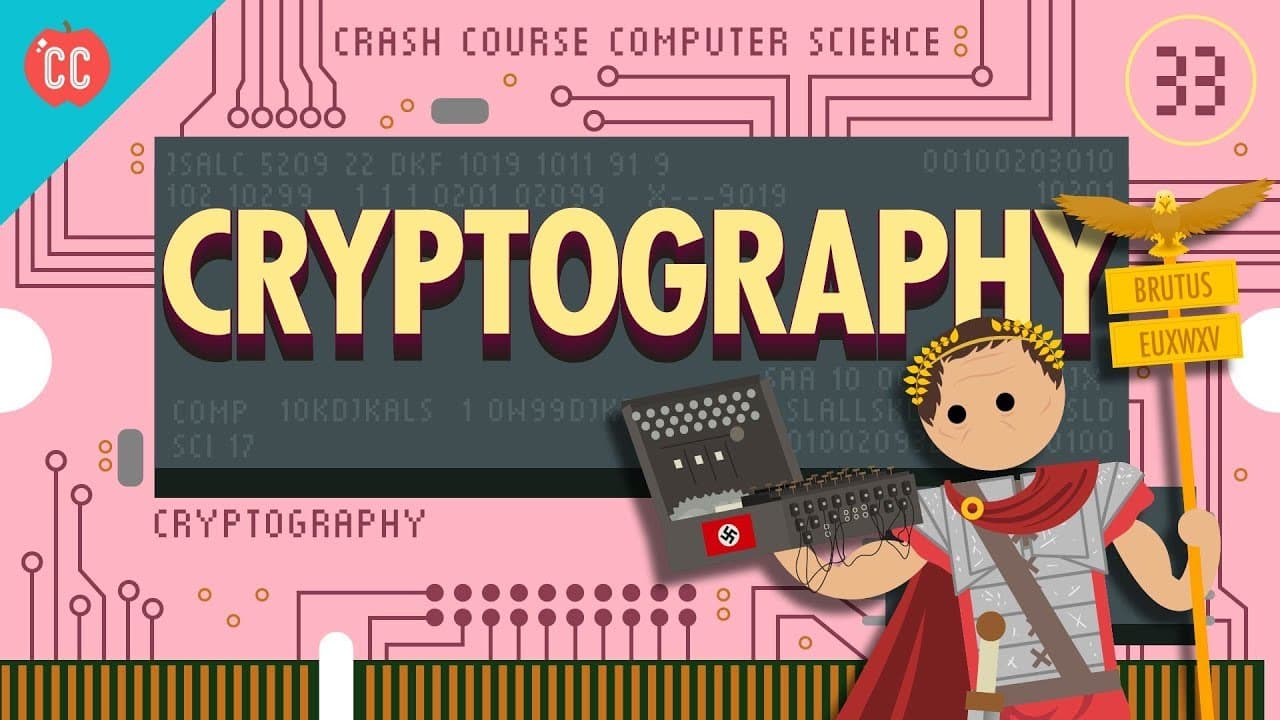
Cryptography is essential for securing information, employing techniques like encryption and decryption to keep data private. Historically used by figures like Julius Caesar, modern cryptography involves complex algorithms such as AES and RSA, ensuring secure communication over the internet. Key exchange methods like Diffie-Hellman allow secure key agreement without direct transmission.
Transcript
Hi, I’m Carrie Anne, and welcome to CrashCourse Computer Science! Over the past two episodes, we’ve talked a lot about computer security. But the fact is, there’s no such thing as a perfectly, 100% secure, computer system. There will always be bugs and security experts know that. So system architects employ a strategy called defence in depth, which... Read More
Key Insights
- Cryptography is the practice of securing information through encryption and decryption.
- The Caesar cipher is a simple substitution cipher used by Julius Caesar for secret communication.
- Permutation ciphers reorder message characters, serving as another encryption method.
- The Enigma machine, used in WWII, was a complex encryption device eventually cracked by Alan Turing.
- AES uses large keys and multiple encryption rounds for robust security in modern applications.
- Diffie-Hellman Key Exchange allows secure key agreement without direct key transmission.
- RSA is a widely used asymmetric encryption technique involving public and private keys.
- Public key cryptography verifies servers and establishes secure communication over the internet.
Install to Summarize YouTube Videos and Get Transcripts
Explore YouTube Video Summarizer or Get YouTube Transcript Extractor
Questions & Answers
Q: How does the Caesar cipher work?
The Caesar cipher is a substitution cipher where each letter in the plaintext is shifted a certain number of places down or up the alphabet. For example, with a shift of three, A becomes D, B becomes E, and so on. The recipient must know the shift key to decrypt the message back to its original form.
Q: What is the Enigma machine?
The Enigma machine was a German encryption device used during World War II to secure military communications. It employed a series of rotors and a plugboard to create complex substitution ciphers. The machine's configuration changed with each keystroke, making it a formidable cryptographic tool until it was cracked by Allied cryptanalysts, including Alan Turing.
Q: What is the Advanced Encryption Standard (AES)?
AES is a symmetric encryption algorithm that uses keys of 128, 192, or 256 bits to encrypt data. It breaks data into 16-byte blocks and applies a series of substitutions and permutations, repeated multiple times, to ensure security. AES is widely used in various applications, from encrypting files to securing internet communications.
Q: How does Diffie-Hellman Key Exchange work?
Diffie-Hellman Key Exchange is a method for two parties to securely agree on a shared secret key over a public channel. It uses modular exponentiation, where each party selects a private number and exchanges a computed value based on a public base and modulus. Both parties independently compute the shared key using the other's exchanged value, ensuring secure communication without directly transmitting the key.
Q: What is RSA encryption?
RSA is an asymmetric encryption technique that uses a pair of keys: a public key for encryption and a private key for decryption. It is based on the difficulty of factoring large prime numbers. RSA enables secure data transmission and digital signatures, ensuring that only the intended recipient can decrypt the message using their private key.
Q: What is symmetric encryption?
Symmetric encryption is a cryptographic method where the same key is used for both encrypting and decrypting data. This means that both the sender and recipient must have access to the secret key. Symmetric encryption is efficient and widely used for securing data, with algorithms like AES being popular choices due to their speed and security.
Q: What is asymmetric encryption?
Asymmetric encryption uses two different keys: a public key for encryption and a private key for decryption. This allows anyone to encrypt a message using the recipient's public key, but only the recipient can decrypt it with their private key. Asymmetric encryption is used for secure communications and digital signatures, providing a high level of security.
Q: How does public key cryptography ensure security?
Public key cryptography ensures security by using a pair of keys: a public key for encryption and a private key for decryption. The public key can be shared openly, allowing others to encrypt messages that only the private key holder can decrypt. This method verifies identities, secures data transmission, and enables digital signatures, ensuring data integrity and authenticity.
Summary & Key Takeaways
-
Cryptography involves encrypting and decrypting information to keep it secure. Historically, techniques like the Caesar cipher were used, while modern methods include AES and RSA. These algorithms ensure data privacy and secure communication over the internet by employing complex key exchanges and public-key cryptography.
-
The Enigma machine, a sophisticated encryption device used during WWII, exemplifies the evolution of cryptography. Alan Turing's team cracked its codes, highlighting the importance of cryptanalysis. Today, asymmetric encryption like RSA and symmetric methods like AES protect online communications and transactions.
-
Key exchange methods, such as Diffie-Hellman, enable secure key agreement without directly transmitting keys. This innovation is crucial for internet security, allowing encrypted communication between parties. Cryptography remains vital for protecting sensitive information in the digital age, balancing performance and security.
Read in Other Languages (beta)
Share This Summary 📚
Summarize YouTube Videos and Get Video Transcripts with 1-Click
Try YouTube Summary with ChatGPT & Claude or YouTube Transcript Generator
Explore More Summaries from CrashCourse 📚





Summarize YouTube Videos and Get Video Transcripts with 1-Click
Try YouTube Summary with ChatGPT & Claude or YouTube Transcript Generator