138 – Alternative Ways to Cue & Provide Feedback
TL;DR
Explores innovative feedback and cueing techniques for skill acquisition.
Transcript
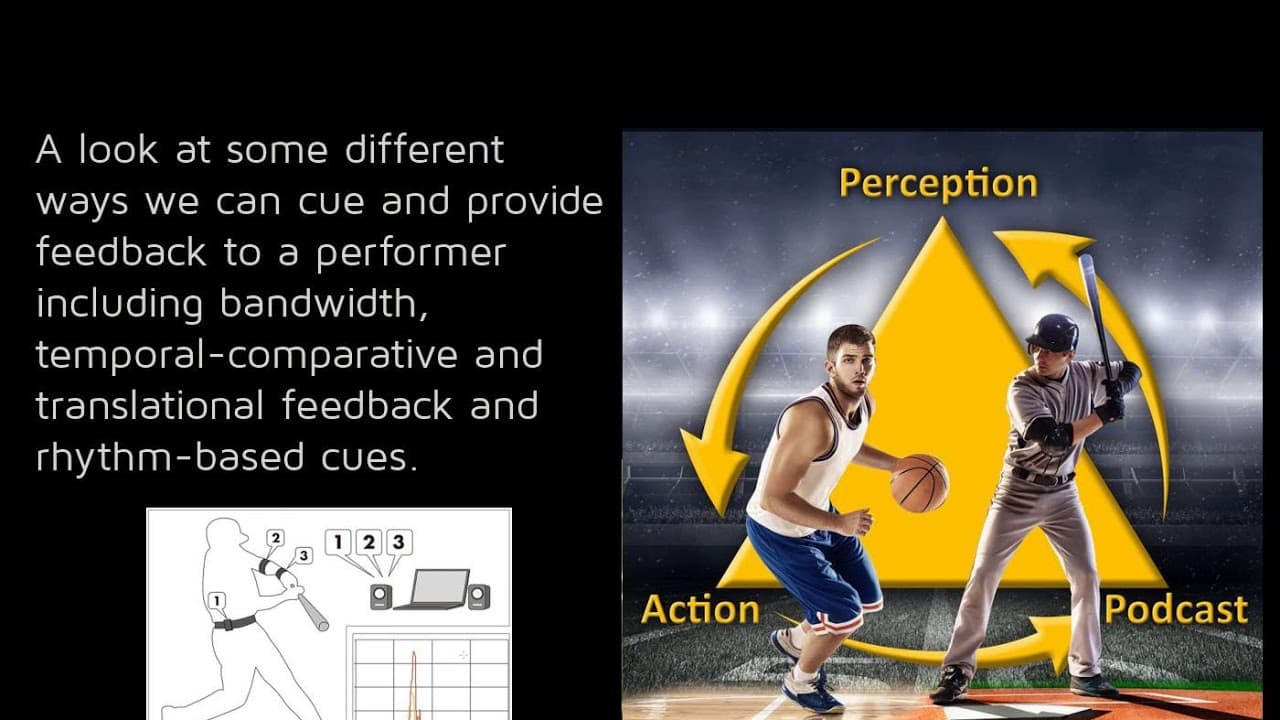
today on the perception and action podcast a look at some different ways we can cue and provide feedback to a performer including bandwidth temporal comparative and translational feedback and rhythm based queuing so it's time for a call to action hi everyone this is Rob gray from Arizona State University in perception action calm welcome to the per... Read More
Key Insights
- Traditional feedback methods, like extrinsic knowledge of results, can hinder skill acquisition if overused or mistimed, leading to performer desensitization to intrinsic feedback.
- Bandwidth feedback provides feedback only when performance falls outside a defined range, reducing overcorrection and focusing on significant errors.
- Translational feedback combines knowledge of results and performance, directing attention to movement aspects needing correction, enhancing complex skill learning.
- Temporal comparative feedback, even when false, can motivate learners by suggesting performance improvement, though its effectiveness may vary with experience level.
- Rhythm cueing emphasizes the timing of movements rather than dissecting them into parts, potentially enhancing performance by maintaining a natural rhythm.
- Auditory cues are more effective than visual cues for conveying temporal structure and synchronizing movements, useful in rhythm-based training.
- Research shows rhythm cueing can improve kinetic chain effectiveness in movements like baseball swings by promoting efficient energy transfer.
- Integrating rhythm and temporal structure understanding into training can refine movement patterns and improve motor skill performance.
Install to Summarize YouTube Videos and Get Transcripts
Explore YouTube Video Summarizer or Get YouTube Transcript Extractor
Questions & Answers
Q: What is bandwidth feedback and how does it work?
Bandwidth feedback involves providing feedback only when an athlete's performance falls outside a predefined range around a target outcome. This method reduces the frequency of feedback, preventing overcorrection and allowing athletes to focus on significant errors. By defining a performance bandwidth, coaches can give feedback when it is most needed, enhancing skill learning and retention.
Q: How does translational feedback differ from traditional feedback?
Translational feedback combines knowledge of results (KR) and knowledge of performance (KP) by directing an athlete's attention to specific movement aspects needing correction. This approach helps performers understand how to adjust their movements based on feedback, addressing the limitations of KR feedback in complex tasks where simple error correction is not straightforward.
Q: What is the role of temporal comparative feedback in motor learning?
Temporal comparative feedback provides information comparing an athlete's current performance to previous trials, often suggesting improvement. This type of feedback can enhance motivation by creating a sense of progress and competence, even if the feedback is false. It is particularly effective for novices, though experienced performers may recognize discrepancies between feedback and actual performance.
Q: Why are rhythm cues considered effective in coaching?
Rhythm cues focus on the temporal structure of movements, emphasizing the timing of an entire skill rather than dissecting it into parts. This approach helps maintain a natural rhythm, which is crucial for efficient and effective movement execution. Rhythm cueing can refine movement patterns without invoking conscious control, making it a valuable tool for coaches.
Q: What advantages do auditory cues have over visual cues in training?
Auditory cues can convey more temporal information than visual cues and allow for more accurate synchronization with movements. This makes them particularly effective for rhythm-based training, where maintaining the timing of movements is crucial. Auditory feedback can enhance motor learning by providing clear temporal guidance without visual distraction.
Q: How can rhythm-based training improve kinetic chain efficiency?
Rhythm-based training can improve the kinetic chain by promoting effective energy transfer through coordinated body movements. By focusing on the relative timing of movement components, athletes can enhance the connection between different body parts, leading to more powerful and efficient movements. This approach is beneficial for complex tasks like baseball swings.
Q: What are the implications of using false feedback in training?
Using false feedback, such as in temporal comparative feedback, can motivate learners by suggesting improvement, enhancing their sense of competence. However, its effectiveness may vary depending on the athlete's experience level. Novices may benefit from the motivational aspect, while experienced performers might recognize the feedback's inaccuracies, potentially reducing its impact.
Q: How does rhythm cueing relate to metabolic efficiency?
Rhythm cueing aligns with the body's preferred cadence or pace, reducing the effort required for movements. When athletes perform at their natural rhythm, they experience lower oxygen consumption and greater metabolic efficiency. This makes rhythm cueing not only effective for performance enhancement but also beneficial for energy conservation during physical activities.
Summary & Key Takeaways
-
The podcast discusses innovative feedback and cueing methods for athletes, including bandwidth, translational, and temporal comparative feedback, which address limitations of traditional techniques. These methods aim to enhance skill acquisition by focusing on significant errors and providing motivational cues.
-
Rhythm-based cueing is highlighted as an effective alternative for refining movement patterns. By emphasizing the temporal structure of movements, rhythm cueing can help maintain natural movement rhythms and improve performance, particularly in complex tasks requiring coordinated body movements.
-
Auditory cues are preferred for rhythm-based training due to their ability to convey temporal information effectively. Research supports the use of rhythm cues in improving kinetic chain efficiency in sports, suggesting a potential for broader application in coaching and skill development.
Read in Other Languages (beta)
Share This Summary 📚
Summarize YouTube Videos and Get Video Transcripts with 1-Click
Try YouTube Summary with ChatGPT & Claude or YouTube Transcript Generator
Explore More Summaries from Rob Gray 📚
Summarize YouTube Videos and Get Video Transcripts with 1-Click
Try YouTube Summary with ChatGPT & Claude or YouTube Transcript Generator