Should We Build a Dyson Sphere? | Space Time | PBS Digital Studios
TL;DR
Dyson spheres are impractical, but Dyson swarms and Kugelblitzes offer feasible energy solutions.
Transcript
MATTHEW O'DOWD: This episode is supported by "The Great Courses plus." The idea of Dyson spheres has captured our imaginations. Vast mega structures, capable of harvesting the power output of entire stars, the as yet inexplicable Kepler Space Telescope observation of swarms of somethings partially eclipsing a distant star has led to some rampant sp... Read More
Key Insights
- Dyson spheres, as proposed by Freeman Dyson, are massive structures that could theoretically capture the energy of an entire star, elevating a civilization to type 2 on the Kardashev scale.
- A solid Dyson sphere is impractical due to material constraints, gravitational issues, and instability, making it an inefficient method for energy capture.
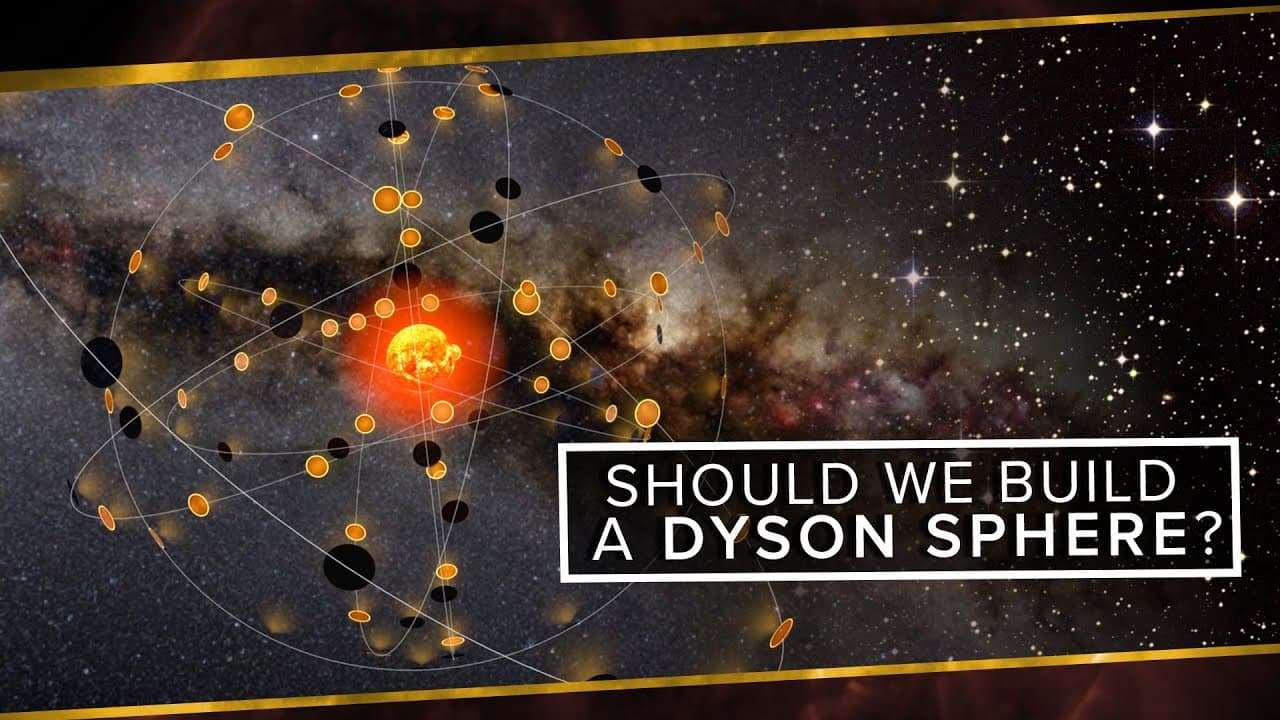
- A Dyson swarm, composed of numerous smaller solar collectors orbiting a star, offers a more feasible alternative to harnessing stellar energy.
- The construction of a Dyson swarm could begin with Mercury, utilizing its abundant iron core and low gravity for efficient material launch into space.
- The exponential growth of autonomous mining and manufacturing technologies could facilitate the construction of a Dyson swarm within decades.
- Alternative energy solutions like Kugelblitzes, which involve black hole engines, offer 100% mass-to-energy conversion efficiency, potentially surpassing Dyson swarms.
- Kugelblitzes require immense energy to create, but a partial Dyson swarm could provide the necessary power for their formation.
- The absence of detectable Dyson swarms in the galaxy might be explained by civilizations transitioning to more efficient energy solutions like Kugelblitzes.
Install to Summarize YouTube Videos and Get Transcripts
Explore YouTube Video Summarizer or Get YouTube Transcript Extractor
Questions & Answers
Q: What is a Dyson sphere and why is it impractical?
A Dyson sphere is a hypothetical megastructure that encircles a star to capture its energy output. It is impractical because no known or imagined material could withstand the stresses of such a structure. Additionally, it would require more material than exists in the solar system and would be unstable due to gravitational forces.
Q: How does a Dyson swarm differ from a Dyson sphere?
A Dyson swarm consists of numerous smaller solar collectors orbiting a star, each with its own stable orbit. Unlike a solid Dyson sphere, a swarm is feasible because it avoids the material and stability issues of a single large structure. It allows for gradual construction and scalability using available resources.
Q: Why is Mercury considered ideal for starting a Dyson swarm?
Mercury is ideal for starting a Dyson swarm because it has a large iron core, providing abundant materials for construction. Its low gravity makes launching materials into space efficient. The planet's composition allows for the creation of reflective materials needed for solar collectors, making it a strategic starting point for a swarm.
Q: What are Kugelblitzes and how do they compare to Dyson swarms?
Kugelblitzes are black hole engines that convert mass into energy with 100% efficiency, offering a more efficient energy capture method than Dyson swarms. They require significant energy to create, but once formed, they are scalable and can provide energy for a type 3 civilization. A partial Dyson swarm could supply the energy needed to create Kugelblitzes.
Q: What technological advancements are needed to build a Dyson swarm?
Building a Dyson swarm requires advancements in autonomous mining, manufacturing, and space transportation technologies. These technologies are progressing exponentially, with plans for space-based assembly and 3D printing. Autonomous asteroid mining is also in development, which could provide additional resources for constructing a Dyson swarm.
Q: Why might we not observe Dyson swarms in the galaxy?
The absence of observable Dyson swarms could be due to civilizations transitioning to more efficient energy solutions like Kugelblitzes, which are less conspicuous. Alternatively, civilizations may encounter challenges in building such structures, or they might have developed other advanced technologies that are undetectable with our current methods.
Q: What role does the Kardashev scale play in the discussion of Dyson spheres?
The Kardashev scale measures a civilization's technological advancement based on energy consumption. A civilization that harnesses the energy of its star, as with a Dyson sphere or swarm, would reach type 2 status. The discussion explores whether Dyson structures are a necessary step for achieving this level of advancement.
Q: What potential challenges exist in creating Kugelblitzes?
Creating Kugelblitzes requires focusing a significant portion of a star's energy output into a small area to form a black hole. This process demands precise control and immense energy. While a partial Dyson swarm could provide the necessary power, the technological and logistical challenges of forming and maintaining Kugelblitzes remain substantial.
Summary & Key Takeaways
-
Dyson spheres, vast structures proposed to capture a star's energy, are deemed impractical due to material and stability issues. However, Dyson swarms, consisting of smaller solar collectors, offer a feasible alternative.
-
The construction of a Dyson swarm could start with Mercury, utilizing its iron core for materials. Autonomous technologies could enable the swarm's growth, potentially leading to a type 2 civilization.
-
Kugelblitzes, or black hole engines, provide an alternative energy solution with 100% efficiency. A partial Dyson swarm could supply the energy needed for their creation, offering a path beyond type 2 civilization.
Read in Other Languages (beta)
Share This Summary 📚
Summarize YouTube Videos and Get Video Transcripts with 1-Click
Try YouTube Summary with ChatGPT & Claude or YouTube Transcript Generator
Explore More Summaries from PBS Space Time 📚





Summarize YouTube Videos and Get Video Transcripts with 1-Click
Try YouTube Summary with ChatGPT & Claude or YouTube Transcript Generator