How to build a profitable SaaS from scratch
TL;DR
Start by identifying a deeply annoying problem you personally feel and that you would pay to solve. Then find a complementary co founder and move fast to build a minimal viable product, get early users, and iterate based on tight feedback from real customers.
Transcript
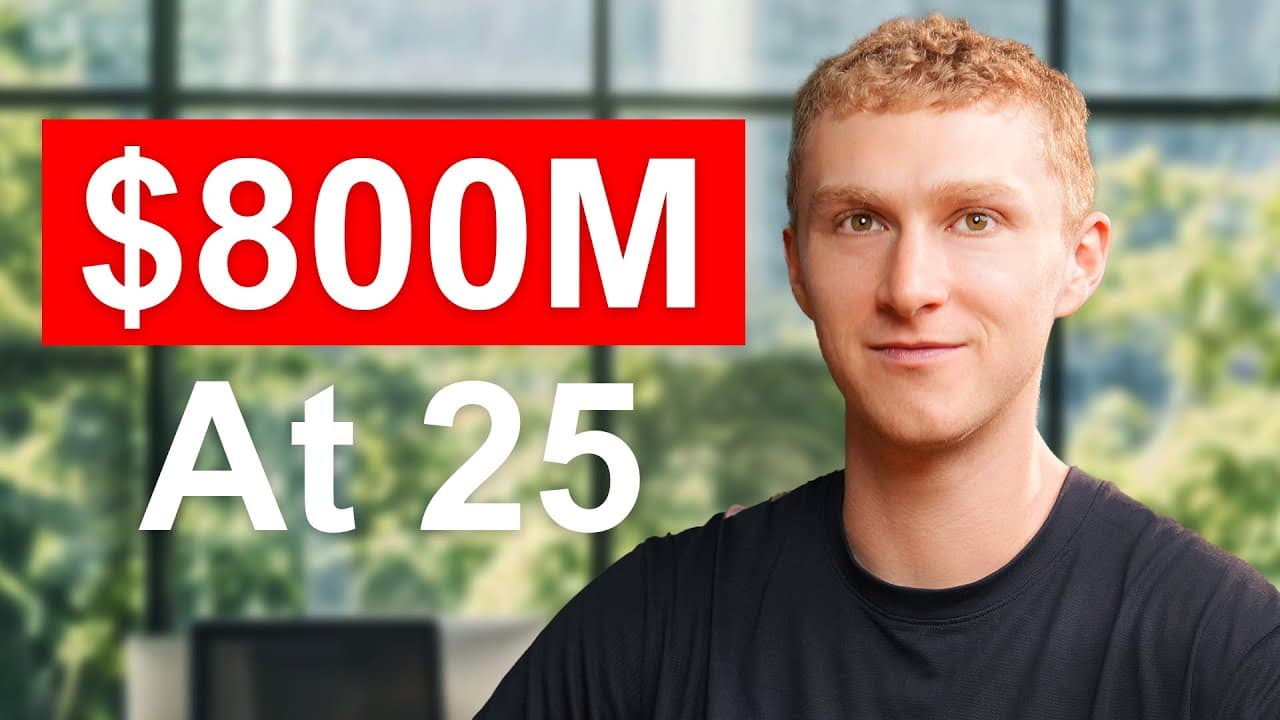
How old were you when you made your first $100,000? Um, probably like end of 13 years old, early 14. You made $100,000 at 14 years old. How old were you when you dropped out of high school? 16. How much is your company roughly worth right now? Um, our last valuation we raised at last year, a little over a year ago, was uh $800 million. You've done ... Read More
Key Insights
- The starting point is a problem you personally find annoying and worth solving, which increases motivation and likelihood of finding a viable solution.
- Founders should seek a complementary co founder rather than going solo, using groups and communities to meet potential partners and build a long term working relationship.
- Build the product quickly with a clearly defined minimum viable product that satisfies core functionality and can be tested by real users to gather meaningful feedback.
- Get the product in front of users as fast as possible, even before all features are complete, to start learning what to improve through direct conversations.
- Validation requires talking to both sellers and buyers in the target space, identifying where they hang out online or offline, and arranging conversations or paid interviews for feedback.
- Pricing can be initially generous toward early adopters to remove friction and encourage trials, helping to accelerate early traction and data collection for iteration.
- The approach favors an adaptable, factory-line mentality where each stage has a clear next checkpoint and the team relentlessly pushes toward getting a working version live.
- The decision framework for building is to maximize learning per unit of time, balancing annoyance with excitement to ensure the project remains both motivated and feasible.
- More videos from this channel:
- More from this channel: Brett Malinowski
Install to Summarize YouTube Videos and Get Transcripts
Explore YouTube Video Summarizer or Get YouTube Transcript Extractor
Questions & Answers
Q: How do you identify a strong initial idea for a SaaS product?
A strong first idea comes from a problem that annoys you and that you would pay to fix. You should write down daily annoyances for a month and evaluate which ones create value and excite you enough to sustain effort. The best ideas are those with both high annoyance and high personal interest, guiding you toward a product that you will champion and refine through real user feedback.
Q: Why is finding a co founder so important, and how should you approach it?
Finding a co founder with complementary skills is essential because building software often requires technical and business collaboration. The approach is to actively post in relevant groups, reach out to potential partners, and treat it like dating—look for someone you can work with long term. The right partner accelerates development and widens capability beyond what you can do alone.
Q: What is the minimal viable product for a first release, and how do you decide its scope?
The MVP should be the smallest set of features that render the core workflow functional and testable. If removing any component breaks the product, it stays in; otherwise, prune aggressively until you have something that works end to end. Early access for users should be possible, and you should be able to demonstrate the essential value in a real use case.
Q: How do you obtain early feedback from users after launching an MVP?
Early feedback comes from direct conversations with buyers and sellers in the target space. Identify communities where your customers congregate, approach them respectfully, and offer value such as early access or a demo. Pay for time to speak with you if needed, and use those sessions to understand needs, pain points, and what to improve next.
Q: Where should you look for initial customers or users?
Look for communities where your target users spend time, such as specific Discord servers, forums, or groups related to the product domain. For example, sellers of related bots or buyers in the same ecosystem can be found in dedicated spaces. The key is to engage with real users who will test, critique, and validate your solution.
Q: What is the role of experimentation in product development according to the speaker?
Experimentation is framed as a fast cycle of building, releasing, and learning. The team should continuously test hypotheses, measure responses, and adapt the product accordingly. If users react positively or negatively to a feature, you adjust scope, pricing, or functionality to maximize value and reduce friction.
Q: How does the speaker advise handling pricing during early adoption?
The speaker recommends keeping the product free for the initial period or charging minimal standard fees to avoid giving potential customers a reason not to use the product. Early pricing should remove friction, encourage adoption, and enable abundant feedback, which in turn informs later pricing and monetization strategy.
Q: What mindset is important for moving fast in a startup, according to the interview?
A fast moving mindset requires combining urgency with thoughtful prioritization. Focus on high impact, high learning activities, avoid overbuilding upfront, and push to unlock a functioning product quickly. Maintaining momentum while staying open to pivoting based on feedback helps sustain rapid growth and scalability.
Summary & Key Takeaways
-
You begin with a high annoyance, high excitement idea and validate it by speaking with potential users. The process emphasizes rapid iteration, a minimal viable product, and direct customer feedback to steer product decisions.
-
A co founder with complementary skills is essential; the speaker describes treating the partnership like a dating process and leveraging online communities to find the right collaborator.
-
Validation comes from real conversations with buyers and sellers in relevant communities, using a live, usable product early and refining it through continuous user feedback and targeted outreach.
Read in Other Languages (beta)
Share This Summary 📚
Summarize YouTube Videos and Get Video Transcripts with 1-Click
Try YouTube Summary with ChatGPT & Claude or YouTube Transcript Generator
Explore More Summaries from Brett Malinowski 📚




Summarize YouTube Videos and Get Video Transcripts with 1-Click
Try YouTube Summary with ChatGPT & Claude or YouTube Transcript Generator