What Happens During a Quantum Jump?
TL;DR
Quantum jumps are not instantaneous and may be predictable.
Transcript
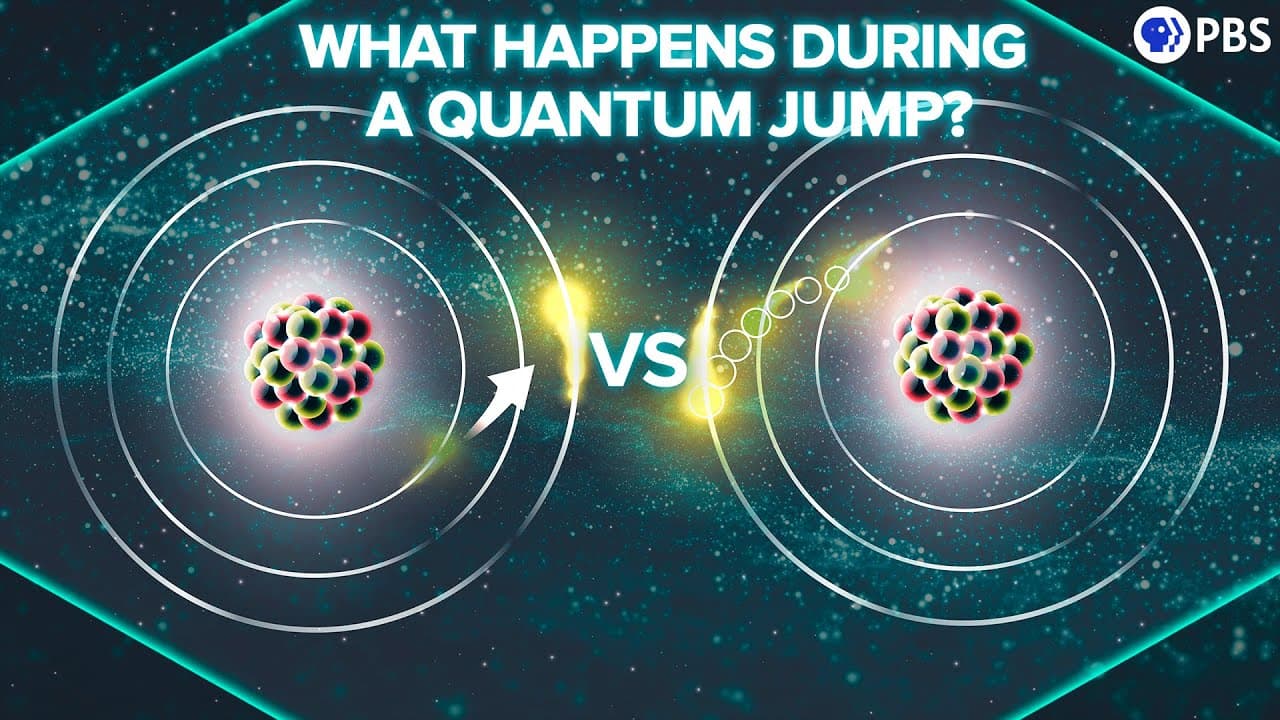
Since the very beginning of quantum mechanics, a debate has raged about how to interpret its bizarre predictions. And at the heart and origin of that debate is the quantum jump or quantum leap - the seemingly miraculous and instantaneous transitions of quantum systems that have always defied observation or prediction. At least, until now. The notio... Read More
Key Insights
- Quantum jumps, a core concept of quantum mechanics, involve electrons transitioning between energy levels without occupying intermediate space, challenging traditional observation methods.
- Erwin Schrödinger, a key figure in quantum mechanics, opposed the idea of quantum jumps, viewing them as unnatural and a cover-up for unexplained phenomena.
- Niels Bohr's model of the atom introduced quantized energy levels, explaining emission spectra but failing for complex elements, inspiring further quantum mechanics developments.
- The Copenhagen interpretation describes quantum state transitions as fundamentally random, with measurement collapsing the wavefunction and causing quantum jumps.
- Schrödinger believed quantum phenomena could be explained by classical resonance phenomena, rejecting the concept of photons and discrete energy level transitions.
- In the 1980s, experiments directly observed quantum jumps in single atoms, confirming some of Bohr's predictions about randomness and instantaneous transitions.
- Recent advancements allow monitoring and even interrupting quantum jumps mid-transition, revealing they are continuous and predictable rather than instantaneous.
- The Quantum Zeno Effect and measurement strength influence the predictability and nature of quantum jumps, suggesting a blend of deterministic and random processes.
Install to Summarize YouTube Videos and Get Transcripts
Explore YouTube Video Summarizer or Get YouTube Transcript Extractor
Questions & Answers
Q: What are quantum jumps?
Quantum jumps refer to the transitions of electrons between discrete energy levels within an atom without occupying the intermediate space. These transitions have historically been considered instantaneous and random, forming a core concept in quantum mechanics and sparking debates about their true nature and interpretation.
Q: Why did Schrödinger oppose quantum jumps?
Schrödinger opposed quantum jumps because he found them unnatural and unphysical, viewing them as a hack to cover up phenomena that quantum theory could not yet explain. He believed that quantum phenomena could be explained by classical resonance phenomena and that electrons transitioned smoothly through intermediate states rather than undergoing instantaneous jumps.
Q: How did Bohr's model explain emission spectra?
Bohr's model explained emission spectra by introducing the concept of quantized energy levels within atoms. Electrons could only occupy specific energy levels, and transitions between these levels involved the absorption or emission of photons corresponding to the energy difference. This model successfully explained hydrogen's emission spectra but struggled with more complex elements.
Q: What is the Copenhagen interpretation?
The Copenhagen interpretation, developed by Bohr and Heisenberg, describes quantum state transitions as fundamentally random, with measurement collapsing the wavefunction and causing quantum jumps. It posits that subatomic phenomena are probabilistic, and the electron transitions between energy levels instantaneously without occupying intermediate states.
Q: What were the findings of the 1980s quantum jump experiments?
The 1980s experiments observed quantum jumps in single atoms, confirming some of Bohr's predictions about randomness and instantaneous transitions. They used laser beams to monitor electron transitions between energy levels, providing evidence of quantum jumps and showing that these transitions occurred at random times, supporting the Copenhagen interpretation.
Q: How have recent experiments changed our understanding of quantum jumps?
Recent experiments using artificial atoms and superconducting circuits have revealed that quantum jumps are not instantaneous but continuous transitions through intermediate states. These experiments have shown that quantum jumps can be monitored and even interrupted mid-transition, suggesting they are predictable and challenging the idea of fundamental randomness in quantum mechanics.
Q: What role does the Quantum Zeno Effect play in quantum jumps?
The Quantum Zeno Effect influences quantum jumps by suggesting that the act of measuring a system can collapse the wavefunction, altering the system's behavior. This effect can trap the system in one state, affecting the predictability and nature of quantum jumps. The strength of the measurement determines the likelihood of true quantum jumps occurring.
Q: Are quantum jumps deterministic or random?
Quantum jumps appear to be a mix of deterministic and random processes. While the timing of jumps seems random, recent experiments have shown that the onset of jumps can be predicted, and their trajectory follows theoretical predictions. The nature of quantum jumps may depend on the strength of the system's coupling to the measurement apparatus, suggesting a blend of deterministic and random elements.
Summary & Key Takeaways
-
Quantum jumps have been a central debate in quantum mechanics, initially defying observation and prediction. Recent experiments have challenged the idea of instantaneous transitions, showing they are continuous and potentially predictable.
-
Niels Bohr's model introduced quantized energy levels, explaining hydrogen's emission spectra but failing for complex elements. This inspired further quantum mechanics developments by Schrödinger and Heisenberg, leading to the Copenhagen interpretation.
-
Recent experiments using artificial atoms and superconducting circuits have advanced our understanding of quantum jumps, revealing continuous transitions and suggesting a mix of deterministic and random processes guided by measurement strength.
Read in Other Languages (beta)
Share This Summary 📚
Summarize YouTube Videos and Get Video Transcripts with 1-Click
Try YouTube Summary with ChatGPT & Claude or YouTube Transcript Generator
Explore More Summaries from PBS Space Time 📚



Summarize YouTube Videos and Get Video Transcripts with 1-Click
Try YouTube Summary with ChatGPT & Claude or YouTube Transcript Generator