What Is Taylor-Couette Flow and How Does It Work?
TL;DR
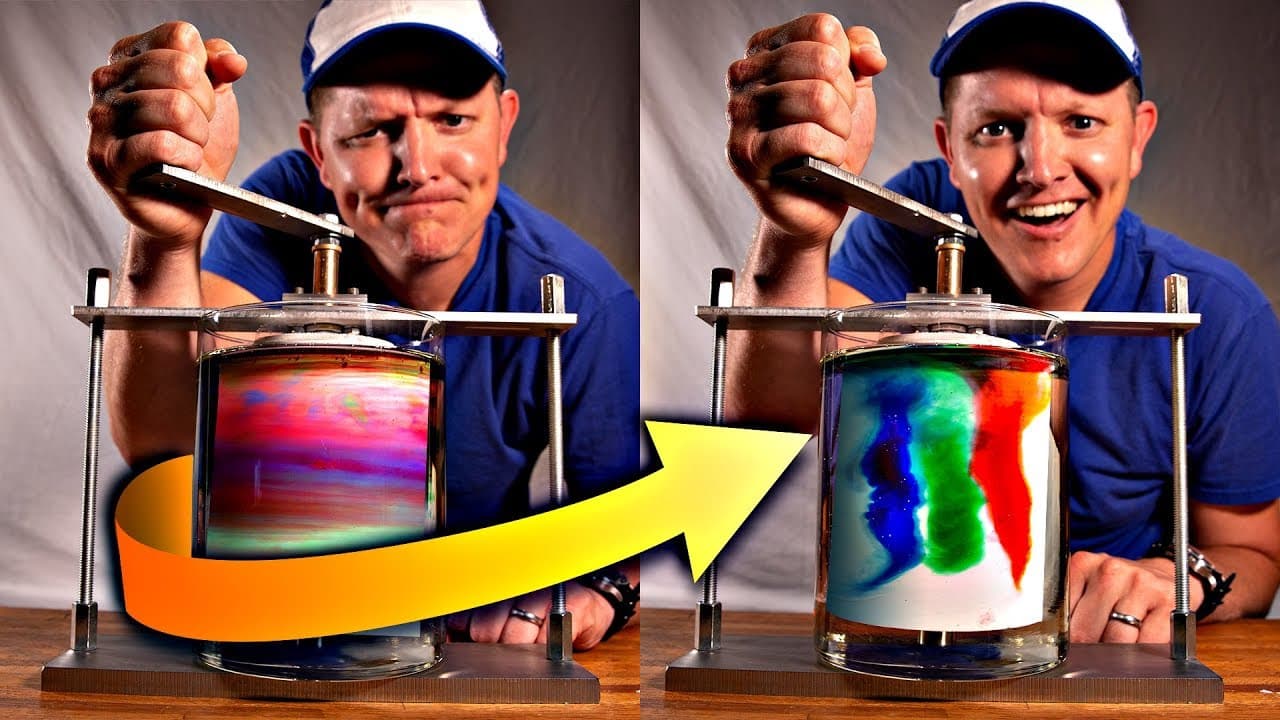
Taylor-Couette flow occurs between two concentric cylinders and is used to study the viscosity of fluids, like corn syrup, by rotating the inner cylinder. This creates spiral flow patterns that illustrate the principles of laminar flow, particularly at low Reynolds numbers. The experiment demonstrates that with careful manipulation, the flow can be made reversible.
Transcript
- It is Laminar Flow day and you know this about me, I love Laminar Flow. There's a cool video on Smarter Every Day that talks about how Laminar Flow works but we're doing what I call today, Ultra Laminar Flow! It's not really called that, I just made this sign to try to make it a thing. But, check this out! We're gonna look at something called Tay... Read More
Key Insights
- 🔨 Taylor-Couette Flow is a valuable tool for quantifying the viscosity of fluids.
- 👻 Ultralow Reynolds Number Flow allows for the study of Laminar Flow in controlled conditions.
- 🎴 The no-slip boundary condition plays a crucial role in creating laminar flow patterns.
- 💐 Observing the properties of fluids in a laminar flow can provide insights into fluid dynamics and behavior.
- 🤔 Patience and deliberate thinking are important in both experimental science and navigating through life's challenges.
- 👂 Audible is a useful platform for listening to audiobooks and making the most of travel time.
- 👨⚖️ The book "The Sun Does Shine" by Anthony Ray Hinton offers a perspective on life and justice.
Install to Summarize YouTube Videos and Get Transcripts
Explore YouTube Video Summarizer or Get YouTube Transcript Extractor
Questions & Answers
Q: What is Taylor-Couette Flow and how does it work?
Taylor-Couette Flow is a fluid flow phenomenon where a cylinder rotates inside another cylinder, creating spiral patterns due to the no-slip boundary condition. The inner cylinder pulls the fluid along with it, resulting in the formation of spirals.
Q: What is the purpose of using corn syrup in the experiment?
Corn syrup is used because it is a highly viscous fluid, allowing for the observation of Laminar Flow patterns. The viscosity of the fluid affects how it moves in response to the rotation of the cylinders.
Q: What is the significance of achieving ultra low Reynolds Number Flow?
Ultra low Reynolds Number Flow signifies a highly viscous flow with minimal turbulence. By achieving this state, the video aims to showcase the properties of Laminar Flow in a controlled and reversible manner.
Q: What can be observed in the colored corn syrup during the experiment?
The colored corn syrup in the tank forms spiral patterns as a result of Taylor-Couette Flow. By observing the fluid carefully, different layers with varying viscosities can be seen due to shear thinning.
Summary & Key Takeaways
-
The video introduces the concept of Taylor-Couette Flow, which involves the rotation of a cylinder inside another cylinder to quantify the viscosity of a fluid.
-
The demonstration in the video involves filling a tank with corn syrup, which is a highly viscous fluid, and observing the formation of spiral patterns due to the no-slip boundary condition.
-
The video aims to achieve ultra low Reynolds Number Flow and reversible flow in order to showcase the properties of Laminar Flow.
Read in Other Languages (beta)
Share This Summary 📚
Summarize YouTube Videos and Get Video Transcripts with 1-Click
Try YouTube Summary with ChatGPT & Claude or YouTube Transcript Generator
Explore More Summaries from SmarterEveryDay 📚



Summarize YouTube Videos and Get Video Transcripts with 1-Click
Try YouTube Summary with ChatGPT & Claude or YouTube Transcript Generator