How Do Microprojects Help You Do Big Things?
TL;DR
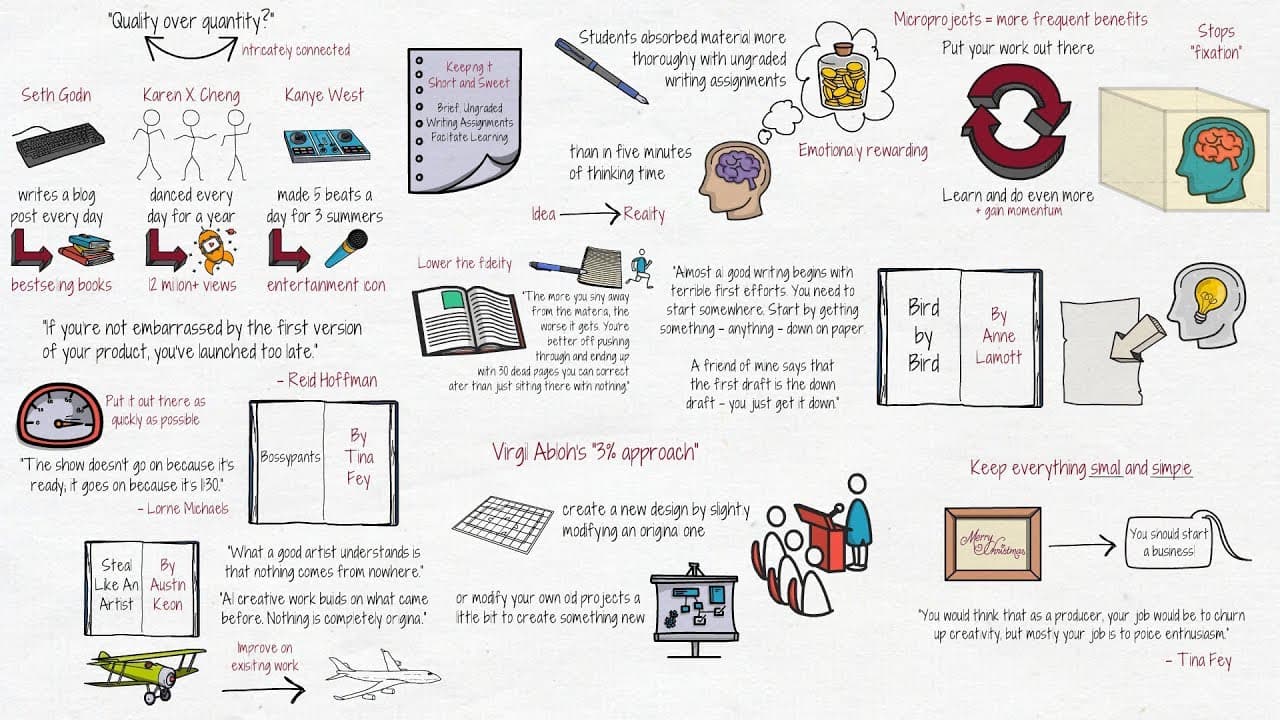
Microprojects help you do big things by turning small, consistent acts of creation into better work, active learning, feedback, and momentum. Karen X. Cheng danced every day for a year, then her timelapse video received 12 million views. Starting with imperfect drafts, lowering fidelity, shipping quickly, and keeping ideas simple make creative progress easier, so read on for practical ways to begin.
Transcript
Author Seth Godin writes a blog post every day. Karen X. Cheng, the founder of the creative agency Waffle, danced every day for a year — at work, at bus stops, in line at the grocery store. Kanye West, before he won dozens of Grammys, made five beats a day for three summers. People like to tout “quality over quantity,” a phrase that sets up quantit... Read More
Key Insights
- 🥺 Regular, small projects lead to quality work over time.
- ☢️ Active learning through creation enhances understanding and emotional rewards.
- 💦 Sharing work consistently prevents fixation and promotes growth.
- 💐 Lowering fidelity and embracing imperfection kickstart creativity.
- 🛩️ Starting small and constantly releasing projects enables continuous learning and improvement.
- 💦 Copying and modifying existing work is a valid method of learning and creating something new.
- ⛽ Tight deadlines and simplicity fuel creativity and prevent distractions.
Install to Summarize YouTube Videos and Get Transcripts
Explore YouTube Video Summarizer or Get YouTube Transcript Extractor
Questions & Answers
Q: What are microprojects?
Microprojects are small, focused pieces of work that contribute to a larger body of work. Creating and releasing them consistently can build momentum and improve quality over time.
Q: How are quantity and quality connected in creative work?
Making and releasing a high quantity of work is presented as a reliable path to improving its quality. Seth Godin wrote daily blog posts and turned his best posts into bestselling books, while Karen X. Cheng turned daily dance sessions into a timelapse video that received 12 million views.
Q: Why is active learning useful for creative projects?
Active learning involves interacting, participating, or doing, and the cited research found it more effective than passive learning. Students absorbed material more thoroughly through ungraded five-minute writing assignments than through five minutes of thinking time.
Q: Why should creators continually ship their work?
Declaring work finished and moving to the next project can prevent fixation, the mental block that obstructs valuable insights. Releasing work also lets other people respond, helping creators escape their own limited perspective and learn how to improve.
Q: How can someone start a microproject?
Begin with a simple, focused idea and put something imperfect into the world. Lowering the work's quality or level of detail, such as sketching in a notebook or making a paper prototype, can produce faster feedback.
Q: Why can tight deadlines help creativity?
Tight deadlines force creators to finish and release work instead of waiting until it feels perfect. Tina Fey described the Saturday Night Live principle that the show goes on because it is 11:30, not because it is ready.
Q: Can copying existing work be a valid microproject?
Yes, copying and modifying existing work is presented as a way to learn and create. Virgil Abloh's 3% approach makes a new design by slightly modifying an original, and creators can similarly revise their own drawings, essays, or code.
Q: Why should a microproject remain small and simple?
Creative ideas often expand once work begins, and that enthusiasm can distract from the immediate task. Keeping the scope small and then making it even smaller helps creators execute continuously and is described as the fastest way to create something big.
Summary & Key Takeaways
-
Definition: Microprojects are small, consistent creative practices that become part of a larger body of work.
-
Number: Karen X. Cheng danced every day for a year, and her resulting timelapse video received 12 million views.
-
Number: Kanye West made five beats a day for three summers before winning dozens of Grammys.
-
Number: Danielle Steel, who has written over 179 books, recommended pushing through even if the result is 30 dead pages to correct later.
-
Step 1: Choose a simple, focused idea and get an imperfect first effort out of your head and into the world.
-
Step 2: Lower the fidelity by using a notebook or paper prototype to express the vision faster and collect feedback sooner.
-
Step 3: Release the work quickly, learn from people's responses, and move on to the next small project.
-
Compare: Students absorbed material more thoroughly with ungraded five-minute writing assignments than with five minutes of thinking time.
-
Tool: Virgil Abloh's 3% approach creates a new design by slightly modifying an original one.
-
When: Saturday Night Live goes on because it is 11:30, illustrating how a firm deadline can force completion.
Read in Other Languages (beta)
Share This Summary 📚
Summarize YouTube Videos and Get Video Transcripts with 1-Click
Try YouTube Summary with ChatGPT & Claude or YouTube Transcript Generator
Explore More Summaries from The Art of Improvement 📚

Summarize YouTube Videos and Get Video Transcripts with 1-Click
Try YouTube Summary with ChatGPT & Claude or YouTube Transcript Generator