Let's make a movie recommendation system: Crash Course AI #16
TL;DR
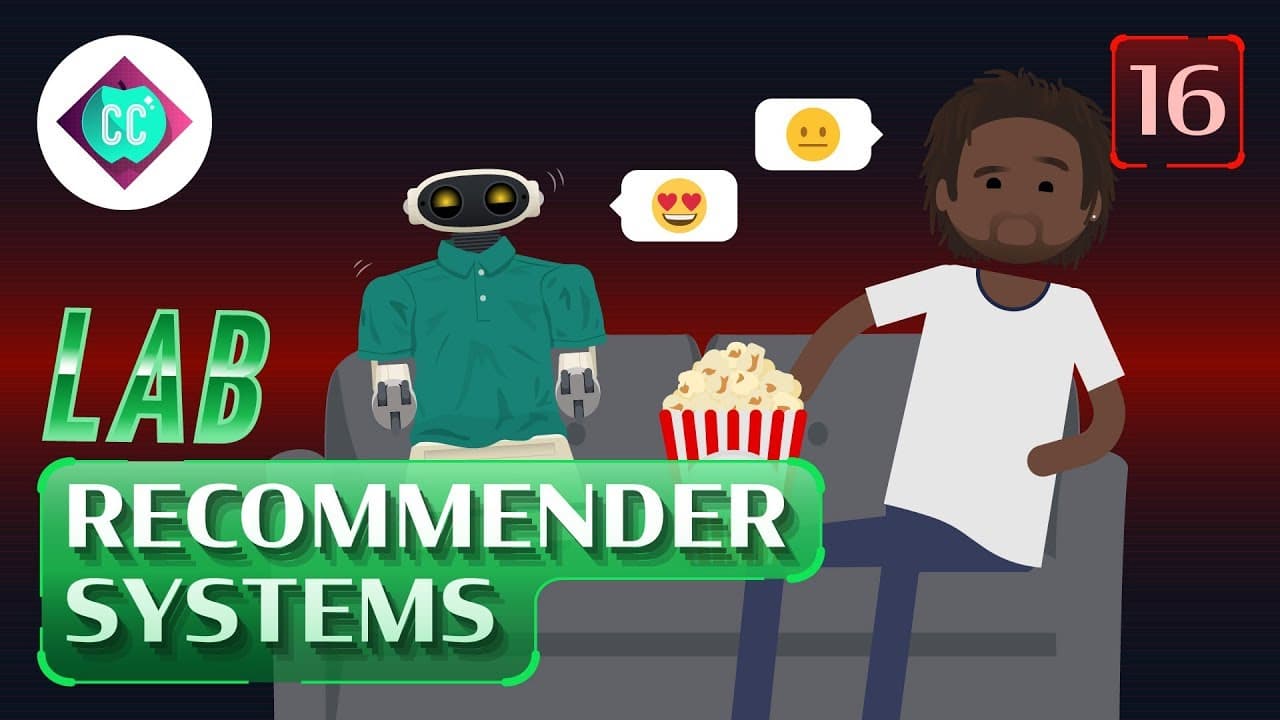
In this video, Jabril works on creating a movie recommender system AI to find a movie to watch with John-Green-bot for their next movie night.
Transcript
Jabril: Yeah, that was... John Green Bot: … the BEST movie ever! Jabril: That’s not what I was gonna say. How about for the next movie night we pick a new movie that we’ll both probably like? John-Green-Bot: Maybe something romantic? How about Pride & Prejudice? Jabril: Oh John Green Bot... I'm going to need this. Okay, I think it’s time to make a ... Read More
Key Insights
- 😒 Recommender systems use data and social ratings to suggest new things to people.
- 👤 User-user collaborative filtering is a common approach in building recommender systems.
- 👾 Ratings datasets often handle missing data by not storing unranked items, which saves space.
- 👤 Personalizing the dataset by adding user ratings improves the accuracy of recommendations.
- ❓ The size of the neighborhood in collaborative filtering affects the specificity and popularity of recommendations.
- 👂 Combining multiple users' ratings can result in a more diverse and inclusive recommendation list.
- 🎥 Building a movie recommender system AI can be based on smaller datasets, but larger datasets offer more movie options.
Install to Summarize YouTube Videos and Get Transcripts
Explore YouTube Video Summarizer or Get YouTube Transcript Extractor
Questions & Answers
Q: What is the goal of building a movie recommender system AI?
The goal is to find a movie that both Jabril and John-Green-bot will enjoy for their movie night, using their own ratings and the ratings of other users.
Q: How does the user-user collaborative filtering algorithm work?
The algorithm clusters users based on their movie ratings and finds similar users to generate recommendations. It predicts how a user might rate a movie based on the ratings of similar users and suggests movies that haven't been seen yet.
Q: What is the cold-start problem in recommender systems?
The cold-start problem refers to the challenge of making personalized recommendations when there is limited or no data available for a user. In this case, the AI system doesn't know much about Jabril and John-Green-bot's movie preferences initially.
Q: What is the benefit of combining Jabril and John-Green-bot's ratings in the hybrid dataset?
Combining their ratings allows for a more comprehensive and tailored recommendation list that takes into account both of their preferences. It provides a reasonable estimate across both of their ratings.
Summary & Key Takeaways
-
Jabril aims to build a recommender system for movies to find a new movie that both he and John-Green-bot will enjoy for their movie night.
-
He starts by importing a dataset of movies and their ratings from MovieLens, which has about 100,000 user ratings for 10,000 movies.
-
Jabril explores the dataset, performs basic analysis, and combines it with his and John-Green-bot's own movie ratings to generate personalized recommendations using user-user collaborative filtering.
Read in Other Languages (beta)
Share This Summary 📚
Summarize YouTube Videos and Get Video Transcripts with 1-Click
Try YouTube Summary with ChatGPT & Claude or YouTube Transcript Generator
Explore More Summaries from CrashCourse 📚




Summarize YouTube Videos and Get Video Transcripts with 1-Click
Try YouTube Summary with ChatGPT & Claude or YouTube Transcript Generator